
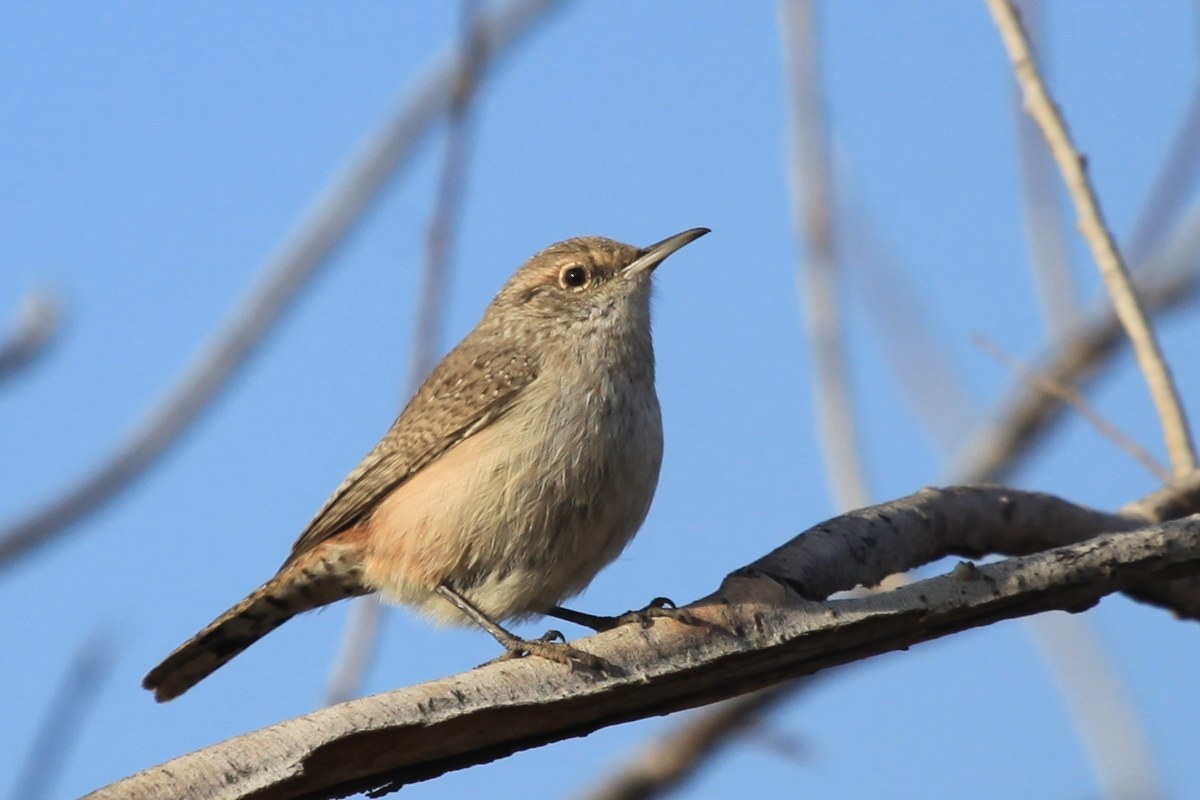
Rock Wren
Salpinctes obsoletus
A pale, finely speckled wren of arid rocky terrain, identified by its habit of bobbing on boulders and its buffy-tipped tail corners flashed in flight.
- Feather type
- Finely patterned body feathers with buffy tail corners
- Colours
- Grayish-brown finely speckled upperparts, pale buffy underparts, buffy tail tips
- Bird size
- Small, ~13-15 cm
Found a feather like this?
Identify any feather from a photo, free.
Overview
The Rock Wren is a specialist of arid, rocky habitats across western North America, from canyon walls and talus slopes to rocky outcrops in desert and mountain terrain. Its subtly patterned, pale grayish plumage blends well with its rocky surroundings, and it is often first noticed by its habit of bobbing while perched on stones or by its loud, varied song echoing off canyon walls.
Identifying the Feather
- Body feathers: Grayish-brown upperparts finely speckled with pale spots, giving a subtly mottled texture that matches rocky substrates.
- Underpart feathers: Pale buffy to whitish, with light streaking on the breast in some individuals.
- Tail feathers: Show buffy-orange corners or tips, visible as flashes when the tail is spread or in flight.
- Compared to similar species: The finely speckled upperparts and buffy tail corners distinguish it from Canyon Wren, which is notably darker rufous below with a bright white throat and lacks the speckled back pattern.
Plumage & Molt
Sexes look alike, both showing grayish-brown, finely speckled upperparts, pale buffy underparts, and buffy tail corners. Juveniles are similar but slightly less crisply patterned until their first molt. A single complete molt after breeding renews the plumage annually, and there is little seasonal variation in overall appearance.
Habitat & Range
Rock Wrens inhabit arid and semi-arid rocky terrain, including canyon walls, talus slopes, rock outcrops, and boulder fields, across much of the western United States, Mexico, and southwestern Canada. Most populations are resident, though birds at higher elevations or in the northern part of the range may move to lower, milder terrain during winter.
Behavior & Field Notes
This wren forages among rocks and crevices for invertebrates, often bobbing its body up and down while perched on a boulder, a characteristic behavior useful for identification. Its song is a long, varied series of loud, ringing phrases, often repeated and echoing distinctively off canyon walls and rock faces. Nests are placed in rock crevices or cavities, frequently with a distinctive paved entrance of small flat stones leading to the nest chamber. Its close association with bare rock and talus makes habitat a strong clue to its identity.
Frequently asked questions
How can you identify a Rock Wren by its feathers?
Look for finely speckled grayish-brown upperparts, pale buffy underparts, and buffy-orange corners on the tail.
How does it differ from the Canyon Wren?
The Rock Wren has speckled, grayish upperparts and buffy underparts, while the Canyon Wren shows a bright white throat and notably darker rufous body and lacks the speckled back.
What behavior helps identify a Rock Wren?
It frequently bobs its body while perched on rocks, a habit that helps distinguish it from other small songbirds in rocky habitat.
What habitat does this species require?
It is closely tied to arid rocky terrain such as canyon walls, talus slopes, and boulder fields across the western United States and Mexico.
Rock Wren guides
In-depth guides for identifying and understanding Rock Wren.
Other feathers you may enjoy

Yellow-breasted Bunting
Contour and flight feathers, chestnut-and-yellow breeding pattern

Sedge Wren
Tiny streaked crown and back feathers

Yellow-winged Cacique
Glossy black body feathers, yellow wing patch, shaggy crest

Yellow Warbler
Small contour and flight feathers

Yellow-throated Warbler
Small contour and flight feathers

Yellow-throated Vireo
Bright yellow throat and spectacle feathers; olive-green back feathers; two white wing-bar feathers

Yellow-rumped Warbler
Small contour and flight feathers

Yellow-hooded Blackbird
Contrasting hood and body feathers

Yellow-headed Blackbird
Glossy black body plumage with a bright yellow head and breast

Yellow-eyed Junco
Contour and flight feathers

Yellow-fronted Canary
Small, smooth body plumage

Yellow-breasted Greenfinch
Compact, smooth body plumage