
How to Identify Rook Feathers
How to identify the glossy black feathers and distinguishing bare face patch of the Rook, a highly social corvid of European farmland.
Read the full Rook encyclopedia entry →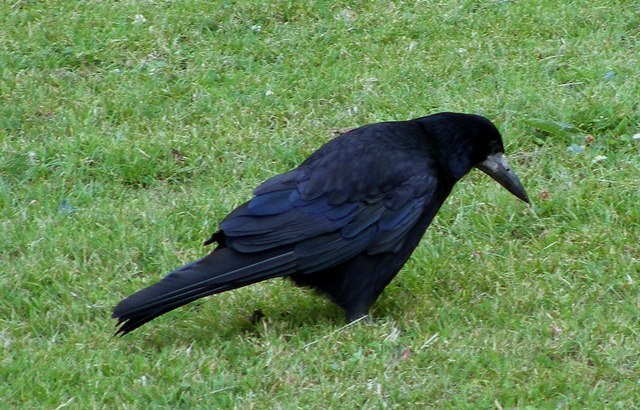
What Rook Feathers Look Like
The Rook (Corvus frugilegus) is a highly social corvid of European and western Asian farmland, and while its feathers are essentially all black like many crow relatives, several specific details help confirm this species over similar-looking corvids.
- Body feathers: glossy black overall with a distinct purple-blue iridescent sheen in good light, similar in richness to a Carrion Crow but often described as having a slightly more purplish, less greenish cast.
- Thigh feathers: notably loose, shaggy, "baggy trousers"-like feathering around the upper legs — this looser, almost ragged thigh feathering is a genuinely useful and distinctive trait among black corvids, giving the live bird its characteristic silhouette.
- Head feathers: sleek and black, but adult Rooks have a bare, greyish-white patch of skin at the base of the bill (not feathers) — while this isn't a feather itself, its presence (or the surrounding feather line where it meets bare skin) is a key identifying context if facial skin is found alongside feathers.
- Wing feathers: black with strong iridescent sheen, moderately long and pointed, supporting fairly efficient, direct flight typical of corvids that commute long distances between roosts and feeding fields.
- Tail feathers: black, rounded at the tip rather than wedge-shaped (a useful shape distinction from the more wedge-tailed Common Raven).
- Texture: dense and moderately stiff, typical of corvid feathers generally, built for a robust, adaptable bird.
Step-by-Step: Is This Feather From a Rook?
- Check the iridescent sheen. Glossy black with a purple-blue cast in good light fits Rook, though this alone won't separate it from Carrion Crow — combine with other clues below.
- Look for shaggy thigh feathers. Loose, almost baggy-looking feathers from the upper leg/thigh area, if identifiable, are a distinctive Rook trait not shared by most other black corvids.
- Assess tail feather shape. A rounded tip rather than a wedge shape rules out Common Raven in favor of a crow-sized corvid like Rook or Carrion Crow.
- Consider size. Rook feathers are similar in size to Carrion Crow — noticeably smaller than raven feathers — so size alone won't separate Rook from crow.
- Factor in social context and habitat. Found near a large, noisy colonial rookery in farmland trees (Rooks nest in dense colonies, unlike the mostly solitary-nesting Carrion Crow), a glossy black corvid feather strongly favors Rook.
Similar Species & How to Tell Them Apart
- Carrion Crow: nearly identical feather color and size — the most reliable non-feather clue is the bare greyish face patch adults show at the bill base (absent in Crow, which has fully feathered faces), plus Rook's colonial nesting habits versus the Crow's solitary pairs.
- Common Raven: notably larger overall with a wedge-shaped tail (versus Rook's rounded tail) and shaggier throat "hackle" feathers, providing a size and shape distinction.
- Jackdaw: smaller, with a distinctive pale grey nape/neck patch contrasting against an otherwise black body, an easy color-pattern distinction from the uniformly black Rook.
- Western Jackdaw's larger relatives or hybrids: rare and generally distinguishable by the same grey-nape rule, so a solidly all-black feather without any grey rules these out.
Where & When You'll Find Them
Rooks are widespread across farmland, pasture, and open country in Europe and western Asia, nesting in large, dense colonies ("rookeries") typically in tall trees near agricultural fields, where they feed heavily on soil invertebrates and grain. Feathers are most abundant beneath and around these communal rookeries, especially during the breeding season in spring, and again during the late-summer post-breeding molt when adults replace worn flight feathers before the demands of winter foraging in large flocks.
Frequently asked questions
How do I tell a Rook feather from a Carrion Crow feather?
The feathers themselves are very hard to distinguish reliably, so context matters most — Rooks nest in large noisy colonies while Carrion Crows nest as solitary pairs, and if any facial skin is attached, Rook's bare greyish patch at the bill base is diagnostic where Crow has a fully feathered face.
What are the 'baggy trousers' people mention with Rooks?
That refers to the loose, shaggy feathering around the thighs that gives the live bird a distinctive silhouette, and it's a genuinely useful trait to look for if leg-area feathers are identifiable.
How can I rule out Common Raven?
Check tail feather shape — Raven tail feathers form a wedge shape when fanned, while Rook (and Crow) tail feathers are more evenly rounded at the tip, and Raven feathers run noticeably larger overall.
Why would I find so many feathers in one spot?
Rooks are highly colonial nesters, so a productive rookery can shed large numbers of feathers in a concentrated area, especially during the breeding season and the late-summer molt.
Rook identified by the community
Recent Rook feathers identified with Feather Identifier.

