
How to Identify Senegal Parrot Feathers
How to identify the gray-headed, green-backed, orange-bellied feathers of the Senegal Parrot and its distinctive short, blunt tail.
Read the full Senegal Parrot encyclopedia entry →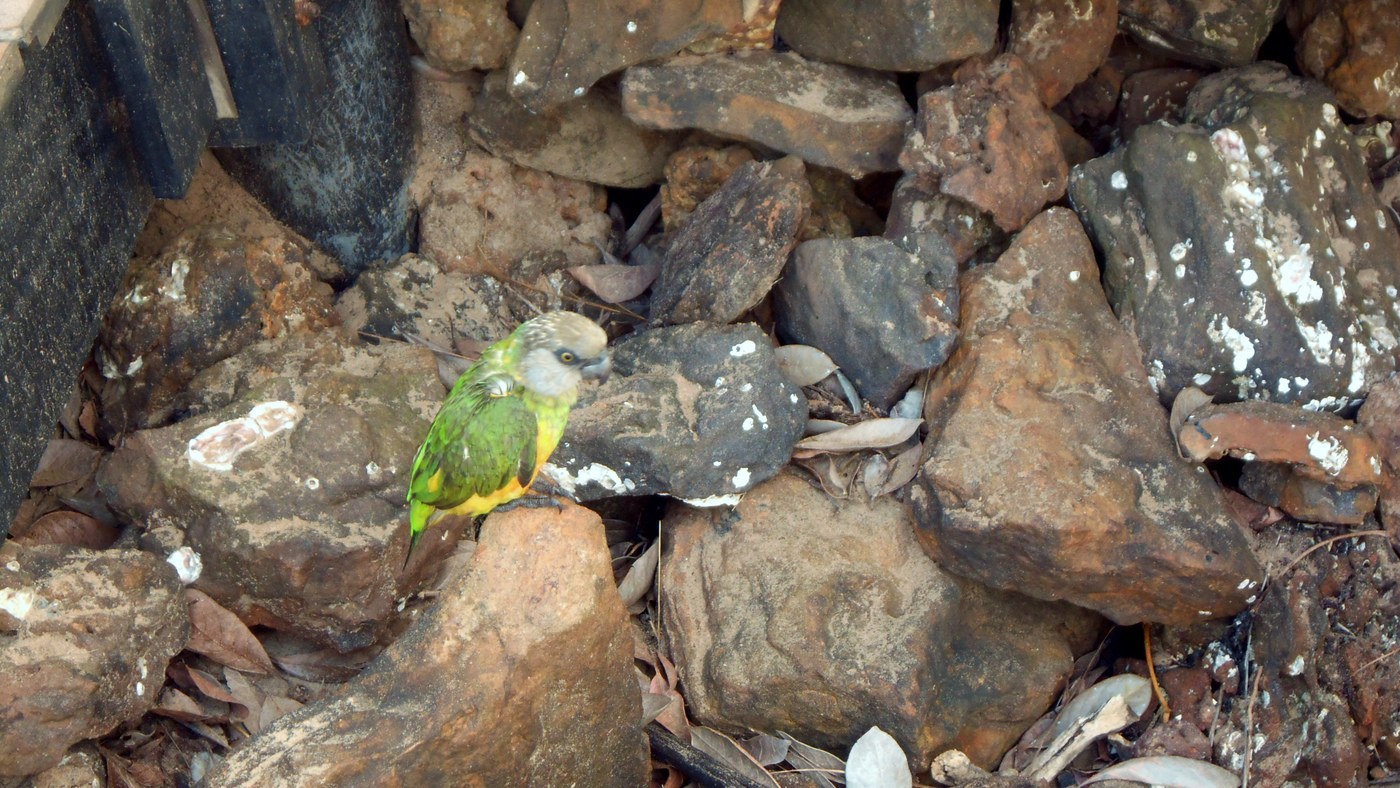
What Senegal Parrot Feathers Look Like
Senegal Parrot feathers show the crisp, blocky color zones typical of Poicephalus parrots. Head feathers are a solid dark gray, cleanly demarcated from the rest of the body with no streaking or mottling. Back, wing, and mantle feathers are bright grass-green, uniform and glossy rather than patterned. The chest and belly feathers are the most eye-catching: a yellow-to-orange color (often deepening to orange on the lower belly) forms a distinctive V-shaped patch when seen on the bird, and individual feathers from this region show a clean yellow-orange color with no barring. Tail feathers are notably short, broad, and blunt-tipped rather than long and pointed — a hallmark of the genus that immediately separates them from long-tailed parakeets. Flight feathers are dark green to blackish-green, sturdy and somewhat stiff compared to softer body contour feathers.
Step-by-Step: Is This Feather From a Senegal Parrot?
- Sort by body region first. Gray-headed, green-backed, and yellow-orange-bellied feathers found together (or matching this palette individually) strongly suggest this species.
- Check tail feather shape. Short, blunt, and rounded rather than long and tapering — very different from typical parakeet tail feathers.
- Confirm clean, unpatterned color blocks. No streaking, barring, or spotting on any feather type — colors should be solid and crisp.
- Assess brightness of belly feathers. True yellow shading to orange, not a duller olive-yellow, is expected.
- Consider feather stiffness. Flight feathers should feel relatively stiff and somewhat glossy dark green, typical of parrot flight feathers generally.
- Factor in context. As a popular pet species as well as a wild African bird, feathers may be found in either a captive/domestic setting or wild West African habitat.
Similar Species & How to Tell Them Apart
Other Poicephalus species like Meyer's Parrot or Red-bellied Parrot share the gray head and green body plan but differ in belly color and pattern — Meyer's Parrot shows more blue-green tinges and yellow shoulder patches rather than a clean orange belly V, while Red-bellied Parrot males show a distinctly orange-rufous chest that extends higher up rather than being confined to the lower belly. Budgerigars and other small parakeets, sometimes confused due to captive contexts, have much longer, pointed tail feathers and often show fine barring on the head/back in wild-type coloring, both of which Senegal Parrot lacks entirely.
Where & When You'll Find Them
In the wild, Senegal Parrots inhabit savanna woodlands, forest edges, and cultivated areas across West Africa, from Senegal to Chad, where they're non-migratory residents feeding on seeds, fruit, and blossoms in a fairly fixed home range. Because of their popularity as pets, feathers of this species are just as commonly found indoors or around aviaries as in wild African habitat, and captive birds may molt somewhat less predictably than wild ones due to controlled indoor conditions. Wild birds molt gradually and continuously being tropical residents, though feather turnover often increases somewhat after the breeding season; captive individuals typically show a noticeable molt once or twice a year depending on light-cycle and environmental factors.
Frequently asked questions
What color pattern makes a Senegal Parrot feather distinctive?
A gray head, green back and wings, and a yellow-to-orange belly forming a V-shaped patch together are very distinctive for this species.
Why is tail feather shape a good clue?
Senegal Parrot tail feathers are short, broad, and blunt-tipped, unlike the long, pointed tail feathers of many parakeets, making shape alone a useful separator.
How do I tell a Senegal Parrot feather from a Meyer's Parrot feather?
Meyer's Parrot typically shows more blue-green tinges and yellow shoulder patches rather than the clean orange belly V seen in Senegal Parrot.
Are Senegal Parrot feathers only found in the wild?
No, because they're a popular pet species, feathers are commonly found around homes and aviaries as well as in West African savanna habitat.
Is there a strong seasonal molt pattern to expect?
Wild birds molt fairly continuously as tropical residents, while captive birds often show a more distinct molt once or twice yearly tied to environmental cycles.