
How to Identify Spectacled Owl Feathers
How to recognize a Spectacled Owl's dark brown facial feathers with bold white eyebrow-and-throat 'spectacles', and separate them from Crested Owl and Band-bellied Owl.
Read the full Spectacled Owl encyclopedia entry →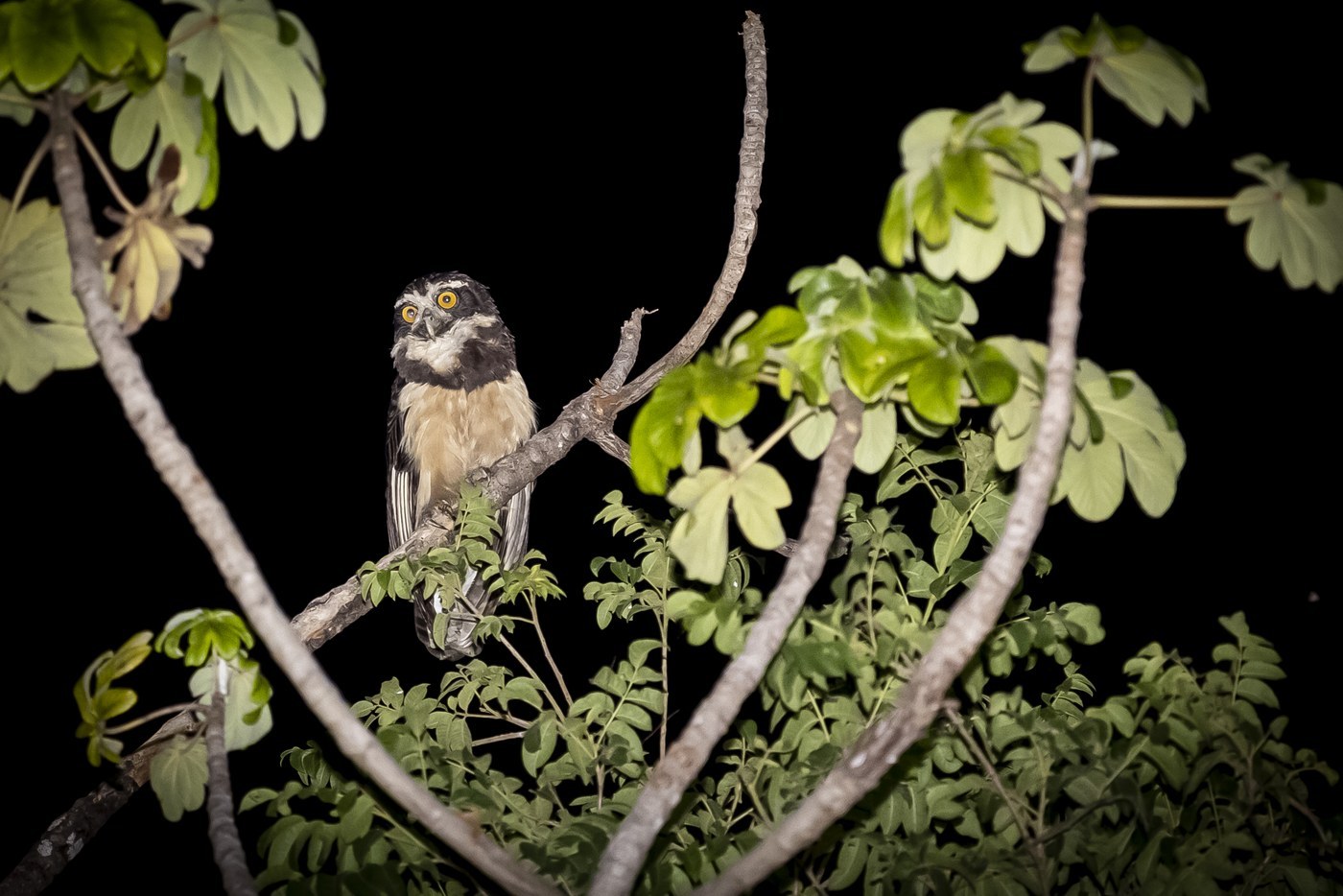
What Spectacled Owl Feathers Look Like
The Spectacled Owl is a large Neotropical owl named for its bold facial markings, and its feathers show a striking combination of a dark hood-like face with pale accents, plus dramatically different juvenile plumage.
- Facial feathers: Overall dark chocolate-brown, but with a bold white band running from above each eye down the sides of the face to the throat, forming the "spectacles" that give the species its name — small, fine-barbed white facial feathers found alongside dark brown ones are a strong clue.
- Crown and back feathers: Deep dark brown, dense and soft as in most owls.
- Underpart feathers: Warm buffy to tawny-ochre, plain and unbarred, a notable contrast to the dark hood-like head/back.
- Flight feathers: Dark brown with faint pale barring, and like all owls, a soft comb-like fringe along the leading edge of the outer primary for silent flight.
- Juvenile feathers: Radically different — young birds are almost entirely white with a dark brown-black facial mask, essentially an inverse of the adult pattern; a mostly white downy feather with a dark mask remnant could indicate a juvenile of this species.
Step-by-Step: Is This Feather From a Spectacled Owl?
- Check for the silent-flight fringe. A soft, comb-toothed leading edge on a flight feather confirms owl before anything else.
- Look for the white spectacle band. Small white facial feathers running eyebrow-to-throat around an otherwise dark brown face is the species' clearest diagnostic mark in adults.
- Assess underparts. Warm buffy-tawny, unbarred body feathers contrasting with a dark brown hood support this identification.
- Consider juvenile plumage separately. A mostly white feather with a dark mask fragment may indicate a young Spectacled Owl rather than an adult.
- Weigh the location. Found in Neotropical lowland or foothill forest from Mexico to South America, the dark-hood-with-white-spectacle pattern strongly supports this species.
Similar Species & How to Tell Them Apart
- Band-bellied Owl: A close relative in the same genus, but shows a distinct dark barred band across the upper breast, which Spectacled Owl lacks — Spectacled Owl's underparts are plain buffy-tawny throughout.
- Crested Owl: Has long, elongated white eyebrow tufts that extend well past the face as plume-like projections, quite different from the Spectacled Owl's band-like (not tufted) white facial markings.
- Black-and-white Owl: Shows fine black-and-white barring across the entire underside, a very different pattern from the Spectacled Owl's plain tawny belly.
- Mottled Owl: Smaller, with an overall mottled brown pattern throughout and no bold white spectacle band, appearing much plainer and more camouflaged.
Where & When You'll Find Them
Spectacled Owls inhabit lowland and foothill tropical forest from southern Mexico through Central America and into much of South America, roosting by day in dense canopy vegetation and hunting a wide range of prey by night. Because juveniles take an unusually long time (up to four years) to molt fully into adult plumage, feathers found near a single territory may show quite different patterns depending on the age of the individual; feathers are most often found near regularly used daytime roost sites and nest trees, with somewhat increased feather loss during the breeding season when adults are most active around the nest.
Frequently asked questions
What is the clearest way to identify a Spectacled Owl feather?
Look for small white facial feathers forming a band from above the eye down to the throat, framing an otherwise dark chocolate-brown face — the species' namesake 'spectacle' pattern.
Why might I find an almost entirely white feather from this species?
Juvenile Spectacled Owls are nearly all white with a dark facial mask, essentially the reverse of the adult pattern, and take several years to molt into full adult plumage.
How do I tell Spectacled Owl apart from Band-bellied Owl?
Band-bellied Owl shows a distinct dark barred band across the upper breast, while Spectacled Owl's underparts are plain, unbarred buffy-tawny throughout.
What separates this species from Crested Owl?
Crested Owl has long, elongated white eyebrow tufts projecting outward like plumes, while Spectacled Owl's white facial markings form a flatter band rather than tufted plumes.