
How to Identify Striated Heron Feathers
How to identify the scaly grey-green back feathers and dark cap of the Striated Heron, and separate it from night-herons and its close relative the Green Heron.
Read the full Striated Heron encyclopedia entry →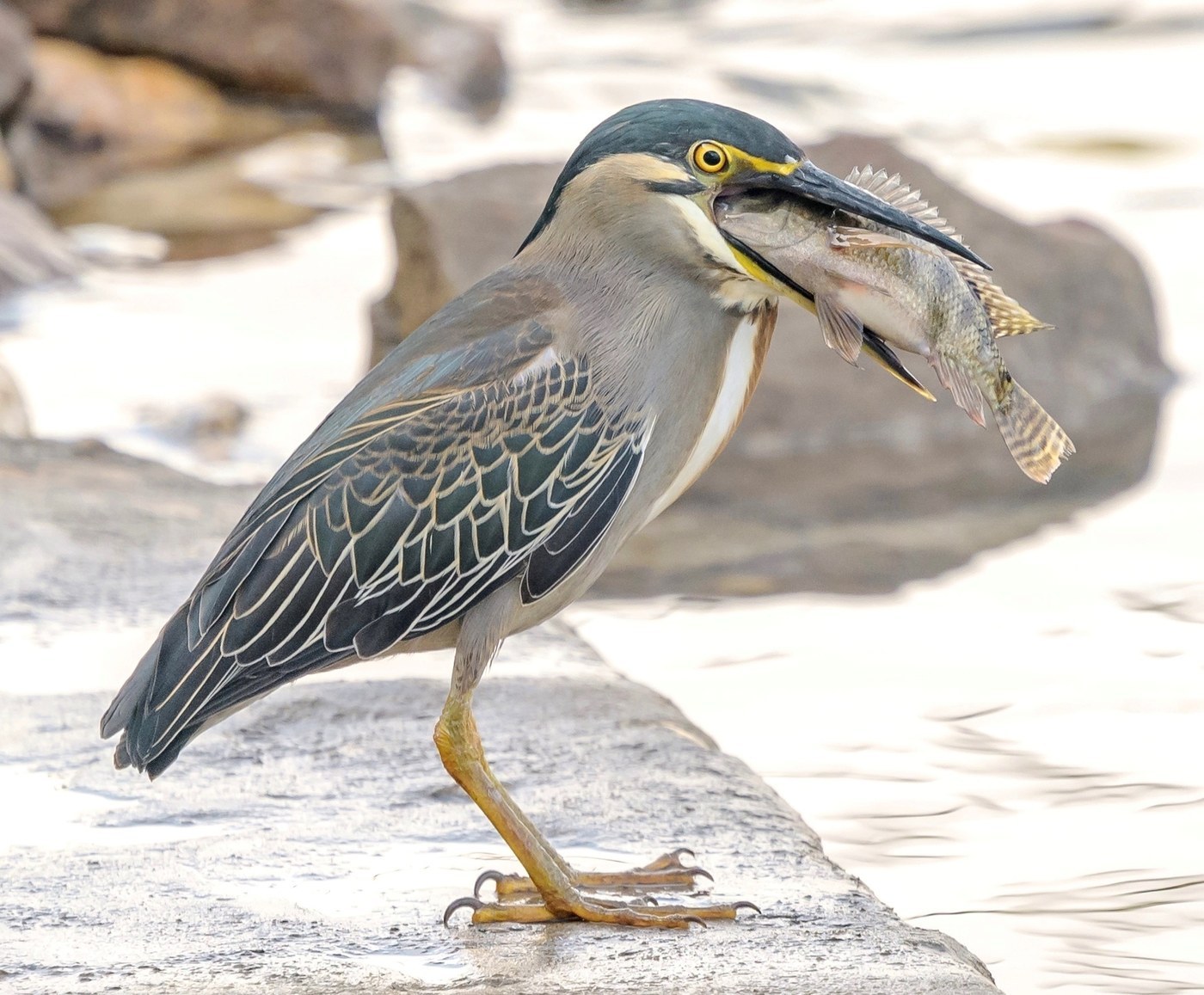
What Striated Heron Feathers Look Like
The Striated Heron is a small, stocky heron found across tropical and subtropical wetlands worldwide, and its feathers show a distinctive muted, cryptic pattern suited to still-hunting at the water's edge.
- Back and wing covert feathers: grey-green to olive-grey, each often edged with a narrow pale fringe, creating a subtle scaled or scalloped look, especially pronounced on immature birds.
- Crown feathers: glossy blackish-green, forming a short cap that can be raised into a slight crest.
- Neck feathers: grey with variable chestnut or buff tones on the sides.
- Underparts feathers: pale grey, and in juveniles, finely streaked with brown and buff (hence the name).
- Flight feathers: dark grey-green, relatively broad and rounded compared to smaller songbirds.
Step-by-Step: Is This Feather From a Striated Heron?
- Check for a scalloped pattern. Grey-green feathers with narrow pale edges creating a scaled look on the back/wing coverts is a strong lead, especially from an immature bird.
- Look at the crown. A glossy blackish-green feather with a slightly elongated, crest-like shape suggests the cap area.
- Examine underparts for fine streaking. Pale grey feathers with thin brown streaks point to a juvenile's underside.
- Compare size and structure. Feathers should be moderate in size and somewhat stiff/broad, consistent with a small, stocky heron rather than a large wading bird or small songbird.
- Consider habitat. Look for confirmation near mangroves, quiet riverbanks, ponds, or coastal mudflats — this heron's typical still-hunting terrain.
Similar Species & How to Tell Them Apart
- Green Heron (often considered a separate but closely related species in the Americas): very similar overall, with a more pronounced chestnut neck, but feather-level differences are subtle and range is the best separator — Striated Heron occurs across Africa, Asia, and Australasia, while Green Heron occurs in the Americas.
- Black-crowned Night-Heron: considerably larger, with clean white underparts and a solid black back/crown lacking the scalloped pattern.
- Bitterns: show bold buff-and-brown streaking over the entire body rather than the more uniform grey-green scalloped back of the Striated Heron.
Where & When You'll Find Them
Striated Herons occupy mangroves, mudflats, rivers, and ponds across much of the tropical and subtropical Old World, from Africa through Asia to Australia. They are largely non-migratory in most of their range, molting on a schedule tied to local breeding rather than a single fixed season — feathers are typically found near quiet, vegetated shorelines and mangrove roosts year-round, with a higher chance shortly after the local breeding season ends.
Frequently asked questions
What's the best clue for identifying this heron's feathers?
A grey-green back or wing feather with a narrow pale edge creating a scalloped look, often paired with a glossy blackish-green crown feather.
How is this different from the Green Heron?
They are extremely similar and closely related; the most reliable separator is range, since Striated Heron occurs in the Old World tropics and Green Heron in the Americas.
Why do juvenile feathers look streaked?
Young Striated Herons have fine brown streaking on pale grey underparts feathers, which fades as they mature into the more uniform adult pattern.
Is there a fixed molt season for this species?
Not strictly — molt timing tracks local breeding cycles, which vary by region, so feathers can be found near mangroves and shorelines throughout much of the year.