
How to Identify Takahe Feathers
How to identify the large, dense, flightless-adapted feathers of this rare New Zealand rail by their deep blue-green color and unusual structure.
Read the full Takahe encyclopedia entry →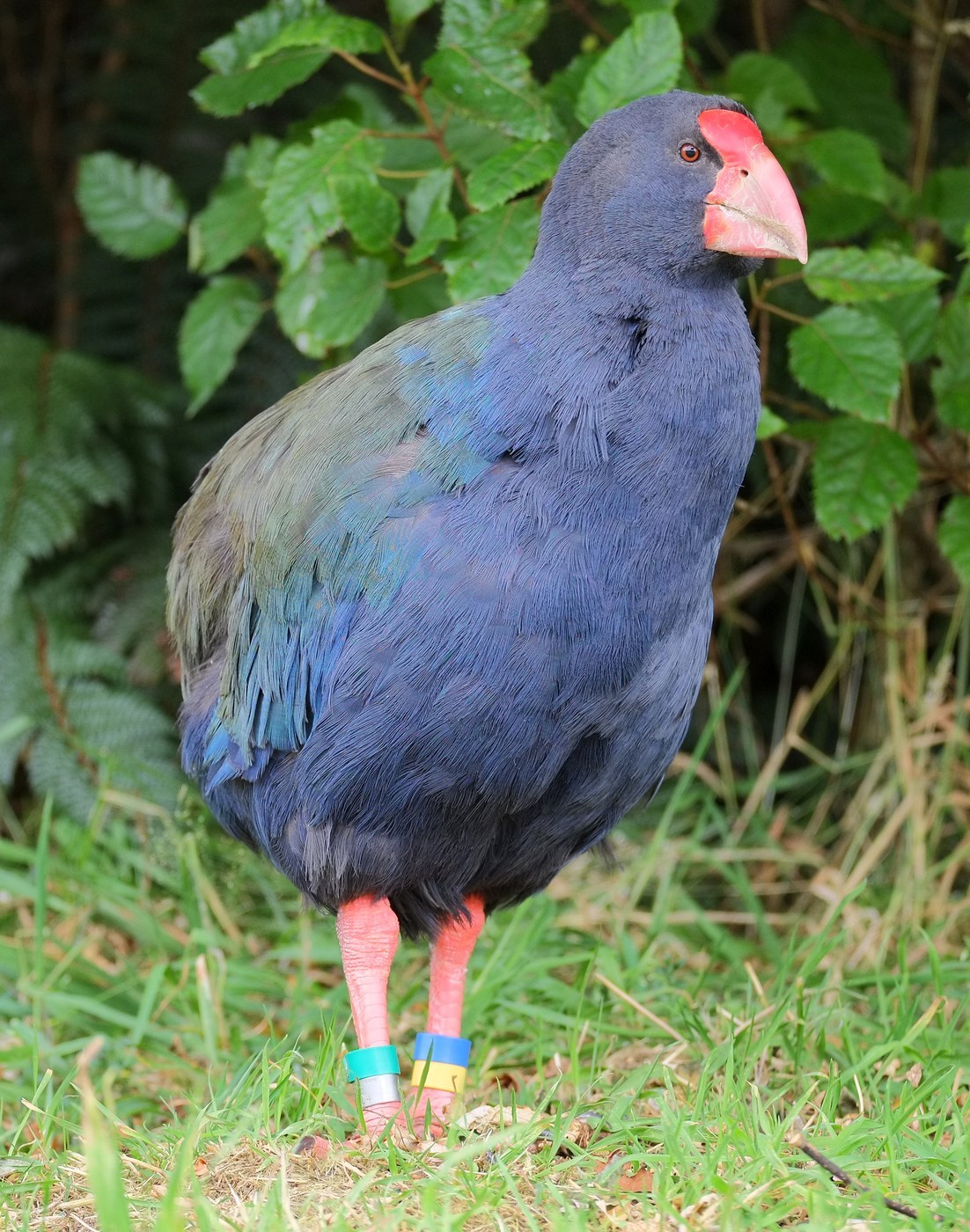
What Takahe's Feathers Look Like
Takahe is a large, flightless rail found only in New Zealand, and its feathers show clear adaptations to a grounded, non-flying lifestyle in addition to a striking color palette. Head, neck, and breast feathers are a deep indigo-blue to purplish-blue, richly colored and glossy, while the back and wings shift to an olive-green to bluish-green, giving the bird a two-toned look from front to back. Because Takahe cannot fly, its wing (remex) feathers are notably short, rounded, and structurally reduced compared to a flying rail's — the barbs are looser and less tightly interlocked, so wing feathers feel softer and less "aerodynamic" than typical flight feathers, lacking the stiff, tapering shape needed for flight. Body contour feathers are dense and somewhat coarse, an adaptation to New Zealand's cold, wet alpine tussock grassland habitat. There is no true tail to speak of in terms of long tail feathers; the short tail feathers are dark and unremarkable. Overall feather size is large, consistent with a heavy-bodied bird roughly the size of a large chicken, much bigger than any other rail sharing its range.
Step-by-Step: Is This Feather From a Takahe?
- Check color first. A combination of deep indigo-blue feathers (head/breast) and olive-green feathers (back/wings) on the same bird is a strong positive sign.
- Assess wing feather structure. Short, rounded, loosely-barbed flight feathers that look unfit for sustained flight support this flightless species over any flying rail or waterfowl.
- Consider size. Feathers noticeably large and robust, consistent with a heavy, ground-dwelling bird, rule out smaller New Zealand rails like Weka in terms of feather scale (though Weka is also flightless-ish, its coloring is dull brown, not blue-green).
- Look at feather density and texture. Thick, dense contour feathers suit a cold alpine tussock grassland environment.
- Consider location. Given Takahe's extremely restricted range and small, actively managed population (largely in specific Fiordland valleys and translocated island/sanctuary sites), any feather find should be considered in the context of these very specific locations.
Similar Species & How to Tell Them Apart
Pukeko (Australasian Swamphen), a much more common and widespread relative found throughout New Zealand, shares a similar blue-and-black color scheme but is considerably smaller with proportionately longer, more functional flight feathers since it can fly, and its blue tends toward a brighter, more purple-violet rather than Takahe's deeper indigo paired with olive-green back feathers. Weka, another flightless-ish New Zealand rail sometimes sharing similar terrain, is uniformly dull brown with no blue or green coloring at all, making color alone sufficient to rule it out.
Where & When You'll Find Them
Takahe survives naturally only in a handful of remote alpine valleys in Fiordland, New Zealand's South Island, with additional populations established through conservation translocation to predator-free islands and fenced sanctuaries elsewhere in the country. Feathers are most likely to be found in tussock grassland and subalpine scrub in these specific managed locations, with molt occurring gradually through the year; given the species' critically small and carefully monitored population, feather finds are rare events tied almost entirely to these known conservation sites.
Frequently asked questions
What makes Takahe feathers different from a typical flying bird's feathers?
Because Takahe is flightless, its wing feathers are short, rounded, and loosely structured compared to the stiff, tapering flight feathers of birds that fly, even though its body feathers are still richly colored.
How do I tell Takahe feathers from Pukeko feathers?
Takahe is noticeably larger with deeper indigo-blue and olive-green coloring, while Pukeko is smaller, more brightly purple-blue, and has functional flight feathers since it can fly.
Why are Takahe feathers rarely found?
The species survives in only a few remote Fiordland valleys plus a handful of conservation sanctuaries, and its total population is very small, making any feather encounter uncommon.
What color combination should I look for on a Takahe feather?
Deep indigo-blue on the head, neck, and breast paired with olive-to-bluish-green on the back and wings is the species' signature two-toned color pattern.