
How to Identify Topknot Pigeon Feathers
How to identify the gray body feathers, scalloped tail, and unique double crest feathers of an Australian Topknot Pigeon.
Read the full Topknot Pigeon encyclopedia entry →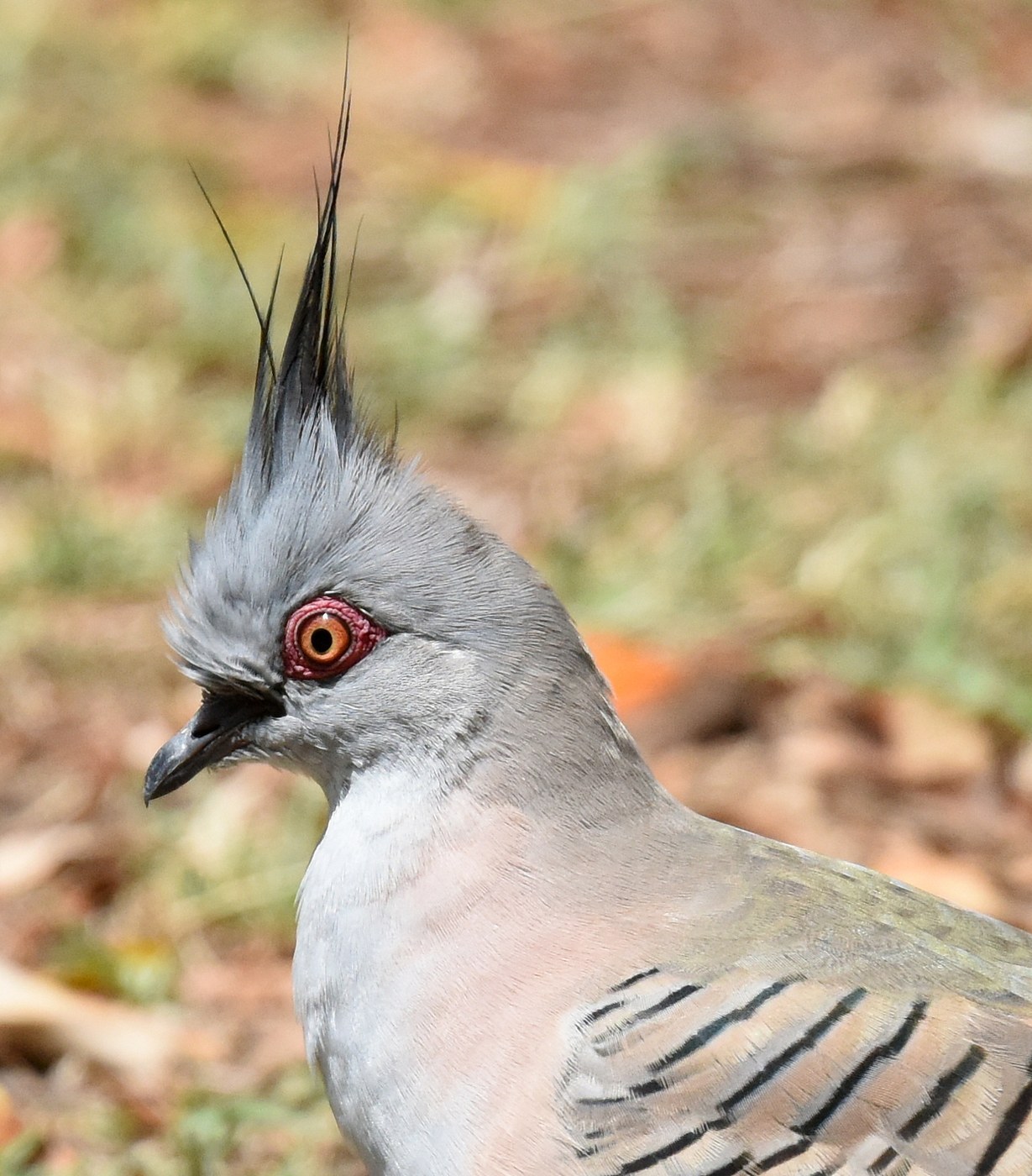
What Topknot Pigeon's Feathers Look Like
Topknot Pigeon is a large Australian rainforest pigeon best known for its unusual double crest, and its feathers reflect a soft, muted rainforest-canopy palette.
- Body/contour feathers: soft blue-gray overall on the back and underparts, with a subtly darker, more slate-toned wash across the chest.
- Crest feathers: a signature two-part crest — a rufous-cinnamon front crest feather set low over the forecrown, and a longer grayish-black crest feather rising from the back of the crown; an isolated crest feather with this two-tone rufous/gray-black look is highly diagnostic and found in no other Australian pigeon.
- Tail feathers: broad, with a distinctive pale gray base grading to a dark blackish terminal band, creating a scalloped or banded look when the tail is fanned.
- Wing feathers: gray with darker gray-black tips on the primaries, unmarked and smooth without barring.
- Size: this is a large pigeon, so feathers run larger than typical Australian doves — contour feathers 3-4 cm, tail feathers 12-15 cm.
Step-by-Step: Is This Feather From a Topknot Pigeon?
- Look for a crest feather. A feather that's rufous-cinnamon at the front transitioning to elongated gray-black at the back is unique to this species among Australian pigeons.
- Check tail banding. A broad pale gray tail feather with a solid dark terminal band supports Topknot Pigeon; solid gray without banding suggests a different species.
- Assess overall size. Feathers noticeably larger than a typical dove or smaller pigeon fit this bulky rainforest species.
- Rule out iridescence or bright color. Topknot Pigeon plumage is muted gray without the metallic green/purple sheen seen on some other pigeons, or bright fruit-dove colors.
- Consider habitat. Feathers found in or near subtropical/tropical rainforest canopy in eastern Australia strongly support this identification.
Similar Species & How to Tell Them Apart
- White-headed Pigeon: has a clean white head and neck rather than gray, and lacks any crest feathers entirely.
- Wonga Pigeon: shows a white throat/breast pattern with dark spotting on the belly, quite different from Topknot's plain gray underparts.
- Crested Pigeon: has a thin, upright black crest (not the two-part rufous/gray-black crest of Topknot) and a much smaller body overall.
- Torresian Imperial Pigeon: mostly white-bodied with black wingtips, easily separated from Topknot's overall gray tone.
Where & When You'll Find Them
Topknot Pigeon inhabits subtropical and tropical rainforests along the eastern coast of Australia, from central New South Wales north through Queensland, feeding heavily on rainforest fruit in the canopy. It undertakes local nomadic movements tracking fruit availability rather than long-distance migration, so feathers can be found in rainforest and adjacent habitat throughout the year, with an increase during and after the breeding season molt in the austral spring and summer months.
Frequently asked questions
What is the single most diagnostic feather for this species?
A crest feather showing rufous-cinnamon at the base transitioning to elongated gray-black — a two-part crest pattern unique among Australian pigeons.
How can I tell the tail feather apart from other pigeons?
Look for a broad, pale gray tail feather with a solid dark terminal band, giving a scalloped look when several feathers are viewed together.
Would this feather have any bright colors or iridescence?
No — Topknot Pigeon plumage is a muted blue-gray without metallic sheen or bright accent colors.
Where in Australia would I most likely find this feather?
In or near subtropical and tropical rainforest along the eastern coast, from central New South Wales through Queensland.