
How to Identify Townsend's Solitaire Feathers
How to identify the plain gray feathers, buffy wing patch, and white outer tail feathers of a Townsend's Solitaire.
Read the full Townsend's Solitaire encyclopedia entry →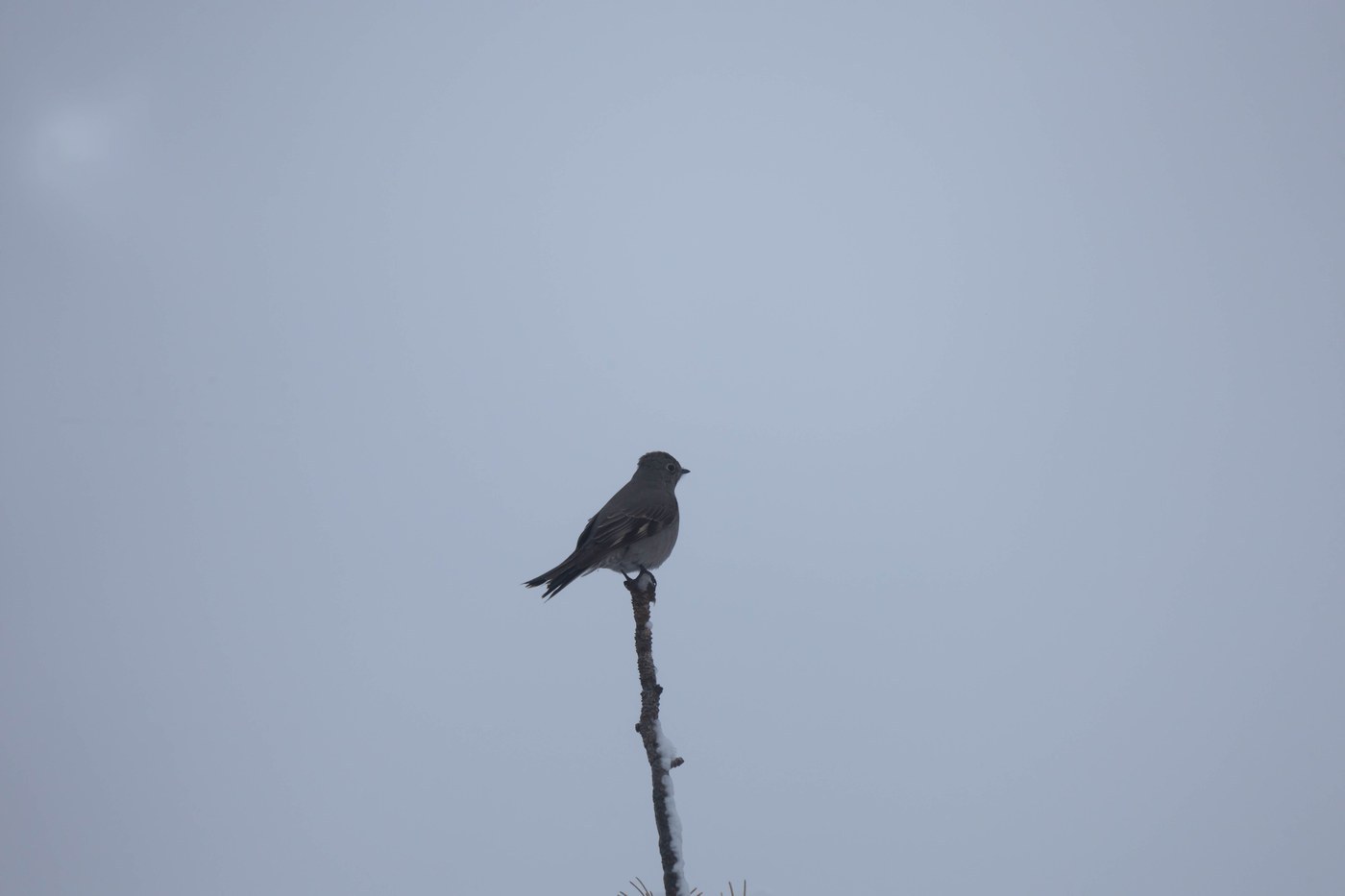
What Townsend's Solitaire's Feathers Look Like
Townsend's Solitaire is a slender, thrush-relative songbird of western mountain forests, and its feathers are subtly patterned rather than boldly marked.
- Body/contour feathers: overall plain soft gray, slightly paler on the belly, without streaking or spotting — a notably uniform, unmarked look compared to many thrushes.
- Eye-ring feather detail: a thin white eye-ring is visible on the bird but isn't itself a loose-feather trait; still, small whitish feathers immediately around the eye may show this pale tone.
- Wing feathers: blackish flight feathers with a buffy-orange patch at the base of the primaries, visible as a flash in flight and identifiable on a single detached primary as a feather that's buff-orange near the base and dark toward the tip.
- Tail feathers: black, with the outer tail feathers broadly white, creating a strong white-flash pattern when the tail is spread or when comparing outer versus central tail feathers.
- Size: slim, thrush-sized feathers; contour feathers 2-3 cm, tail feathers 7-9 cm.
Step-by-Step: Is This Feather From a Townsend's Solitaire?
- Check tail feather color pattern. Outer tail feathers that are mostly white with only a dark base or edge strongly support this species; central tail feathers should be solid black by contrast.
- Look for a buff patch on a wing feather. A primary feather that transitions from buff-orange at the base to blackish at the tip is a strong match.
- Assess overall body feather color. Plain, unmarked gray without streaking or spotting fits Townsend's Solitaire; heavily spotted feathers suggest a true thrush (like a Hermit Thrush) instead.
- Measure size. Slim, thrush-sized feathers in the 2-3 cm contour range fit this species' slender build.
- Consider elevation and habitat. Feathers found in coniferous mountain forest, especially near canyons or juniper stands in winter, support this identification.
Similar Species & How to Tell Them Apart
- Northern Mockingbird: also shows white outer tail feathers and a pale wing patch, but its body feathers are browner-gray with a bolder white wing patch band rather than solitaire's buff-orange flash, and it favors lowland open habitat rather than mountain forest.
- Hermit Thrush: shows a spotted breast pattern and rufous-tinged tail, quite different from solitaire's plain gray body and black-and-white tail.
- Gray Catbird: overall slate-gray but lacks white in the tail entirely, showing a plain dark tail with rufous undertail coverts instead.
- Clark's Nutcracker: larger, with bold white wing patches and white outer tail feathers too, but body feathers are pale gray with black wings showing a different overall pattern and much larger size.
Where & When You'll Find Them
Townsend's Solitaire breeds in coniferous forests of western mountain ranges from Alaska and western Canada south through the Rockies and Sierra Nevada, often near canyons and rocky slopes. In winter, many descend to lower elevations and juniper woodlands to feed on juniper berries. Molt occurs after breeding in late summer at higher elevations, while worn feathers are more often found at lower-elevation wintering sites from fall through early spring.
Frequently asked questions
What's the best single clue on a tail feather?
Outer tail feathers that are mostly white contrasting with solid black central tail feathers is the strongest indicator for this species.
How is the wing patch different from a mockingbird's?
Townsend's Solitaire shows a buff-orange patch at the base of the primaries, while Northern Mockingbird shows a bolder, whiter wing patch.
Would a spotted breast feather match this species?
No — Townsend's Solitaire has plain, unmarked gray body feathers; a spotted feather points instead to a true thrush like Hermit Thrush.
Where would I most likely find this feather in winter?
In lower-elevation juniper woodlands, since many Townsend's Solitaires descend from high mountain forest to feed on juniper berries in winter.