
How to Identify Tropical Kingbird Feathers
How to identify the gray-headed, yellow-bellied feathers of a Tropical Kingbird and separate them from other kingbirds.
Read the full Tropical Kingbird encyclopedia entry →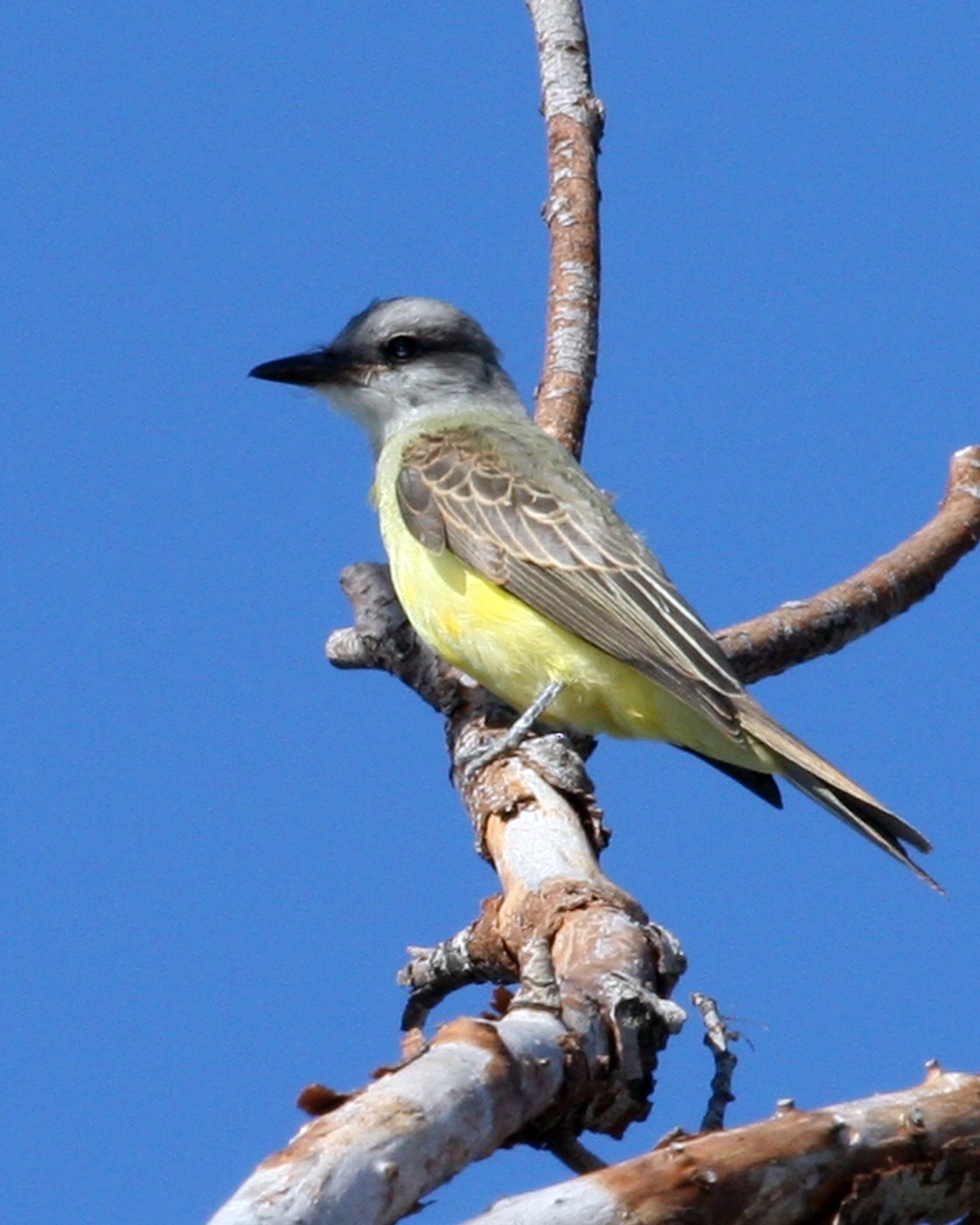
What Tropical Kingbird's Feathers Look Like
Tropical Kingbird is a large, vocal flycatcher common across the American tropics and southern borderlands, and its feathers show a clean gray-and-yellow contrast typical of many kingbirds.
- Head feathers: pale gray crown and nape, slightly darker gray-black through the eye/lores forming a subtle mask.
- Back feathers: olive-gray, blending into the gray head above and the yellow underparts below.
- Underparts feathers: bright lemon-yellow on the belly and flanks, fading to a paler, grayish-olive wash across the breast.
- Wing feathers: dusky brown-black, unmarked, without pale edging or wingbars of note.
- Tail feathers: notched, dark brownish-black, importantly without white edges — this is a key difference from Western Kingbird, whose tail shows white outer edges.
- Size: fairly large flycatcher feathers; contour feathers 2-3 cm, tail feathers 8-9 cm.
Step-by-Step: Is This Feather From a Tropical Kingbird?
- Check the tail feather edges. Plain dark brown-black with no white margin supports Tropical Kingbird; any white edging points to Western Kingbird or Cassin's Kingbird instead.
- Assess the tail shape. A distinctly notched (forked) tail tip fits Tropical Kingbird better than the more squared tail of Western Kingbird.
- Look at underparts color intensity. Bright yellow extending fairly far up onto the breast, with an olive-gray wash on the upper chest, is typical of this species.
- Compare head tone. Pale gray crown without a strong dark cap supports Tropical Kingbird over darker-capped flycatchers.
- Consider range and habitat. Feathers found in open country, farmland edges, or riverine habitat from the southwestern U.S. borderlands south through Mexico, Central America, and much of South America support this identification.
Similar Species & How to Tell Them Apart
- Western Kingbird: tail feathers show white outer edges, a clear difference from Tropical Kingbird's plain dark tail; also has a squarer tail tip rather than notched.
- Cassin's Kingbird: shows a darker, more contrasting gray-black head with a whitish tip band on the tail, differing from Tropical Kingbird's more uniform gray head and unmarked tail.
- Couch's Kingbird: nearly identical in plumage and feather appearance; the two are best separated by voice in the field, since feather-level differences are minimal or absent.
- Great Kiskadee: shows a bold black-and-white head pattern with a rufous wing panel, quite different from Tropical Kingbird's plain gray head and unmarked wings.
Where & When You'll Find Them
Tropical Kingbird ranges from the extreme southwestern United States (southern Arizona, Texas) south through Mexico, Central America, and much of South America, favoring open country, forest edges, farmland, and riverside habitat with scattered trees or utility wires for perching. Many populations are largely resident, though northern populations shift southward outside the breeding season. Molt typically follows breeding in mid-to-late summer, so feathers are found in breeding habitat through that period, with year-round presence in the milder core of its Central and South American range.
Frequently asked questions
How do I rule out Western Kingbird?
Check the tail feather edges — Tropical Kingbird's tail is plain dark with no white edging, while Western Kingbird shows white outer tail edges.
What tail shape should I look for?
A notched or slightly forked tail tip fits Tropical Kingbird, versus the squarer tail typical of Western Kingbird.
Can I reliably separate this from Couch's Kingbird by feather alone?
Not really — the two species are nearly identical in plumage and are best distinguished by voice rather than feather traits.
Where would I most likely find this feather in the U.S.?
In the extreme southwestern borderlands, particularly southern Arizona and Texas, in open country or near scattered trees and wires.