
How to Identify Variable Sunbird Feathers
How to identify the iridescent green head and yellow underparts of a Variable Sunbird, and separate it from similar African sunbirds.
Read the full Variable Sunbird encyclopedia entry →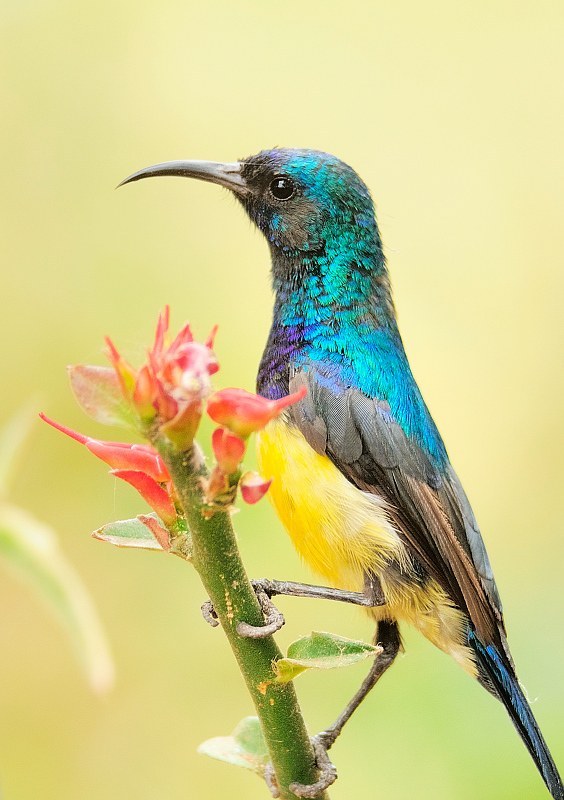
What Variable Sunbird's Feathers Look Like
Variable Sunbird is a tiny, nectar-feeding African bird whose name reflects the species' considerable regional variation, but certain feather traits recur across most populations.
- Head and throat feathers (male): iridescent metallic green to blue-green, shimmering brightly in direct light but appearing dark, almost blackish, in shade — classic sunbird structural iridescence rather than pigment-based color.
- Underparts feathers: typically bright yellow on the belly in most populations, though some subspecies show a darker, sooty, or even scarlet-tinged belly — checking regional variation is important since this species lives up to its name.
- Back and wing feathers: dull olive-brown to dark gray-brown, providing a plainer contrast to the flashy iridescent throat.
- Female/juvenile feathers: overall dull grayish-olive with a pale yellowish wash on the underparts and no iridescence at all — a much subtler feather set than the male's.
- Size: extremely small — body contour feathers run 1-2 cm, flight feathers 3-5 cm, among the smallest feathers you're likely to find outside of true hummingbird-sized species.
- Bill note: while not a feather trait, the long, thin, decurved bill (for nectar feeding) is often a helpful clue if found with feathers at a carcass.
Step-by-Step: Is This Feather From a Variable Sunbird?
- Check for iridescence. A tiny feather that shifts from dark to brilliant green/blue in different light angles strongly suggests a sunbird; flat, non-iridescent color points elsewhere.
- Assess the yellow. Bright yellow underparts feathers (or, depending on subspecies, darker/scarlet variants) support this species — but always weigh this against regional variation.
- Measure the feather. Extremely small size (well under 5 cm even for flight feathers) narrows things to a hummingbird-sized bird; sunbirds and hummingbirds don't overlap geographically, so African/Asian range points to sunbird.
- Rule out plain olive-brown with no yellow at all. A completely dull feather with no yellow wash may be a female, not necessarily a different species.
- Consider the setting. Feathers found near flowering shrubs, gardens, or savanna edge in sub-Saharan Africa support this common and adaptable species.
Similar Species & How to Tell Them Apart
- Scarlet-chested Sunbird: males show a bright red chest patch below the green throat, a feature Variable Sunbird lacks (its underparts are yellow or dark, not red banded).
- Collared Sunbird: smaller overall, entirely green above with all-yellow underparts and no distinct dark breast band separating throat from belly.
- Olive-bellied Sunbird: shows an olive-green belly rather than the brighter yellow typical of many Variable Sunbird populations.
- Amethyst Sunbird: males show deep purple-black iridescence rather than green, a notably different iridescent tone.
Where & When You'll Find Them
Variable Sunbirds are widespread across sub-Saharan Africa, favoring savanna, woodland edge, gardens, and cultivated land wherever flowering plants provide nectar. They are largely resident with some local, nectar-driven movements rather than long-distance migration. Molt timing varies regionally, often tracking local rainy seasons and flowering peaks rather than a single fixed calendar window, so freshly dropped feathers can appear whenever local breeding activity winds down, which differs by region across the species' broad range.
Frequently asked questions
How do I know a tiny feather is from a sunbird and not a hummingbird?
Range is the key — sunbirds occur only in Africa, Asia, and Australia, while hummingbirds are exclusively found in the Americas, so location alone separates the two families.
Why does this feather look black in one light and green in another?
That's iridescence — sunbird throat and head feathers use microscopic structural effects to reflect brilliant color only from certain angles, appearing dark otherwise.
The underparts feather is dark, not yellow — could it still be this species?
Possibly — Variable Sunbird populations vary regionally, with some showing darker or scarlet-tinged bellies instead of the more typical bright yellow.
How can I rule out a Scarlet-chested Sunbird?
Look for a red chest band below the throat — Scarlet-chested Sunbird has this distinct red patch, which Variable Sunbird lacks.