
How to Identify White-necked Jacobin Feathers
A guide to the deep blue-violet head, snow-white belly and tail, and white nape collar that make the White-necked Jacobin one of the most recognizable hummingbird feather finds in the Neotropics.
Read the full White-necked Jacobin encyclopedia entry →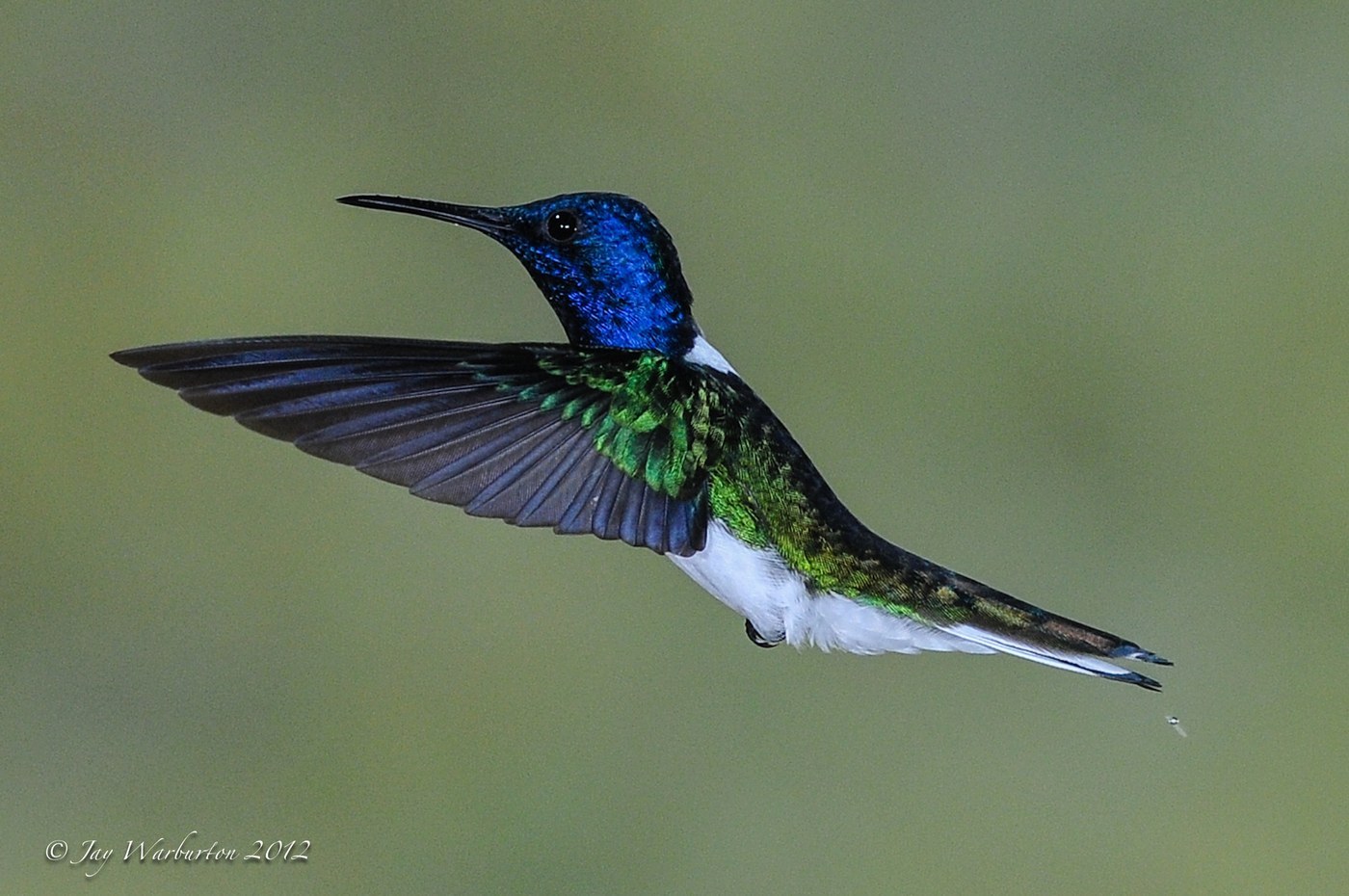
What White-necked Jacobin's Feathers Look Like
White-necked Jacobin is a fairly large hummingbird (about 11-12 cm) found from Mexico through much of tropical South America, and males in particular produce some of the most striking feathers of any hummingbird in the region. Head and upper breast feathers on adult males are an intense, glossy deep blue to violet-blue, iridescent and metallic, giving way to a crisp white collar band across the nape and hindneck — a feather from this collar is pure white with a soft base, standing in sharp contrast to the iridescent blue feathers surrounding it. The belly, vent, and much of the tail are bright white, an unusually large amount of white for a hummingbird, making white body feathers themselves a useful clue when paired with iridescent blue ones.
The back and wing covert feathers are iridescent green, glossy and metallic like the head, while the flight feathers (primaries) are dark, narrow, and blackish with little iridescence, typical of hummingbird wings built for rapid wingbeats. The outer tail feathers are white with a black band near the tip, a distinctive combination — a white tail feather with a crisp dark terminal band, found with iridescent blue or green body feathers, is a strong match for this species. Females and immatures are far less colorful, typically green above with white, scaled or spotted underparts and a white tail corner, lacking the bold blue head and white collar of adult males.
Step-by-Step: Is This Feather From a White-necked Jacobin?
- Check the scale. Body feathers run about 1.5-3 cm, flight feathers up to about 6-7 cm, consistent with a mid-to-large hummingbird.
- Look for blue-violet iridescence on the head area. This intensely colored, metallic feather type, combined with a white collar nearby, is a strong sign of an adult male.
- Find a white tail feather with a black band. This specific combination (white base, dark terminal band) is one of the best diagnostic clues for this species.
- Note the amount of white on the belly. An unusually large white area (rather than just a small white spot) fits this species better than most other hummingbirds in the region.
- Consider female/immature plumage. A green-backed, white-scaled-below feather set without blue on the head may still be this species in immature or female plumage — check the tail-corner white patch as a secondary clue.
Similar Species & How to Tell Them Apart
Few Neotropical hummingbirds combine a blue-violet head, white collar, and extensively white belly and tail quite like the male White-necked Jacobin, making misidentification relatively unlikely for adult males. Female and immature birds can be confused with other white-bellied hummingbirds such as certain mangoes or violetears, but those species typically lack the crisp white tail-corner patch and show more mottled or streaked underparts rather than clean scaling. Black Jacobin, a South American relative, lacks the white collar and shows an overall darker, more uniformly blue-black plumage without the extensive white belly.
Where & When You'll Find Them
White-necked Jacobins range from southern Mexico through Central America and much of tropical South America, favoring forest edges, clearings, and flowering trees in lowland and foothill forest. They are largely resident, though some local and altitudinal movements occur in response to flowering patterns. Because they don't undertake long migrations, feathers can be found across the year, with molt activity often tied to the end of the local breeding season, which varies by region but commonly follows the wettest months when flowers and insects are most abundant. Look for feathers near flowering trees, forest-edge shrubs, and feeders, where these hummingbirds aggressively defend favored feeding territories and leave behind preening debris.
Frequently asked questions
What's the single best clue for an adult male feather?
A deep blue-violet head feather paired with a crisp white collar feather from the nape is close to unique among Neotropical hummingbirds.
How do I identify a female or immature bird's feather?
Look for a green-backed feather with white, scaled underparts and a check for a clean white patch at the tail corner, since females lack the male's blue head and white collar.
What does the tail feather look like specifically?
White at the base with a crisp black band near the tip — a distinctive pattern when combined with iridescent blue or green body feathers found nearby.
How big are this hummingbird's feathers compared to smaller species?
Slightly larger than average — body feathers around 1.5-3 centimeters and flight feathers up to 6-7 centimeters, reflecting its status as a fairly large hummingbird.
Does this species migrate long distances?
No, it's largely resident with only local or altitudinal movements tied to flowering patterns, so feathers can turn up across most of the year.