
How to Identify White-throated Swift Feathers
How to identify the sickle-shaped, black-and-white patterned flight and body feathers of a White-throated Swift, a bird of cliffs and canyons.
Read the full White-throated Swift encyclopedia entry →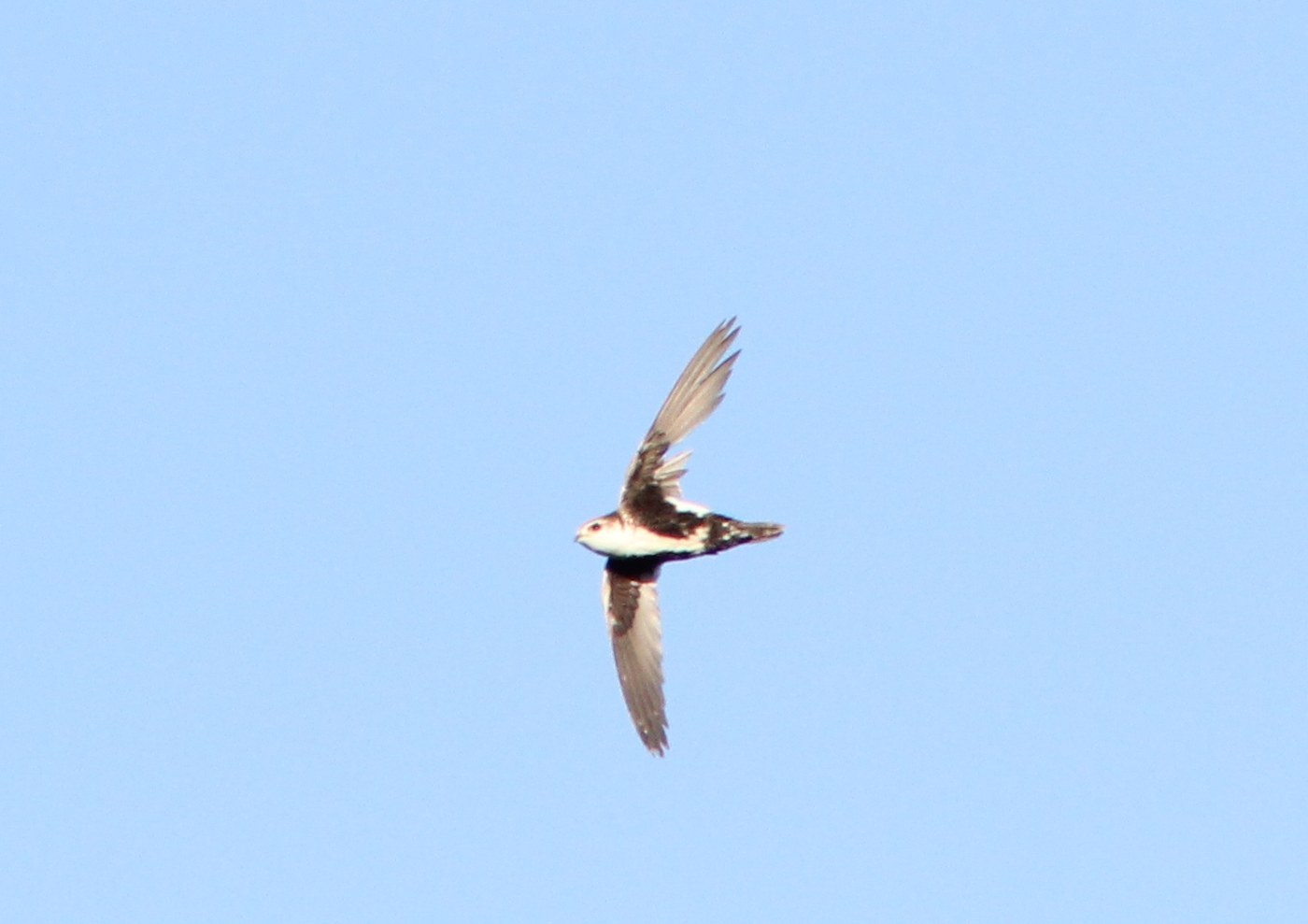
What White-throated Swift's Feathers Look Like
White-throated Swift is a fast-flying aerial insectivore of western North American cliffs and canyons, and its feathers are built for speed and clinging rather than perching.
- Flight feathers (primaries): long, narrow, and stiffly tapered into a sickle or scythe shape, blackish overall — an aerodynamic form very different from the rounder flight feathers of songbirds or swallows of similar size.
- Body feathers: mostly black to sooty-black on the upperparts, head, and central underparts.
- White patches: a clean white throat and central belly stripe, plus bold white flank patches on the sides of the rump/undertail — a black body feather bordered sharply by white is characteristic.
- Tail feathers: short, stiff, and slightly forked, blackish, with the shafts extending slightly beyond the vane tips in some feathers — an adaptation shared with some other cliff-dwelling aerial species for bracing against rock.
- Texture: unusually dense and stiff for the bird's small size, reflecting a life spent almost entirely on the wing at high speed.
- Size: primaries 8-11 cm, body feathers 1.5-2.5 cm, fitting a slim, swallow-sized bird with disproportionately long wings.
Step-by-Step: Is This Feather From a White-throated Swift?
- Check the shape first. A long, narrow, stiffly tapered flight feather with a sickle-like curve is a strong swift indicator, distinct from the blunter feathers of swallows.
- Look for sharp black-and-white borders. A black feather with a crisp white edge or patch (rather than a gradual blend) fits this species' bold flank and throat markings.
- Assess stiffness. Swift feathers feel notably rigid compared to the softer feathers of similarly sized songbirds, reflecting their high-speed flight lifestyle.
- Measure length relative to body size implied. Primaries in the 8-11 cm range from a small-bodied bird support a swift rather than a larger aerial species like a falcon.
- Consider the setting. Feathers found near cliffs, canyons, quarries, or highway rock cuts in the western United States, Mexico, or Central America fit this species' specialized nesting habitat.
Similar Species & How to Tell Them Apart
- Violet-green Swallow: shares a similar range and some white flank patches, but its body feathers show an iridescent green-and-violet sheen rather than flat black, and its flight feathers are broader and less sickle-shaped.
- Vaux's Swift: overall dark sooty-brown rather than black-and-white patterned, lacking the bold white throat/belly stripe and flank patches.
- Black Swift: entirely blackish with no white patches at all, easily separated by the absence of any white in the plumage.
- Barn Swallow: has a deeply forked tail and rufous throat patch, plus softer, broader flight feathers, unlike the stiff sickle-shaped swift primary.
Where & When You'll Find Them
White-throated Swift nests colonially in crevices on cliff faces, canyon walls, and increasingly on tall buildings and highway overpasses across the western United States south through Mexico and into Central America. Many populations are resident or make only short-distance movements, so feathers can be found near cliff and canyon nest sites through much of the year, with the greatest numbers turning up below active colonies during the breeding and molt season from late spring through summer.
Frequently asked questions
What shape should I look for in a flight feather?
A long, narrow, stiffly tapered feather with a sickle-like curve, quite different from the blunter feathers of swallows sharing similar habitat.
Why does the feather feel so stiff?
White-throated Swifts spend nearly all their time on the wing at high speed, so their feathers are denser and more rigid than those of typical perching birds.
How do I rule out Violet-green Swallow?
Check for iridescent green or violet sheen — Violet-green Swallow shows this on its back, while White-throated Swift's body feathers are flat black.
Where are feathers most likely to be found?
Near cliff faces, canyon walls, quarries, or highway rock cuts in the western US, Mexico, or Central America, where the species nests colonially.