
How to Identify White-throated Toucan Feathers
How to identify the glossy black body feathers, white throat and chest patch, and red undertail coverts that mark a White-throated Toucan.
Read the full White-throated Toucan encyclopedia entry →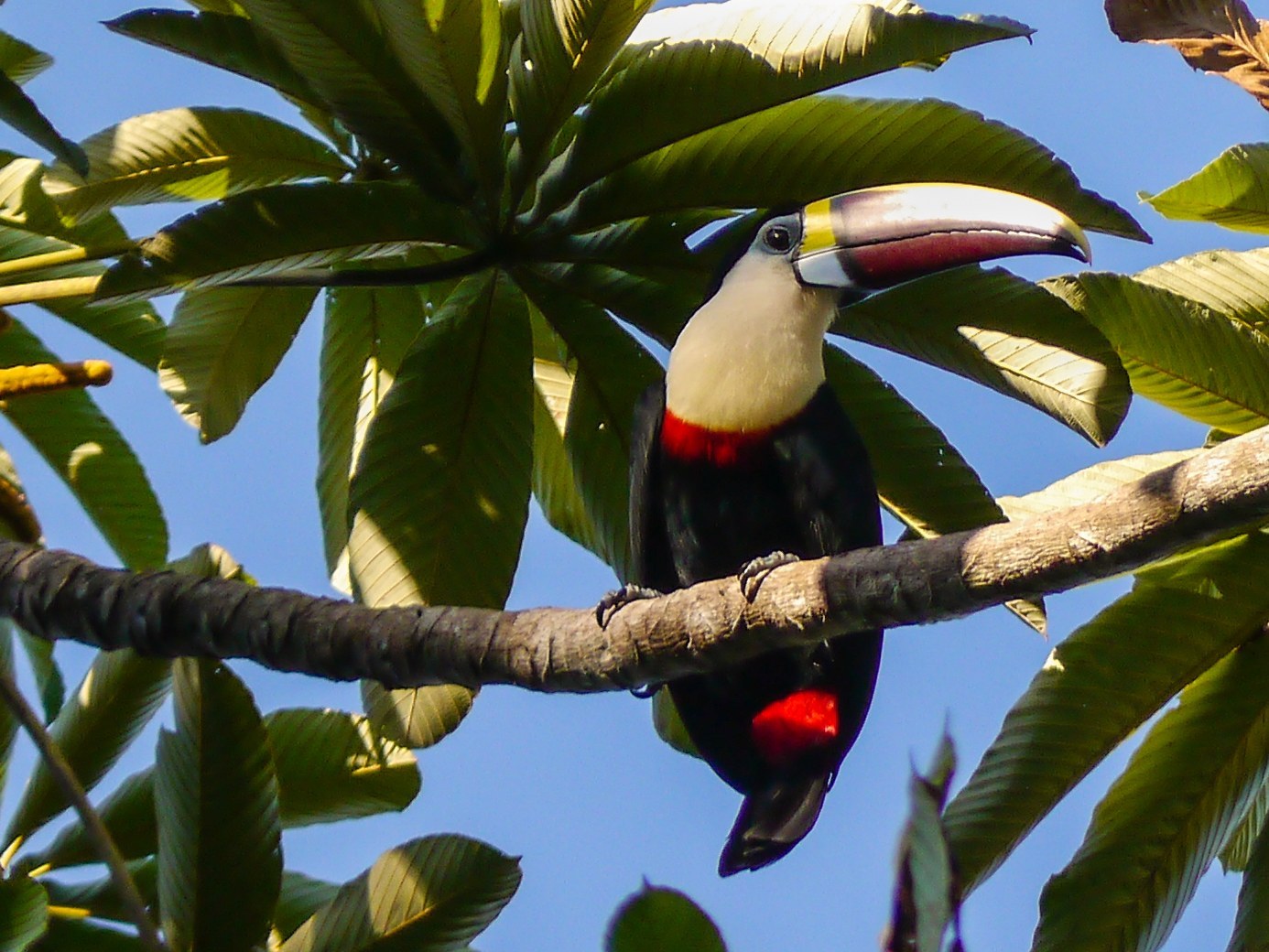
What White-throated Toucan's Feathers Look Like
White-throated Toucan is one of the largest Amazonian toucans, and while its enormous bill draws the most attention, its body feathers carry their own distinctive pattern.
- Body/contour feathers: deep, glossy black, densely packed and slightly stiff, covering the back, wings, crown, and belly.
- Throat and upper breast feathers: a well-defined white patch, sometimes with a faint yellow or buffy tinge at the lower edge, contrasting sharply against the black surrounding plumage.
- Undertail covert feathers: bright red, a small but vivid patch near the base of the tail that is one of the most reliable clues on a detached feather.
- Rump feathers: often white or pale, forming a band visible between the black back and red undertail region.
- Flight feathers: black, broad, and somewhat rounded, built for short, heavy flight between forest trees rather than sustained flying.
- Size: notably large for a passerine-like feather — contour feathers 4-6 cm, flight feathers 12-16 cm, reflecting the toucan's substantial body size.
Step-by-Step: Is This Feather From a White-throated Toucan?
- Check for a white throat/chest patch on an otherwise black feather. This crisp black-and-white contrast, especially from the throat/breast region, is a strong starting clue.
- Look for red undertail covert feathers. A short, vivid red feather from near the tail base found together with black body feathers strongly supports a large toucan.
- Assess feather size. Body feathers in the 4-6 cm range and flight feathers over 12 cm indicate a large-bodied bird, consistent with this species rather than smaller toucanets or aracaris.
- Note feather stiffness. Toucan body feathers are somewhat dense and glossy rather than soft and downy, fitting a large canopy-dwelling fruit-eater.
- Confirm range and habitat. Feathers found in lowland Amazonian rainforest or adjacent humid forest in South America fit this species' range.
Similar Species & How to Tell Them Apart
- Channel-billed Toucan: extremely similar black-and-white-and-red pattern; often best separated by range (largely Atlantic Forest/eastern Brazil versus White-throated Toucan's broader Amazonian and Andean range) rather than feather details alone.
- Toco Toucan: shows extensive white on the throat and upper breast bordered by black, but has an orange (not black-based) enormous bill and a plain black body without red undertail coverts as prominent.
- Chestnut-mandibled/Black-mandibled Toucan (Ramphastos ambiguus): shows yellow rather than pure white throat patches and slightly different undertail covert coloring in some populations.
- Aracaris (Pteroglossus spp.): much smaller overall, with banded or streaked underparts rather than a solid black body with a clean white throat patch.
Where & When You'll Find Them
White-throated Toucan inhabits lowland and foothill rainforest across much of the Amazon Basin and adjacent regions of South America, favoring the forest canopy and edges near fruiting trees. It is a non-migratory resident, so feathers can be found year-round throughout its range, with a modest increase during and after the breeding season when adults undergo their main molt.
Frequently asked questions
What's the most reliable feather clue for this species?
A vivid red undertail covert feather found together with glossy black body feathers and a white throat patch is very characteristic of this large toucan.
How do I separate this from a Toco Toucan feather?
Toco Toucan lacks the same prominent red undertail coverts and is associated with a bright orange bill rather than the black-based, multicolored bill of White-throated Toucan.
Would a feather this large come from a smaller toucanet?
No — toucanets and aracaris have noticeably smaller body and flight feathers; feathers in the 4-6 cm contour and 12-16 cm flight range point to a large toucan like this species.
Is this species found outside the Amazon Basin?
Its core range is the Amazon Basin and adjacent humid forest in South America, so feathers found well outside that region are less likely to be this species.