
How to Identify Whooper Swan Feathers
How to identify the all-white adult body feathers and gray-brown juvenile down that mark a Whooper Swan, plus how to separate it from other white swans.
Read the full Whooper Swan encyclopedia entry →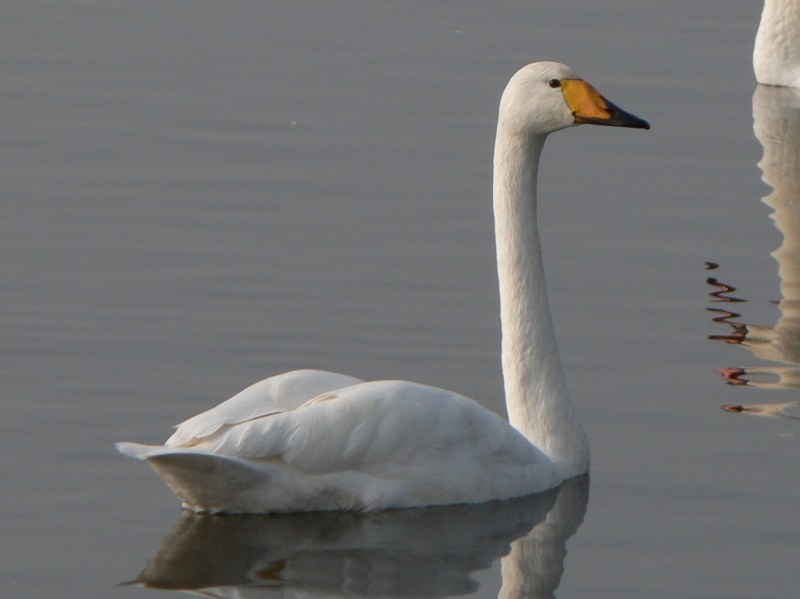
What Whooper Swan's Feathers Look Like
Whooper Swan is a large Eurasian swan known for its loud bugling call and straight-necked posture, and its feathers reflect its status as one of the largest flying birds.
- Adult body/contour feathers: pure white throughout, dense and slightly stiff, with a faint rust-orange staining sometimes present on the head/neck feathers of birds that feed in iron-rich waters (a wear/environmental stain, not a natural pigment).
- Flight feathers: white primaries and secondaries, notably long and broad given the bird's large size, providing the lift needed for a bird that can weigh over 10 kg.
- Juvenile/immature feathers: pale gray-brown to grayish-white, covering the whole body in the first year, gradually replaced by white adult feathers over the first one to two years.
- Down feathers: extremely dense, fine white down beneath the contour feathers, an insulating layer suited to breeding in subarctic wetlands.
- Size: contour feathers 5-8 cm, flight feathers up to 35-45 cm, among the largest feathers likely to be found from any flying bird, reflecting a wingspan that can exceed 2.3 meters.
Step-by-Step: Is This Feather From a Whooper Swan?
- Check the size first. Flight feathers approaching or exceeding 35 cm, and body feathers 5-8 cm, point to a swan-sized bird rather than a goose or large duck.
- Assess overall whiteness (adults) or grayish tone (juveniles). Pure white supports an adult; uniform pale gray-brown supports a first-year bird — either is consistent with this species.
- Look for iron staining. A rust-orange tint concentrated on head/neck feathers (rather than an even wash) is an environmental stain seen in several swan species and doesn't rule this one out.
- Feel the down. Extremely dense, fine white down beneath any contour feather supports a large waterbird adapted to cold climates.
- Consider range and season. Feathers found near northern European or Asian wetlands, lakes, and estuaries in the breeding season, or on temperate wintering wetlands farther south in winter, fit this species' strongly migratory habits.
Similar Species & How to Tell Them Apart
- Tundra Swan (Bewick's Swan in Eurasia): very similar all-white plumage; feathers alone are difficult to separate reliably from Whooper Swan, though Tundra/Bewick's tends to average slightly smaller in feather size.
- Mute Swan: also all-white as an adult, but juvenile Mute Swans can show either gray-brown or all-white ("Polish" morph) down, and adult Mute Swan feathers are essentially indistinguishable from Whooper by color alone — bill color differences in life (orange-and-black knob vs. yellow-and-black) are the more reliable field mark, not something visible on a feather.
- Snow Goose: much smaller feathers overall and often shows black wingtip feathers (visible as black primaries), a pattern absent in swans, which have entirely white flight feathers.
- Domestic white geese: smaller feather size and typically found only near farms or urban ponds rather than natural wetlands.
Where & When You'll Find Them
Whooper Swan breeds on lakes, bogs, and slow rivers across subarctic and northern temperate Eurasia, from Iceland through Scandinavia and across Russia to parts of East Asia, then migrates south to winter on ice-free lakes, estuaries, and coastal wetlands in temperate Europe and Asia. Adults undergo a flightless wing molt in mid-to-late summer on the breeding grounds, so shed flight feathers are most concentrated there in summer, while body feathers and down are more commonly found on wintering wetlands from autumn through early spring.
Frequently asked questions
How can I tell this apart from a Mute Swan feather?
By feather alone it's very difficult — both are all-white as adults. Bill color differences (yellow-and-black in Whooper vs. orange-and-black in Mute) are the more reliable clue, but that's only useful if you saw or found the bird itself, not just a loose feather.
Why would a feather look grayish-brown instead of white?
That's typical of a juvenile or first-year bird, which retains gray-brown body feathers before molting into full white adult plumage over its first year or two.
Is a rust-orange stain on the feathers a natural color?
No — it's an environmental stain picked up from iron-rich water while feeding, not a true pigment, and can occur in several white swan species.
When are shed flight feathers most likely to be found?
During the mid-to-late summer flightless molt period on the breeding grounds, when adults shed all their flight feathers simultaneously.