
How to Identify Wilson's Storm-Petrel Feathers
How to identify Wilson's Storm-Petrel feathers using their sooty black-brown color, pale wing-covert bar, and the diagnostic white U-shaped rump band.
Read the full Wilson's Storm-Petrel encyclopedia entry →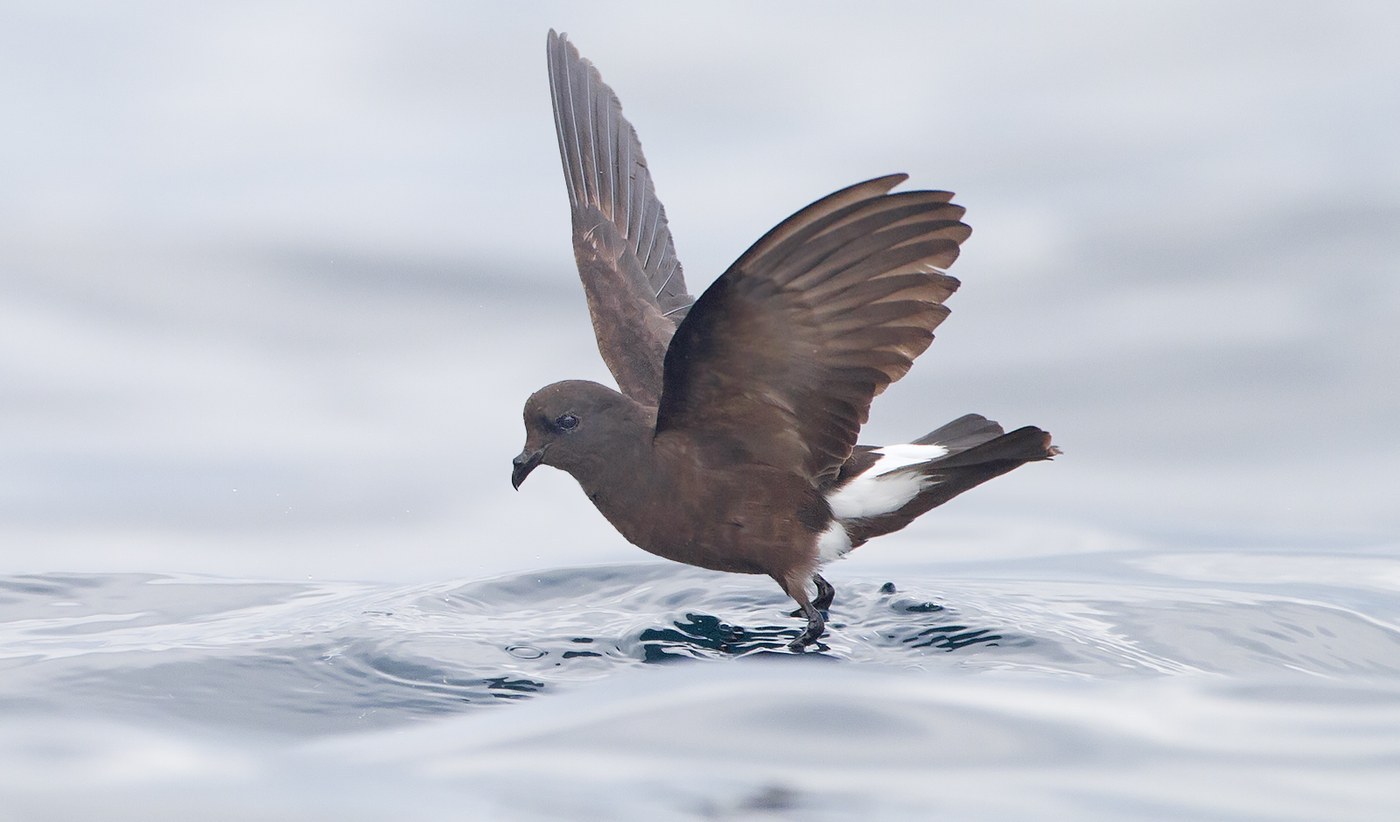
What Wilson's Storm-Petrel's Feathers Look Like
Wilson's Storm-Petrel is a tiny, swallow-sized seabird, and most of its plumage is a uniform sooty blackish-brown, with body and wing feathers showing very little pattern on their own. The single most useful feather to find is one from the rump: a bright white band that wraps around from one side to the other in a U-shape, contrasting sharply against the black tail and back — on this species the white band typically extends slightly onto the undertail area, wrapping further around than in some relatives. Upperwing covert feathers show a subtle pale grayish-brown diagonal bar, visible only in good light and much less bold than the white wingstripes of phalaropes or many shorebirds. The tail is square-tipped to very slightly notched, made up of relatively broad, evenly dark blackish-brown feathers with no white in them (the white is confined to the rump, not the tail itself). Flight feathers are long and narrow relative to body size, an adaptation for the fluttering, swallow-like flight this species uses low over the ocean surface.
Step-by-Step: Is This Feather From a Wilson's Storm-Petrel?
- Look first for a white rump feather. A small, sooty-black feather with a crisp white base or a solid white feather from the rump/uppertail-covert region is the strongest single clue for any storm-petrel, and the extensive wrap-around white supports Wilson's specifically.
- Check overall color. Body and wing feathers should be uniformly sooty black-brown with no streaking, spotting, or barring.
- Examine the tail shape. A square or only faintly notched tail tip (not deeply forked) fits Wilson's Storm-Petrel rather than more deeply forked relatives.
- Assess size. This is a very small seabird (about 18 cm / 7 in body length with a wingspan around 40 cm / 16 in), so feathers should be correspondingly small and light.
- Match to a marine or coastal context. Storm-petrel feathers are essentially never found far from oceanic or coastal environments, since the species spends nearly all its life at sea.
Similar Species & How to Tell Them Apart
Leach's Storm-Petrel shows a forked tail and often a white rump band that is more divided by a dark central line, rather than the fuller, more continuous white band of Wilson's. Band-rumped Storm-Petrel has a broader white rump band set closer to the tail tip and a slightly less deeply notched tail than Leach's, but still shows a more forked tail than Wilson's essentially square tail. Overall, the combination of a square (not forked) tail with an extensive, fully wrapped white rump band is the most reliable feather-based way to favor Wilson's Storm-Petrel over its North Atlantic and Pacific relatives.
Where & When You'll Find Them
Wilson's Storm-Petrel breeds on remote sub-Antarctic and Antarctic islands and spends the nonbreeding season ranging widely over the open Atlantic, Pacific, and Indian Oceans, including well offshore of North America in summer. Because it almost never comes to land outside its breeding colonies, feathers are typically found either washed up on ocean beaches after storms or, more rarely, on remote breeding islands during the austral summer breeding season when adults are provisioning chicks and undergoing wing and body molt.
Frequently asked questions
What's the fastest way to confirm a storm-petrel feather versus a random dark seabird feather?
Check for any white at the rump/uppertail-covert base — a crisp white band on an otherwise sooty-black feather is the storm-petrel signature.
How does Wilson's tail shape help rule out similar species?
Wilson's Storm-Petrel has a square to only slightly notched tail, while Leach's and Band-rumped Storm-Petrels show a more visibly forked tail.
Are these feathers likely to be found inland?
Almost never — this species is highly pelagic and feathers typically wash ashore only after storms or occur at remote breeding islands.
Does the pale wing bar help identify this species?
It's a supporting clue at best, since the diagonal pale covert bar is subtle and shared in weaker form by several storm-petrel species.