
How to Identify Woodchat Shrike Feathers
How to identify Woodchat Shrike feathers by the chestnut crown and nape, black eye-mask, and the sharply contrasting white wing patch on black flight feathers.
Read the full Woodchat Shrike encyclopedia entry →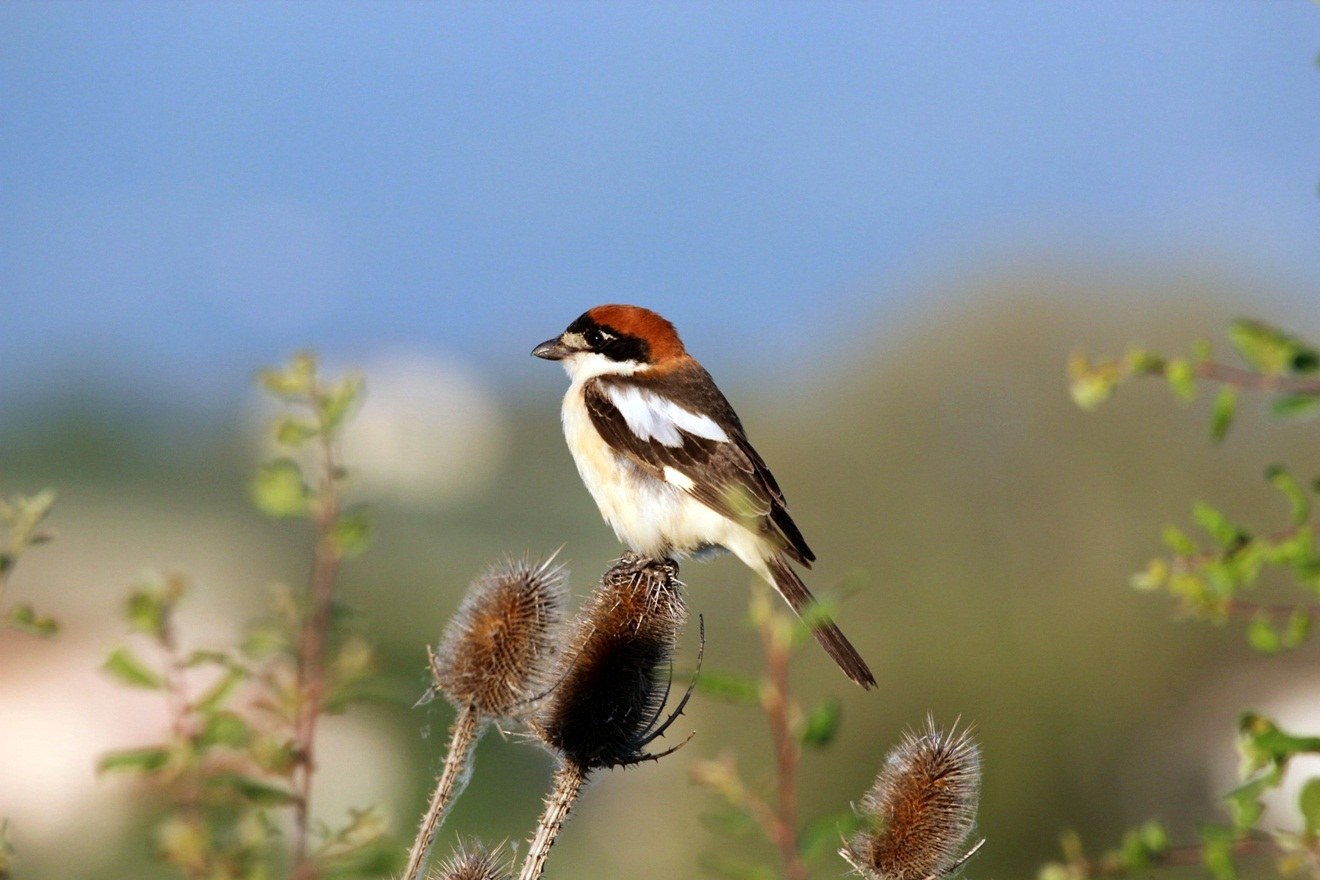
What Woodchat Shrike's Feathers Look Like
Woodchat Shrike is a striking black-white-and-chestnut songbird, and its feathers reflect a very sharply blocked pattern rather than any blending or streaking. The crown and nape feathers are a warm chestnut-rufous, forming a distinct cap that contrasts against a black mask running through the eye — a small cluster of face feathers showing this black-mask-against-chestnut-crown transition is highly diagnostic. The back is grayish, while the wings are mostly glossy black, broken by a bold white patch at the base of the primary flight feathers — a single primary feather showing black through most of its length but with a clean white base is a strong match. Underparts are clean white, unmarked. The rump is white, contrasting with the black tail, and the tail feathers themselves are black with white edges/tips on the outer feathers, creating a white-fringed look when the tail is fanned. Overall the pattern is one of hard, clean-edged color blocks rather than any gradient or fine patterning, consistent with the shrike family's generally bold plumage style.
Step-by-Step: Is This Feather From a Woodchat Shrike?
- Look for chestnut crown/nape feathers next to a black mask feather. This sharp color transition on the head is the strongest single clue.
- Check flight feathers for a white patch at the base of an otherwise black primary. This bold white wing-patch is diagnostic among regional shrikes.
- Examine the rump. A white rump feather set against black tail feathers supports Woodchat Shrike.
- Look at outer tail feathers for white edges or tips on an otherwise black tail.
- Confirm underparts are plain clean white, with no streaking, which fits adult Woodchat Shrike (streaked underparts would suggest a juvenile or a different shrike species).
Similar Species & How to Tell Them Apart
Red-backed Shrike shows a gray crown (not chestnut) with a chestnut back instead, essentially the reverse color placement from Woodchat Shrike. Great Grey Shrike is much larger, mostly pale gray overall with black wings and mask but no chestnut cap at all, and shows a different, more limited white wing patch. Masked Shrike has a black back rather than gray, and a more restricted white wing patch. The chestnut crown-and-nape combined with a bold white patch at the base of the primaries is the most dependable pairing for confirming Woodchat Shrike over these relatives.
Where & When You'll Find Them
Woodchat Shrike breeds across open woodland edges, orchards, and scrubby farmland of southern Europe, North Africa, and parts of the Middle East, and migrates to spend the winter in sub-Saharan Africa. It typically hunts from exposed perches such as fence posts, wires, and isolated shrubs, often impaling prey on thorns as a food cache — a behavior that leaves feathers scattered near these "larders." Feathers are most likely found near breeding territories in open scrubland during spring and summer molt, and around similar semi-open woodland edge habitat in its African wintering range during the nonbreeding months.
Frequently asked questions
What's the single best clue for identifying a Woodchat Shrike feather?
A chestnut crown/nape feather adjoining a black eye-mask feather, paired with a bold white patch at the base of the black primary flight feathers.
How is Woodchat Shrike different from Red-backed Shrike in feather color?
Woodchat has a chestnut crown and gray back, while Red-backed Shrike has a gray crown and chestnut back — essentially reversed color placement.
Does the white wing patch help rule out other species?
Yes, the size and position of the white patch at the primary bases is distinctive compared to Great Grey Shrike's more limited pattern and Masked Shrike's darker back.
Where would I likely find these feathers in the field?
Near open scrubland or orchard perches used for hunting, sometimes close to thorny 'larder' sites where the shrike caches impaled prey.