
How to Identify Yellow-billed Kite Feathers
How to identify Yellow-billed Kite feathers by their overall brown color, shallowly forked tail, dark carpal patches, and the adult's yellow bill for context.
Read the full Yellow-billed Kite encyclopedia entry →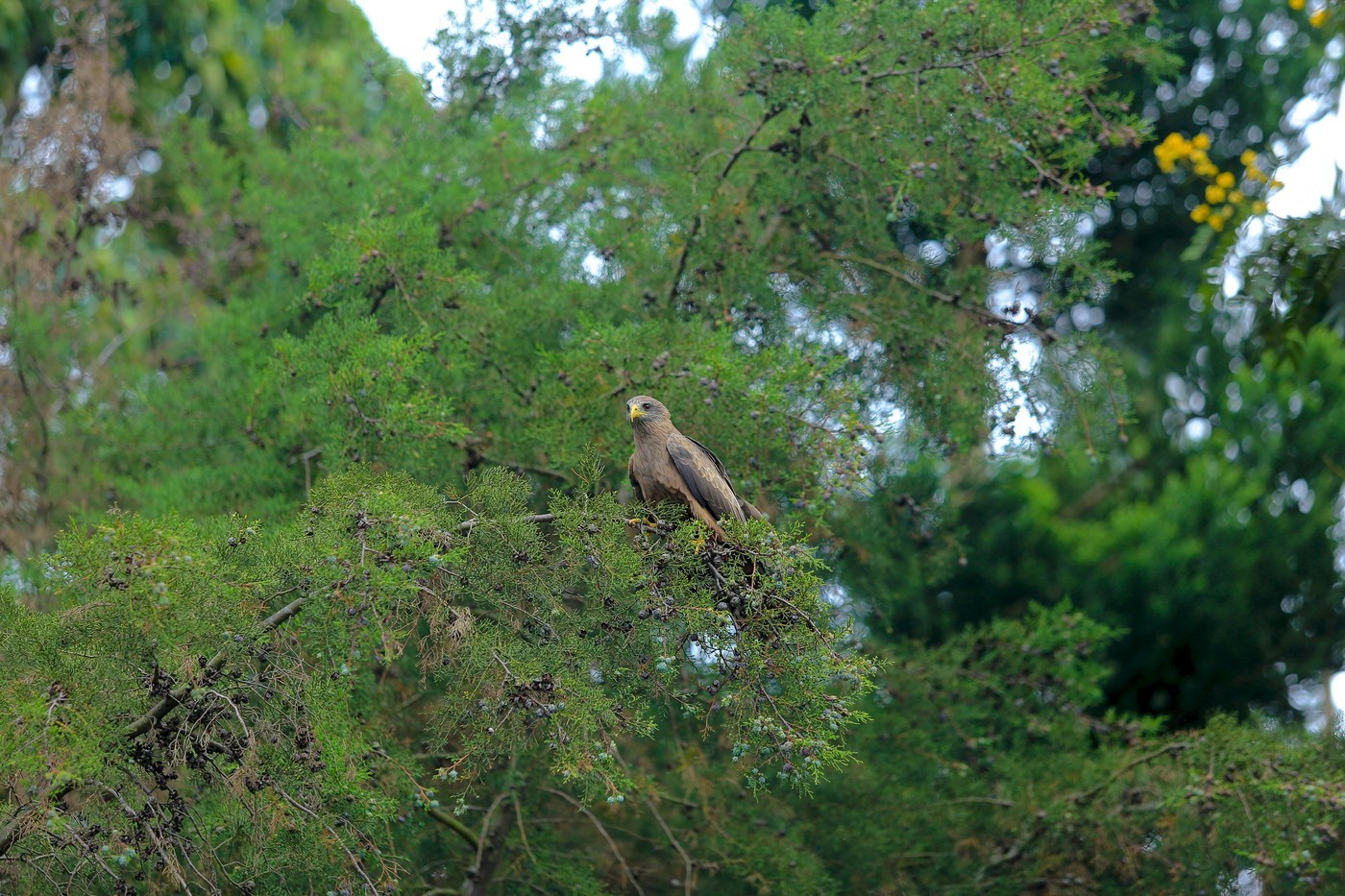
What Yellow-billed Kite's Feathers Look Like
Yellow-billed Kite is a widespread African raptor closely related to the Black Kite, and its feathers show the understated brown tones typical of that group. Body and wing covert feathers are medium-to-dark brown overall, without bold markings, though feathers can show slightly paler, warmer brown fringing when fresh. Flight feathers (primaries and secondaries) are darker brown to blackish-brown, and the underwing shows a darker patch at the wrist/carpal area contrasting subtly against paler flight feather bases — a useful clue if you have a section of underwing covert and flight feathers together. The tail is only shallowly forked (notched rather than deeply forked), made up of brown feathers with faint darker barring, distinguishing it by shape from more deeply forked kites elsewhere in the world. Adult birds have a yellow bill (versus black in juveniles), a helpful non-feather clue if bill material is attached. Overall feather size is fairly large, reflecting a mid-sized raptor with a wingspan around 1.3–1.5 m (4.3–5 ft).
Step-by-Step: Is This Feather From a Yellow-billed Kite?
- Check overall color first. A fairly uniform medium-to-dark brown feather, lacking bold barring or pale patches, is consistent with this species.
- Look at tail feather shape. A shallow fork or notch (not a deep, scissor-like fork) supports Yellow-billed Kite over more deeply forked kite species found elsewhere.
- Examine underwing coverts for a darker carpal patch if a section of underwing is available, contrasting against paler flight-feather bases.
- Judge size. Fairly large, broad flight feathers fit a mid-sized raptor rather than a small hawk or falcon.
- Consider any attached bill material. A yellow bill base indicates an adult; a black bill base indicates a juvenile.
Similar Species & How to Tell Them Apart
Black Kite (of which Yellow-billed Kite was formerly considered a subspecies) is extremely similar in plumage and structure, and the two are largely separated by range and bill color in adults (Black Kite has a dark bill even as an adult) rather than by feather pattern alone, since body and flight feather color and the shallow tail fork are nearly identical between them. African Harrier-Hawk and Augur Buzzard, sharing similar habitat, both show more contrasting plumage patterns (barred underparts or a strongly two-toned wing pattern) and a squarer, unforked tail, differing from the kite's plainer brown tone and forked tail. The shallow tail fork combined with generally uniform brown plumage and a darker carpal patch on the underwing is the most useful combination for confirming a kite (Yellow-billed or Black) over other regional raptors, with bill color as the final check between the two kite forms.
Where & When You'll Find Them
Yellow-billed Kite is a common and conspicuous raptor across savanna, open woodland, farmland, and urban areas throughout sub-Saharan Africa, often seen soaring over roads and settlements scavenging for food. Many populations are intra-African migrants, moving seasonally in response to rains and food availability, so feathers can turn up across a broad range of habitats depending on the time of year, with feather loss concentrated around the breeding season and the extensive soaring flight this species uses for much of its foraging and travel.
Frequently asked questions
What is the best way to separate this species from Black Kite by feather?
Plumage and tail shape are nearly identical between the two; adult bill color (yellow versus dark) is the more reliable distinguishing feature when available.
Why is the tail fork shape a useful clue?
Yellow-billed Kite shows only a shallow fork or notch, unlike more deeply, scissor-forked kites found in other regions, helping narrow down the group even without color detail.
Does this species show any bold wing markings?
Not prominently — its plumage is fairly uniform brown, with only a subtle darker carpal patch on the underwing as a distinguishing feature.
Where and when are feathers most likely to be found?
Across savanna, farmland, and even urban areas throughout sub-Saharan Africa, with numbers shifting seasonally as many populations move in response to rains and food supply.