
How to Identify Yellow-billed Stork Feathers
A field guide to spotting the pink-flushed white body feathers and black flight feathers of the Yellow-billed Stork, a large African wader.
Read the full Yellow-billed Stork encyclopedia entry →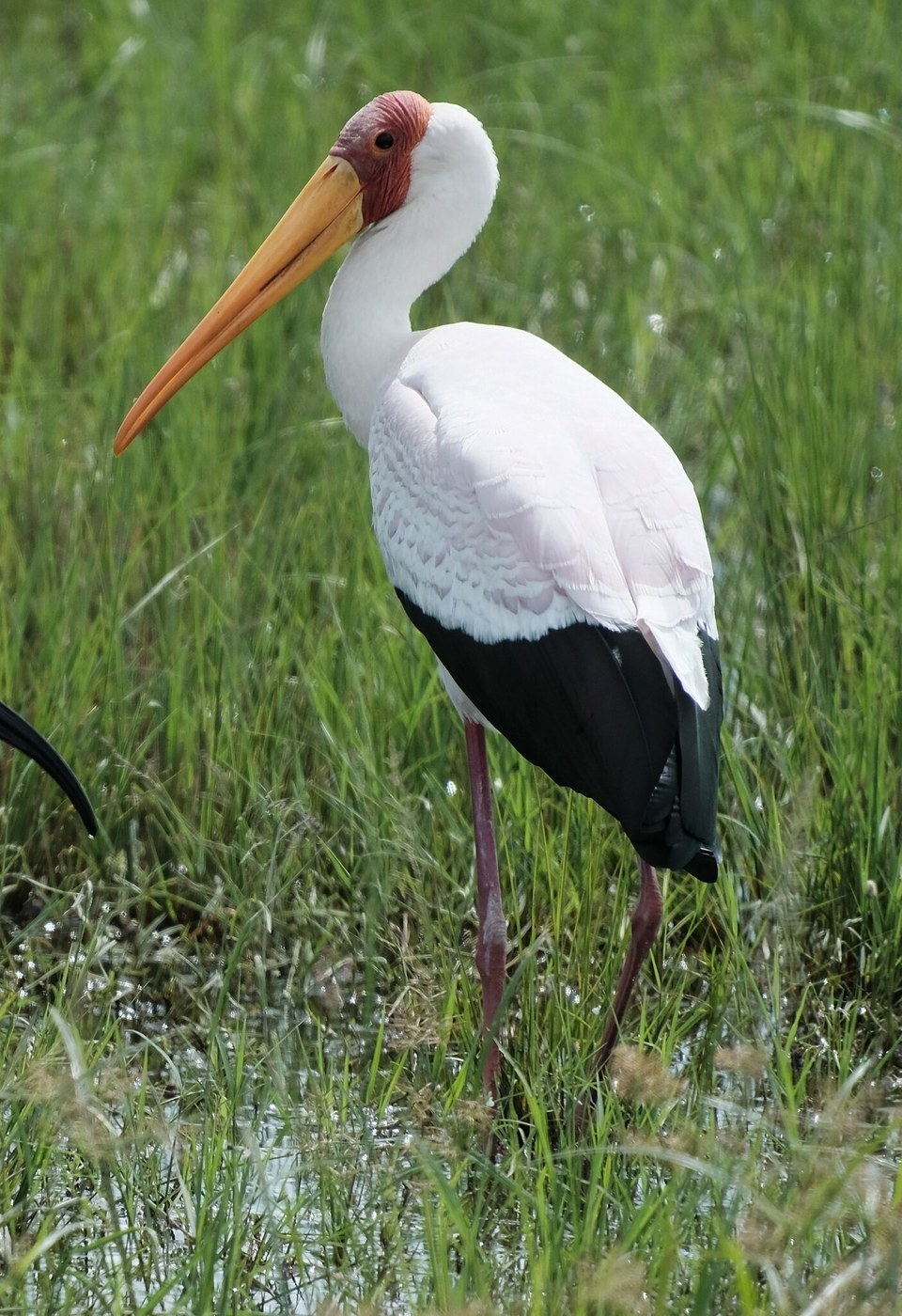
What Yellow-billed Stork Feathers Look Like
The Yellow-billed Stork is a large, mostly white wading bird with strikingly contrasting black flight feathers and tail. Primary and secondary feathers measure 25-35 cm, are glossy black with a subtle greenish sheen in good light, stiff-vaned, and strongly asymmetrical with a curved shape built for soaring flight. The tail feathers are also solid black and slightly shorter, around 15-20 cm. In contrast, the body (contour) feathers covering the neck, back, and underparts are white, often carrying a delicate pink or salmon flush during the breeding season — a feature almost unique among storks and a strong diagnostic clue. These body feathers are soft, loosely structured, and range from 5-12 cm depending on location on the body. The downy under-feathers at the base of contour feathers are pale gray-white and fluffy. No feather on this bird shows barring or spotting — the pattern is one of bold blocks of solid black against white or pink-white, never a mottled or streaked design.
Step-by-Step: Is This Feather From a Yellow-billed Stork?
- Sort by color block: solid glossy black points to a flight or tail feather; white to pale pink points to a body feather.
- Check for a pink wash: a rosy or salmon tint on an otherwise white feather is a strong seasonal indicator specific to this species among African storks.
- Measure size: flight feathers over 25 cm suggest a large-bodied bird capable of soaring, consistent with a stork rather than a smaller wader.
- Examine the sheen: black feathers with a faint green-bronze gloss under sunlight are typical of stork flight feathers rather than the flatter black of an ibis.
- Look at the vane stiffness: flight feathers should be rigid and curved; body feathers should be soft and loosely webbed.
- Note the setting: feathers found near African rivers, lakeshores, or fish-rich wetlands support this identification.
Similar Species & How to Tell Them Apart
The African Openbill and Marabou Stork also show black-and-white or black-and-gray combinations, but neither develops the pink flush on body feathers, and Marabou body feathers tend toward gray rather than pure white. Wood Stork, found in the Americas, is similar in shape and black flight feather pattern but never shows pink-tinged body plumage and has a more restricted New World range, so location is a useful separator. Sacred Ibis feathers are also black and white, but the black is typically confined to wingtips and plume tips rather than covering the entire flight feather as in the stork, and Ibis body feathers are smaller and lack any pink wash.
Where & When You'll Find Them
Yellow-billed Storks inhabit shallow freshwater wetlands, riverbanks, and floodplains across sub-Saharan Africa, often wading in groups to catch fish. Feathers are most commonly found near breeding colonies during and after the nesting season, when the pink-flushed plumage is at its peak and adults are actively molting; outside the breeding season the pink fades to plain white, so a fresh find with strong pink coloring usually indicates a breeding-season molt.
Frequently asked questions
Why is there a pink tint on some feathers?
Yellow-billed Storks develop a temporary pink or salmon flush on their body plumage during the breeding season, likely from preen gland secretions, so a pink-washed white feather is a strong seasonal clue for this species.
Are the black feathers really black or dark brown?
They are true glossy black with a subtle green-bronze sheen in direct light, distinguishing them from the flatter, sootier black seen in some other wetland birds.
How big are the flight feathers compared to a typical wader?
At 25-35 cm, they are considerably larger than most wading bird flight feathers, reflecting the stork's large soaring wingspan.
Could this be confused with a Wood Stork feather?
The two are similar in size and black-and-white pattern, but only Yellow-billed Stork shows the pink body flush, and their ranges do not overlap, which helps rule one out based on location.
Does the pink color fade over time in a found feather?
Yes, the pink pigment is not deeply set and can fade with sun exposure and age, so an older shed feather may appear plain white even though it had a pink flush when grown.