
How to Identify Yellow-rumped Cacique Feathers
A guide to the black body feathers, bright yellow rump and wing patches, and pale eyes that identify Yellow-rumped Cacique feathers.
Read the full Yellow-rumped Cacique encyclopedia entry →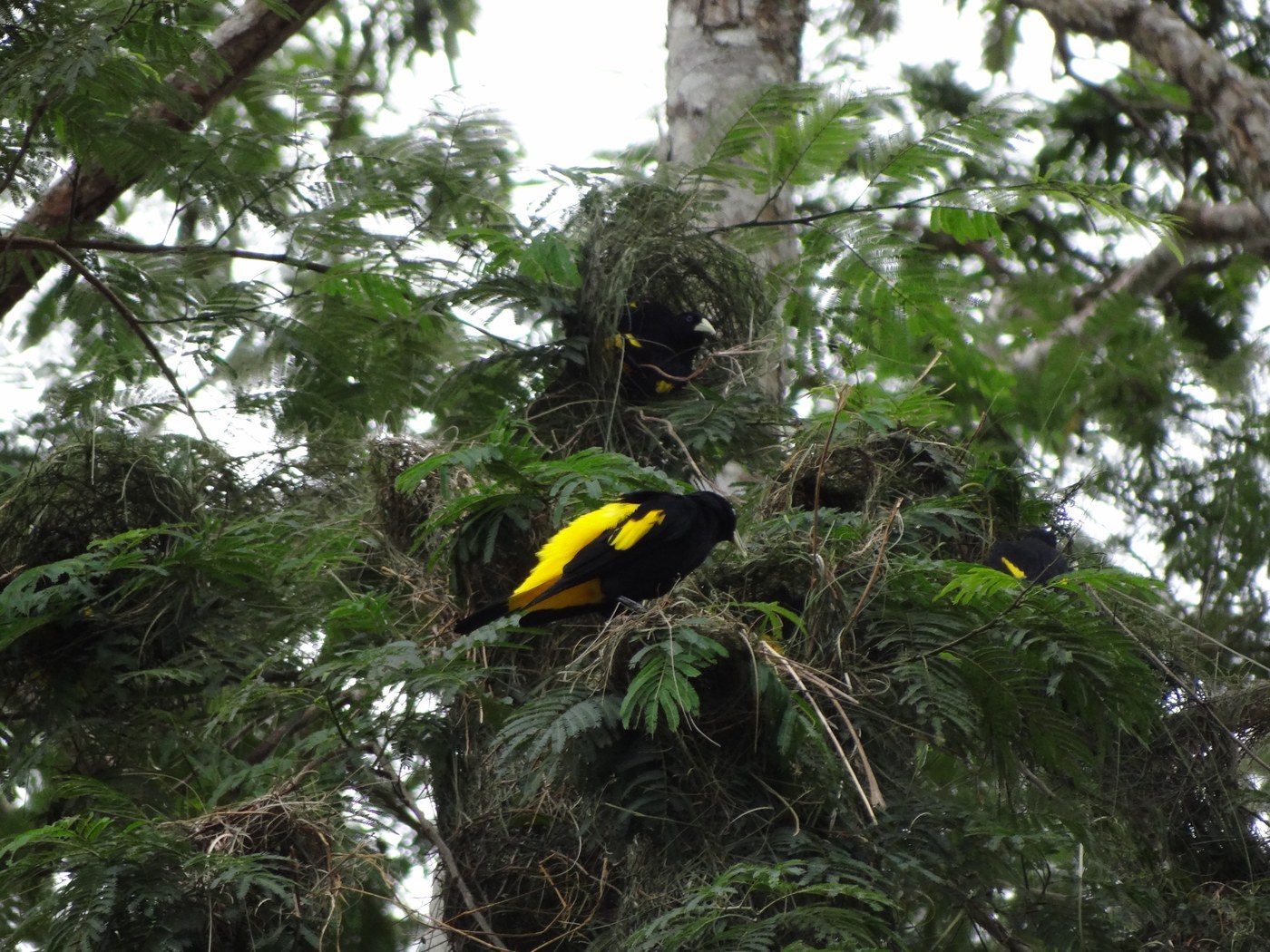
What Yellow-rumped Cacique's Feathers Look Like
The Yellow-rumped Cacique is a colonial South American songbird with a bold black-and-yellow pattern. Flight feathers measure 8-10.5 cm, mostly black, but the outer flight feathers show a bright yellow patch at the base, forming a visible yellow wing patch on the folded wing — a strong diagnostic. Body feathers on the head, back, throat, and breast are a deep glossy black, while the rump and undertail coverts are a vivid yellow, sharply contrasting with the black body — this yellow rump patch is the species' namesake feature and highly diagnostic when a bright yellow feather is found from the lower back area. The bill is pale, and the eye is a pale blue-white, though eye color does not appear in feathers themselves. Tail feathers are mostly black with yellow at the base of the outer feathers. All feathers are fairly firm-vaned with a moderate gloss typical of caciques and their oropendola relatives.
Step-by-Step: Is This Feather From a Yellow-rumped Cacique?
- Look for a bright yellow feather from the lower back/rump: this matches the species' signature yellow rump patch.
- Check flight feathers for a yellow base patch: yellow at the base of otherwise black primaries/secondaries, forming a wing patch, is diagnostic.
- Inspect tail feathers: black with yellow at the base of the outer feathers supports this identification.
- Assess gloss: black body feathers should show a moderate sheen typical of the cacique/oropendola family.
- Measure size: 8-10.5 cm flight feathers fit a mid-sized icterid around 20-23 cm long.
- Match habitat: lowland tropical forest edge and cultivated land in South America, especially near colonial nesting trees, supports this species.
Similar Species & How to Tell Them Apart
Yellow-hooded Blackbird and Yellow-headed Blackbird show yellow concentrated on the head rather than the rump, with the body otherwise black — checking whether the yellow is at the head or the rump quickly separates these species. Crested Oropendola and other oropendolas are much larger with a chestnut-and-black body and pale-tipped tail feathers rather than a solid black body with a yellow rump, differing substantially in both size and overall pattern. Russet-backed Oropendola shows an overall brown-toned body rather than glossy black, making body color alone a useful separator.
Where & When You'll Find Them
Yellow-rumped Caciques inhabit lowland tropical forest edges, clearings, and cultivated areas across much of northern and central South America, nesting colonially in hanging woven nests often over water or in isolated trees. Feathers are most likely found near these conspicuous colonial nest trees during the breeding season, when adults are active around nests and molt follows shortly after breeding; because breeding can be loosely timed to local wet-season patterns, feather finds cluster around these breeding colonies more reliably than around a strict calendar season.
Frequently asked questions
What is the most reliable feather clue for this species?
A bright yellow feather from the lower back or rump area, sharply set against otherwise black body plumage, is the strongest single diagnostic feature.
How do I tell this from Yellow-headed or Yellow-hooded Blackbird?
Those species carry their yellow on the head, while Yellow-rumped Cacique carries its yellow on the rump and wing base, with the head remaining solid black — checking the yellow's location settles it.
Why do I see yellow at the base of the flight feathers too?
The wing patch and rump patch are part of the same overall yellow marking pattern extending from the lower back through the base of the outer flight and tail feathers.
Are oropendolas a likely source of confusion?
They share colonial nesting habits and some overlap in habitat, but oropendolas are notably larger with chestnut-and-black or brown body tones rather than the glossy black-and-yellow pattern of this cacique.
Where should I look for these feathers?
Near conspicuous colonial nest trees in lowland forest edge and cultivated areas across northern and central South America, especially during and shortly after the local breeding season.