
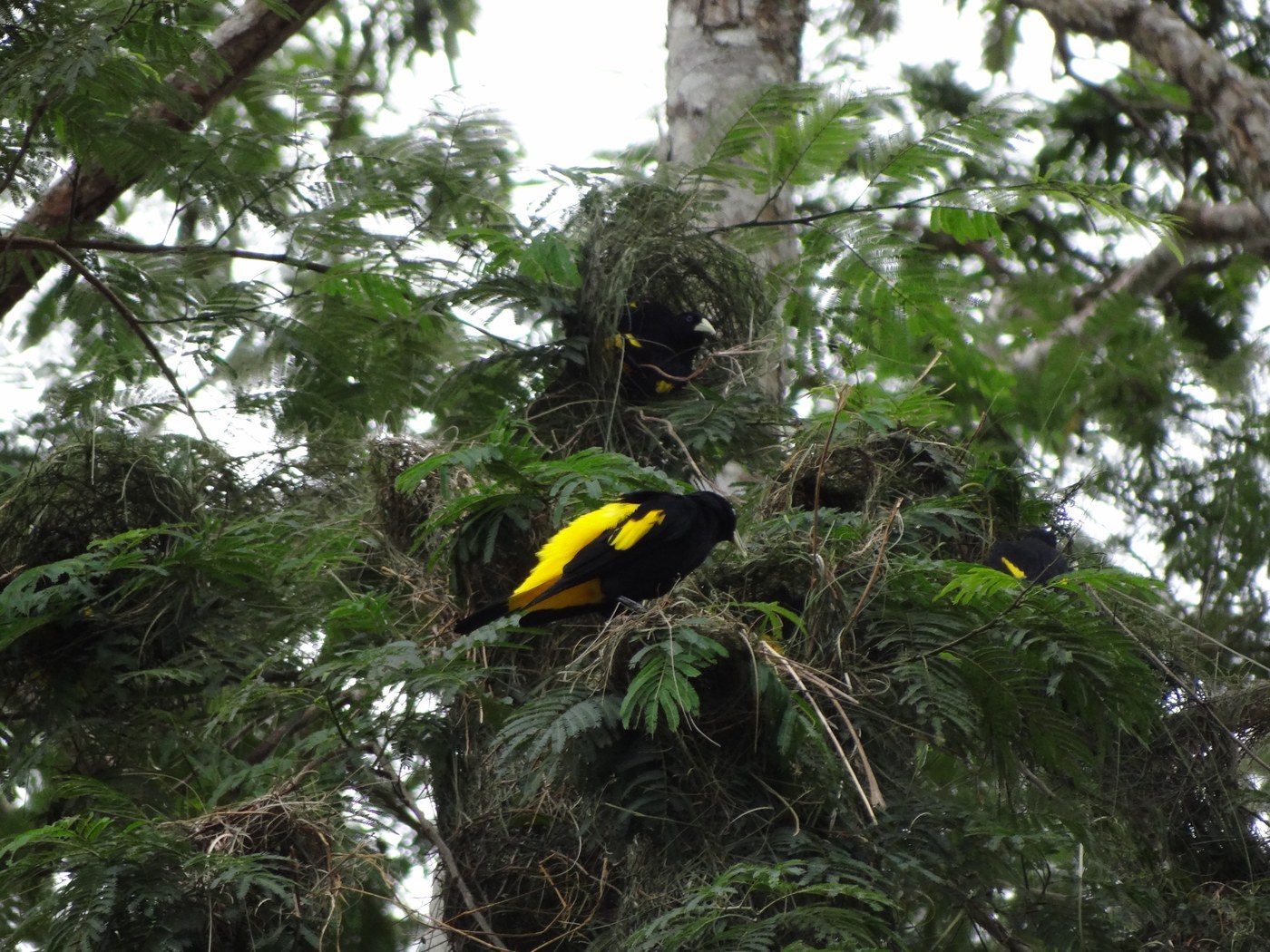
Yellow-rumped Cacique
Cacicus cela
A vocal, colonial songbird of South American lowland forests, marked by glossy black plumage set off by a bright yellow rump and wing patch, and pale, ice-blue eyes.
- Feather type
- Glossy black body feathers, bright yellow rump and wing patch
- Colours
- Black overall with bright yellow rump, wing patch, and outer tail base
- Bird size
- Medium-large, ~24-28 cm
Found a feather like this?
Identify any feather from a photo, free.
Overview
Overview
The Yellow-rumped Cacique is a highly social songbird of South American lowland forests, easily recognized by its glossy black body contrasted with a bright yellow rump, wing patch, and tail base. It nests in large, noisy colonies of long woven hanging nests and is known for its varied vocal repertoire, including mimicry of other species.
Identifying the Feather
Feather Identification
- Body feathers: Glossy black overall, including the head, throat, and back
- Rump feathers: Bright yellow, a key field mark visible in flight and at rest
- Wing feathers: Black with a bold yellow patch on the lesser coverts
- Tail feathers: Black with yellow at the base of the outer feathers
- Eye: Pale blue-white in adults
- Similar species: Distinguished from Yellow-winged Cacique by the additional yellow rump patch and lack of a prominent crest
Plumage & Molt
Plumage Details
Adults are glossy black overall with a bright yellow rump, a yellow patch on the wing coverts, and yellow at the base of the outer tail feathers. The eyes are pale blue-white, contrasting with the black facial feathering. Sexes are similar, though males are somewhat larger. Juveniles are duller with less defined yellow patches and darker eyes.
Habitat & Range
Habitat & Range
Yellow-rumped Caciques are found in lowland forests, forest edges, clearings, and cultivated areas across northern and central South America, including the Amazon Basin. The species is largely resident, though it may move locally in response to food availability and breeding colony sites.
Behavior & Field Notes
Behavior & Field Notes
Yellow-rumped Caciques are highly social, nesting in large colonies of long, woven hanging nests suspended from tree branches, often near wasp nests for protection. They forage for insects and fruit and are known for their loud, varied vocalizations, including whistles, gurgles, and mimicked sounds of other birds. Colonies can be quite noisy and conspicuous.
Frequently asked questions
How can I identify Yellow-rumped Cacique feathers?
Look for glossy black body feathers combined with a bright yellow rump, a yellow wing patch, and yellow at the base of the outer tail feathers.
What color are Yellow-rumped Cacique eyes?
Adults have pale blue-white eyes that stand out against their black facial feathers.
How does the Yellow-rumped Cacique differ from the Yellow-winged Cacique?
The Yellow-rumped Cacique has an additional bright yellow rump patch and lacks the shaggy crest of the Yellow-winged Cacique.
Do Yellow-rumped Caciques nest in colonies?
Yes, they are highly social and nest in large colonies of long, woven hanging nests, often near wasp nests for protection.
Yellow-rumped Cacique guides
In-depth guides for identifying and understanding Yellow-rumped Cacique.
Other feathers you may enjoy

Yellow-breasted Bunting
Contour and flight feathers, chestnut-and-yellow breeding pattern

Sedge Wren
Tiny streaked crown and back feathers

Yellow-winged Cacique
Glossy black body feathers, yellow wing patch, shaggy crest

Yellow Warbler
Small contour and flight feathers

Yellow-throated Warbler
Small contour and flight feathers

Yellow-throated Vireo
Bright yellow throat and spectacle feathers; olive-green back feathers; two white wing-bar feathers

Yellow-rumped Warbler
Small contour and flight feathers

Yellow-hooded Blackbird
Contrasting hood and body feathers

Yellow-headed Blackbird
Glossy black body plumage with a bright yellow head and breast

Yellow-eyed Junco
Contour and flight feathers

Yellow-fronted Canary
Small, smooth body plumage

Yellow-breasted Greenfinch
Compact, smooth body plumage