
How to Identify Yellow-throated Warbler Feathers
Learn to spot the gray back, black-and-white face pattern, bright yellow throat, and white-spotted tail feathers that mark a Yellow-throated Warbler, and how to separate it from vireos and other warblers with yellow throats.
Read the full Yellow-throated Warbler encyclopedia entry →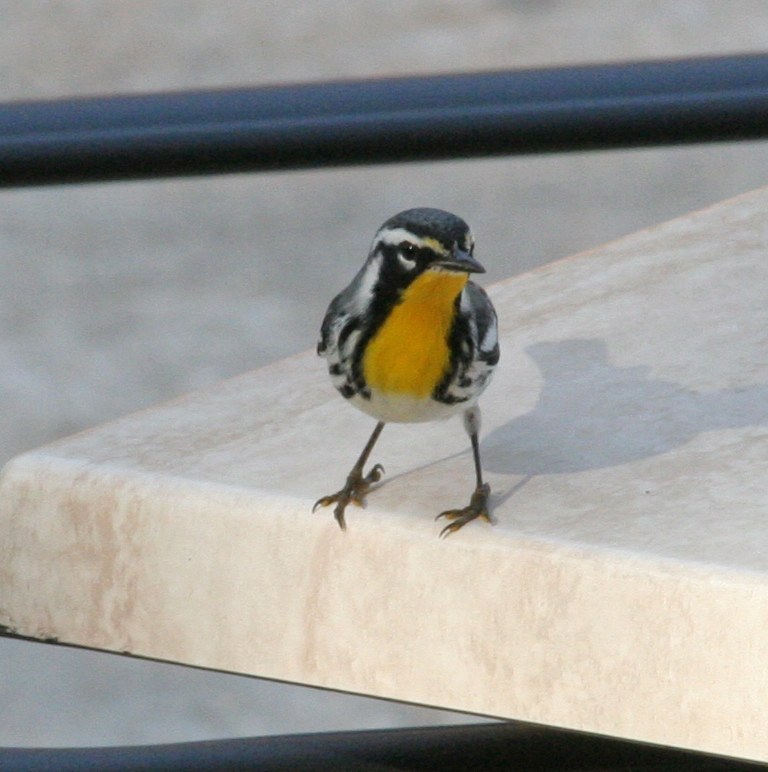
What Yellow-throated Warbler's Feathers Look Like
This is a slim, sharply patterned warbler, and its feathers show crisp contrasts rather than blended color. Back and crown contour feathers are clean blue-gray, entirely unstreaked. The throat and upper breast carry a bright, well-defined yellow patch, bordered by black-and-white facial feathering — a bold black stripe through the eye and a white patch on the side of the neck. The flanks show black streaking on white feathers. Flight feathers are blackish-gray with white edging on the tertials, producing two thin white wingbars. The most diagnostic single clue is the tail: outer tail feathers are dark gray-black with bold white spots or patches near the tips, visible as flashes when the tail fans open. Overall feather size is small, in keeping with a slender warbler body — primaries around 4-5 cm.
Step-by-Step: Is This Feather From a Yellow-throated Warbler?
- Check for white tail spots. A dark gray-black tail feather with a clean white spot near the tip is the single strongest diagnostic feature for this species.
- Look at the back color. Plain blue-gray, unstreaked back feathers rule out most streaky-backed warblers.
- Find the yellow. A bright, sharply bordered yellow patch (rather than yellow washing over the whole body) suggests the throat/breast region of this species.
- Look for black-and-white facial contrast. Feathers showing crisp black stripes against white, near a patch of yellow, fit the facial pattern of this species.
- Measure size. Small, slim contour and flight feathers (well under 5 cm) match a warbler rather than a vireo or larger songbird.
- Rule out barring. No barring should be present anywhere — streaking on the flanks is fine, but barred patterns point to a different family of bird.
Similar Species & How to Tell Them Apart
Yellow-throated Vireo feathers can cause confusion because both show a yellow throat, but the Vireo's back is olive-green rather than gray, its body is stockier, and it lacks the white tail spots entirely. Grace's Warbler, a western relative, has a similar gray back and yellow throat, but shows a yellow eyebrow stripe rather than the bold black-and-white face pattern, and their ranges don't naturally overlap. Black-throated Gray Warbler has a white — not yellow — throat, making it easy to rule out once throat color is visible. The combination of gray back, sharply bordered yellow throat patch, and white-spotted tail feathers is essentially unique to this species among common look-alikes.
Where & When You'll Find Them
Yellow-throated Warblers favor tall pines, cypress groves, and sycamores across the southeastern United States, foraging along trunks and large branches in a nuthatch-like manner. Some populations, especially in the Caribbean and coastal pine belts, are largely resident year-round, while most mainland breeders migrate to Florida, the Caribbean, and Central America for winter. Feathers are most commonly found beneath nesting pines and cypress trees during the breeding season (April-July), with a secondary period of feather loss during the post-breeding molt in late summer (August), just before migratory populations depart. Because this species forages by creeping along bark, small contour feathers can also turn up snagged in rough bark crevices near foraging territory.
Frequently asked questions
What is the single best clue for identifying this feather?
White spots or patches near the tip of a dark gray-black tail feather are the most reliable diagnostic mark for this species.
How do I tell it apart from a Yellow-throated Vireo feather?
Check the back color — this warbler's back is blue-gray, while the vireo's back is olive-green, and only the warbler shows white tail spots.
Does this species have streaking anywhere?
Yes, look for black streaking along the white flank feathers, but the back itself stays plain and unstreaked.
Are the feathers resident or migratory in origin?
Both — some Caribbean and coastal populations are year-round residents, while most inland breeders migrate, so timing and location both matter for context.
Why might I find feathers snagged in bark?
This warbler forages by creeping along trunks and large branches like a nuthatch, so small contour feathers sometimes catch in rough bark near its foraging routes.