

Yellow-throated Warbler
Setophaga dominica
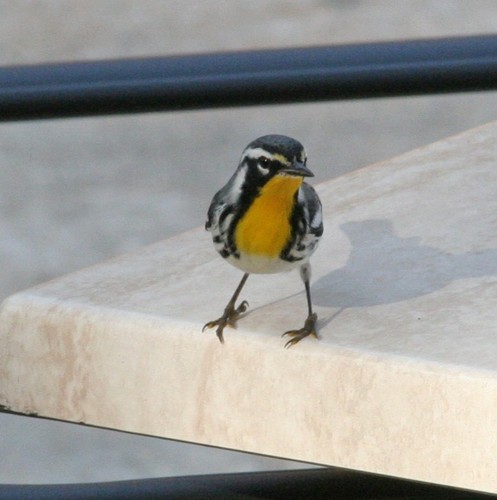
A gray-backed wood-warbler with a bright yellow throat and bold black-and-white facial pattern, often seen creeping along branches in pine and cypress woodland.
- Feather type
- Small contour and flight feathers
- Colours
- Gray upperparts, bright yellow throat and breast, black-and-white facial pattern, black-streaked flanks
- Bird size
- Small, ~13-14 cm
Found a feather like this?
Identify any feather from a photo, free.
Overview
The Yellow-throated Warbler is a wood-warbler of pine and bald cypress woodland and sycamore-lined waterways across the southeastern United States, with populations wintering in the Gulf Coast states, Mexico, and the Caribbean. It shows a striking combination of gray upperparts, a bright yellow throat and breast, and bold black-and-white facial markings, and is notable for its longer, slightly decurved bill.
Identifying the Feather
Upperpart feathers are plain gray, while the throat and upper breast are a vivid yellow, bordered by black facial markings including a black stripe through the eye and a black crescent below it, set off by white patches on the face and neck. The flanks are white with bold black streaking. Wings show two white wingbars. The bill is noticeably longer and slightly decurved compared to most warblers, an adaptation for probing bark crevices.
Plumage & Molt
Sexes are similar, though females may show slightly less crisp black facial markings than males. Immatures are duller, with reduced yellow on the throat and less defined facial pattern, brightening with maturity. A single complete molt occurs after the breeding season.
Habitat & Range
This species breeds in mature pine woodland, bald cypress swamps, and sycamore groves along waterways across the southeastern United States, with some populations extending along the Atlantic coast. It winters in the Gulf Coast states, Mexico, Central America, and the Caribbean.
Behavior & Field Notes
Yellow-throated Warblers forage by creeping along branches and probing bark crevices and clusters of pine needles or Spanish moss with their longer bill, a technique distinct from typical foliage-gleaning warblers. The male's song is a clear, descending series of whistled notes. Nests are often built in clumps of Spanish moss or high in pine trees. It is a relatively short-distance migrant compared to many wood-warblers.
Frequently asked questions
How do I identify a Yellow-throated Warbler feather?
Look for plain gray upperpart feathers combined with a vivid yellow throat feather and bold black-and-white facial markings.
What is distinctive about this warbler's bill?
It has a longer, slightly decurved bill compared to most warblers, adapted for probing bark crevices and needle clusters.
Where does the Yellow-throated Warbler live?
It breeds in pine woodland, cypress swamps, and sycamore groves across the southeastern United States.
How does it forage differently from other warblers?
It often creeps along branches and probes bark and moss clusters rather than gleaning primarily from open foliage.
Yellow-throated Warbler guides
In-depth guides for identifying and understanding Yellow-throated Warbler.
Other feathers you may enjoy

Yellow-breasted Bunting
Contour and flight feathers, chestnut-and-yellow breeding pattern

Sedge Wren
Tiny streaked crown and back feathers

Yellow-winged Cacique
Glossy black body feathers, yellow wing patch, shaggy crest

Yellow Warbler
Small contour and flight feathers

Yellow-throated Vireo
Bright yellow throat and spectacle feathers; olive-green back feathers; two white wing-bar feathers

Yellow-rumped Warbler
Small contour and flight feathers

Yellow-hooded Blackbird
Contrasting hood and body feathers

Yellow-headed Blackbird
Glossy black body plumage with a bright yellow head and breast

Yellow-eyed Junco
Contour and flight feathers

Yellow-fronted Canary
Small, smooth body plumage

Yellow-breasted Greenfinch
Compact, smooth body plumage

Yellow-breasted Chat
Large, plain contour feathers; long rounded tail feathers; thick-based bill-adjacent feathers