
How to Identify Zone-tailed Hawk Feathers
A guide to the black plumage and boldly banded tail feathers that identify Zone-tailed Hawk, a raptor that mimics Turkey Vulture in flight, with tips for telling their feathers apart.
Read the full Zone-tailed Hawk encyclopedia entry →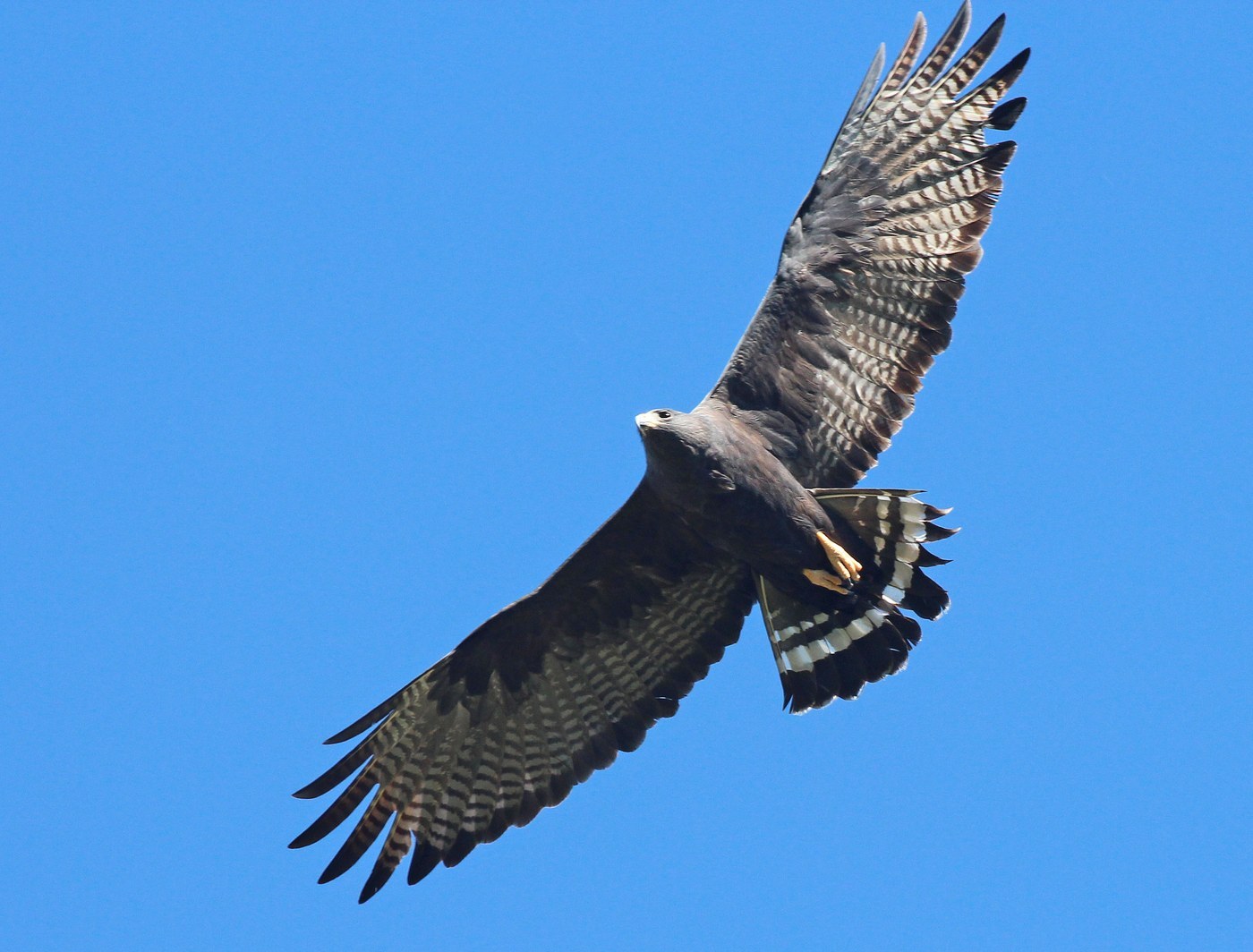
What Zone-tailed Hawk's Feathers Look Like
Zone-tailed Hawk is a mid-sized raptor whose plumage and flight style closely mimic Turkey Vulture, but its feathers carry a key giveaway. Body and covert contour feathers are overall sooty blackish-brown, notably darker and more uniform than most buteos. Flight feathers (primaries and secondaries) are blackish above, with faint pale gray barring visible on the underside. The standout feature, and the source of the species' name, is the tail: tail feathers are blackish crossed by two or three bold pale gray-white bands, creating a distinctly "zoned" banded pattern unlike the tail of most other dark raptors. Feathers are notably large, reflecting this bird's size as a raptor rather than a songbird — primaries can run 30 cm or more, and tail feathers 20-25 cm.
Step-by-Step: Is This Feather From a Zone-tailed Hawk?
- Check the tail banding. Two or three bold pale gray-white bands crossing an otherwise blackish tail feather is the single strongest diagnostic sign for this species.
- Assess overall body color. Sooty blackish-brown contour feathers, darker than typical rufous or mottled buteos, fit this species.
- Look at flight feather undersides. Faint pale gray barring on the underside of primaries/secondaries is consistent with this species.
- Measure size. Large flight and tail feathers (many centimeters long) confirm a raptor rather than a smaller bird of prey.
- Rule out uniform gray-brown. A feather that's uniformly gray-brown without bold black-and-white tail banding suggests Turkey Vulture instead.
- Consider habitat. A find near canyon cliffs, riparian corridors, or arid mountains in the southwestern US, Mexico, or Central/South America supports this identification.
Similar Species & How to Tell Them Apart
Turkey Vulture is the closest visual match, since Zone-tailed Hawk has evolved to resemble it in flight silhouette and coloring, letting it approach prey unnoticed; however, Turkey Vulture's flight feathers are more uniformly silvery-gray on the underside without the bold, discrete black-and-white tail banding that Zone-tailed Hawk shows — a fanned Turkey Vulture tail feather looks plain dark gray-brown, not banded. Common Black Hawk also has dark plumage, but its tail shows a single broad white band rather than multiple narrower zones, making band count and spacing a useful distinguishing feature. Dark-morph Red-tailed Hawk can appear superficially similar in overall darkness, but its tail feathers are rufous-red (sometimes with dark subterminal banding), never the pale gray-white zoned pattern of this species.
Where & When You'll Find Them
Zone-tailed Hawks favor canyons, riparian woodlands, and arid mountain ranges across the southwestern United States, Mexico, and Central and South America, often nesting on cliff ledges or in tall trees near canyon rims. Northern populations are migratory, departing U.S. breeding areas in fall and returning in spring, while more southerly populations tend to be resident. Molt occurs gradually, largely during the breeding season and continuing on the wintering grounds, rather than in one concentrated burst. Feathers are most often found near nesting cliffs and canyon rims, and along known migration corridors during spring and fall movements, since this species spends much of its time soaring over open terrain in search of prey.
Frequently asked questions
What is the single best clue to confirm this feather?
Two or three bold pale gray-white bands crossing an otherwise blackish tail feather is the most reliable diagnostic sign for Zone-tailed Hawk.
How do I tell this apart from a Turkey Vulture feather?
Turkey Vulture's flight feathers look more uniformly silvery-gray underneath without the bold, distinct black-and-white tail banding that Zone-tailed Hawk shows.
Could this be a dark-morph Red-tailed Hawk feather instead?
Check the tail color — dark-morph Red-tailed Hawk shows rufous-red tail feathers, not the pale gray-white banded pattern of Zone-tailed Hawk.
What about Common Black Hawk?
Common Black Hawk shows a single broad white tail band rather than the two or three narrower bands seen on Zone-tailed Hawk.
Where are feathers most likely to be found?
Near nesting cliffs and canyon rims, and along migration corridors in spring and fall, since this species forages over open terrain near those features.