
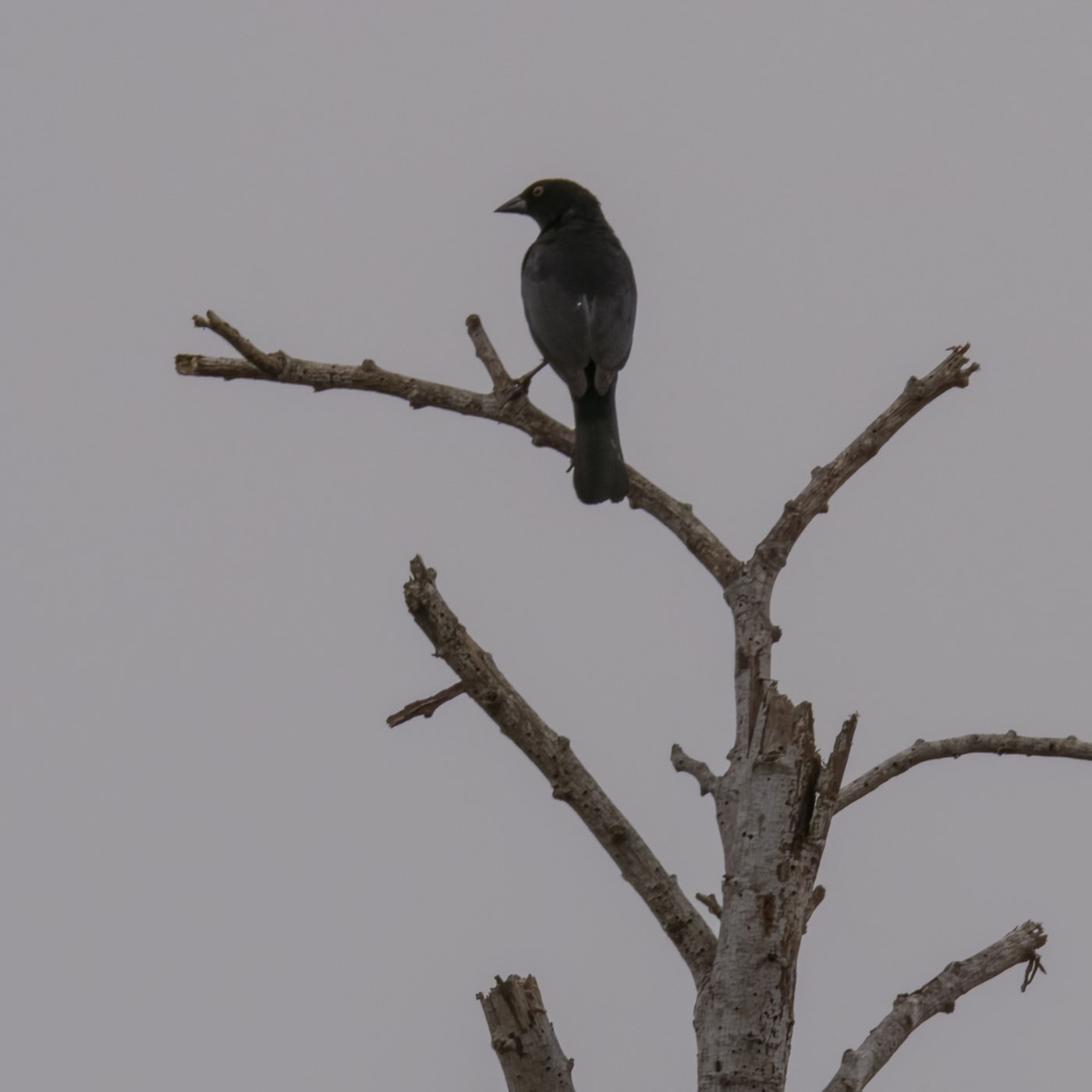
Bronzed Cowbird
Molothrus aeneus
A stocky blackbird relative with a bronze-black sheen, red eyes, and a distinctive neck ruff, found from the southwestern United States south to Panama.
- Feather type
- Glossy body feathers, blue-black flight feathers
- Colours
- Bronze-black body with blue-black wings and tail
- Bird size
- Cowbird-sized, ~19-22 cm
Found a feather like this?
Identify any feather from a photo, free.
Overview
Overview
The Bronzed Cowbird is a medium-sized icterid recognized by its glossy bronze-black body plumage contrasting with darker blue-black wings and tail. Males display a puffed neck ruff during courtship displays, giving the species a hunch-backed silhouette. Like other cowbirds, it is a brood parasite, laying its eggs in the nests of other songbirds.
Identifying the Feather
Feather Identification
- Body feathers: Bronze-black with a metallic sheen, distinct from the bluer wings and tail
- Wing and tail feathers: Deep blue-black gloss, contrasting subtly with the body
- Eye: Bright red in adults (a key field mark, though not feather-based)
- Size: Slightly larger and stockier than Brown-headed Cowbird
- Similar species: Shiny Cowbird lacks the bronze cast and shows uniform purplish-blue gloss; Brown-headed Cowbird males have a contrasting brown head rather than bronze body
Plumage & Molt
Plumage Details
Adult males show glossy bronze-black body plumage with contrasting blue-black wings and tail, and a ruff of elongated neck feathers that can be raised during display. Females are smaller and duller, showing a dark grayish-brown plumage with less gloss and no obvious ruff. Juveniles resemble females. Molt occurs after the breeding season, with adults acquiring fresh glossy feathering by fall.
Habitat & Range
Habitat & Range
Bronzed Cowbirds range from the southwestern United States (Arizona, Texas) south through Mexico and Central America to Panama. They favor open woodlands, farmland, scrubby edges, and areas near livestock, often following grazing animals to feed on flushed insects. Northern populations may withdraw southward in winter, while southern populations are largely resident.
Behavior & Field Notes
Behavior & Field Notes
Bronzed Cowbirds forage on the ground, often near livestock, eating insects and seeds. As obligate brood parasites, females lay eggs in the nests of other songbirds, particularly orioles and tanagers, leaving the host species to raise their young. Males perform ruffed courtship displays with fluffed neck feathers and a brief hovering flight. Their calls include harsh chattering notes and squeaky gurgling songs.
Frequently asked questions
What makes Bronzed Cowbird feathers distinctive?
The body feathers show a warm bronze-black sheen that contrasts with the cooler blue-black gloss of the wings and tail, a combination not seen in most other cowbirds.
How do Bronzed Cowbirds differ from Brown-headed Cowbirds?
Bronzed Cowbird males lack the contrasting brown head of the Brown-headed Cowbird, instead showing a uniformly bronze-black body, and they have red eyes and a neck ruff.
Do Bronzed Cowbirds build their own nests?
No, they are brood parasites that lay eggs in the nests of other songbird species rather than building and tending their own nests.
Where do Bronzed Cowbirds live?
They range from the southwestern United States through Mexico and Central America to Panama, favoring open country and farmland.
Bronzed Cowbird guides
In-depth guides for identifying and understanding Bronzed Cowbird.
Other feathers you may enjoy

Yellow-breasted Bunting
Contour and flight feathers, chestnut-and-yellow breeding pattern

Sedge Wren
Tiny streaked crown and back feathers

Yellow-winged Cacique
Glossy black body feathers, yellow wing patch, shaggy crest

Yellow Warbler
Small contour and flight feathers

Yellow-throated Warbler
Small contour and flight feathers

Yellow-throated Vireo
Bright yellow throat and spectacle feathers; olive-green back feathers; two white wing-bar feathers

Yellow-rumped Warbler
Small contour and flight feathers

Yellow-hooded Blackbird
Contrasting hood and body feathers

Yellow-headed Blackbird
Glossy black body plumage with a bright yellow head and breast

Yellow-eyed Junco
Contour and flight feathers

Yellow-fronted Canary
Small, smooth body plumage

Yellow-breasted Greenfinch
Compact, smooth body plumage