
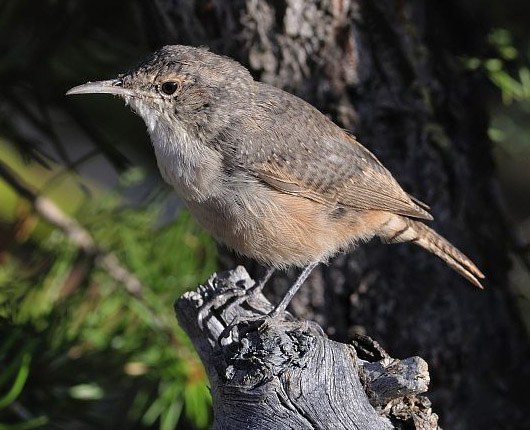
Canyon Wren
Catherpes mexicanus
A rufous-brown, cliff-dwelling wren with a striking bright white throat, best known for its cascading, silvery song that echoes through canyons.
- Feather type
- Soft body feathers with a bright white throat and rufous body
- Colours
- Rich rufous-brown body with a bright white throat and breast, finely barred belly
- Bird size
- Small, ~11-15 cm
Found a feather like this?
Identify any feather from a photo, free.
Overview
The Canyon Wren is closely tied to steep rocky terrain, particularly canyon walls and cliff faces, across the western United States and Mexico. Its bright white throat contrasting with a rich rufous body, combined with its flattened head shape suited for probing rock crevices, make it a distinctive resident of arid canyon country, though it is often best known by its cascading, ringing song.
Identifying the Feather
- Throat and upper breast feathers: Bright white, sharply contrasting with the darker body—an immediately recognizable feature.
- Body feathers: Rich rufous-brown overall, deepening toward the rear of the body and tail.
- Belly feathers: Finely barred with dark markings toward the lower underparts.
- Head: Notably flattened in shape, an adaptation for probing into narrow rock crevices.
- Compared to similar species: The bright white throat set against a deep rufous body separates it clearly from the paler, speckled Rock Wren, which lacks this sharp two-toned contrast.
Plumage & Molt
Sexes look alike, both showing a bright white throat and upper breast, rich rufous-brown body plumage, and fine dark barring on the lower belly. Juveniles are similarly patterned but slightly duller until their first molt. A single complete molt after breeding renews the plumage, with little seasonal variation in overall appearance.
Habitat & Range
Canyon Wrens inhabit steep, rocky canyon walls, cliffs, and boulder-strewn terrain across the western United States and Mexico, often in arid or semi-arid landscapes. They are largely resident throughout their range, closely tied to vertical rock habitat and rarely found far from cliffs or large rock outcrops.
Behavior & Field Notes
This wren forages by probing into narrow rock crevices with its slightly downcurved bill, taking invertebrates from deep within cracks that other birds cannot access, aided by its flattened skull shape. Its song is a distinctive, cascading series of clear, silvery notes that descend in pitch, often echoing dramatically off canyon walls and considered one of the most recognizable sounds of the arid West. Nests are tucked into rock crevices or cavities on cliff faces. Its specialized rock-crevice foraging and striking song make it one of the more distinctive small birds of canyon country.
Frequently asked questions
What is the key feature for identifying a Canyon Wren?
Look for a bright white throat and breast sharply contrasting against a rich rufous-brown body.
How does it differ from the Rock Wren?
The Canyon Wren shows a sharply contrasting white throat and deeper rufous body tones, while the Rock Wren is paler and finely speckled without this strong two-toned pattern.
What habitat does the Canyon Wren require?
It is closely tied to steep canyon walls, cliffs, and rocky terrain, rarely straying far from vertical rock features.
What is distinctive about its song?
Its song is a cascading series of clear, silvery notes descending in pitch, often echoing memorably off canyon walls.
Canyon Wren guides
In-depth guides for identifying and understanding Canyon Wren.
Other feathers you may enjoy

Yellow-breasted Bunting
Contour and flight feathers, chestnut-and-yellow breeding pattern

Sedge Wren
Tiny streaked crown and back feathers

Yellow-winged Cacique
Glossy black body feathers, yellow wing patch, shaggy crest

Yellow Warbler
Small contour and flight feathers

Yellow-throated Warbler
Small contour and flight feathers

Yellow-throated Vireo
Bright yellow throat and spectacle feathers; olive-green back feathers; two white wing-bar feathers

Yellow-rumped Warbler
Small contour and flight feathers

Yellow-hooded Blackbird
Contrasting hood and body feathers

Yellow-headed Blackbird
Glossy black body plumage with a bright yellow head and breast

Yellow-eyed Junco
Contour and flight feathers

Yellow-fronted Canary
Small, smooth body plumage

Yellow-breasted Greenfinch
Compact, smooth body plumage