
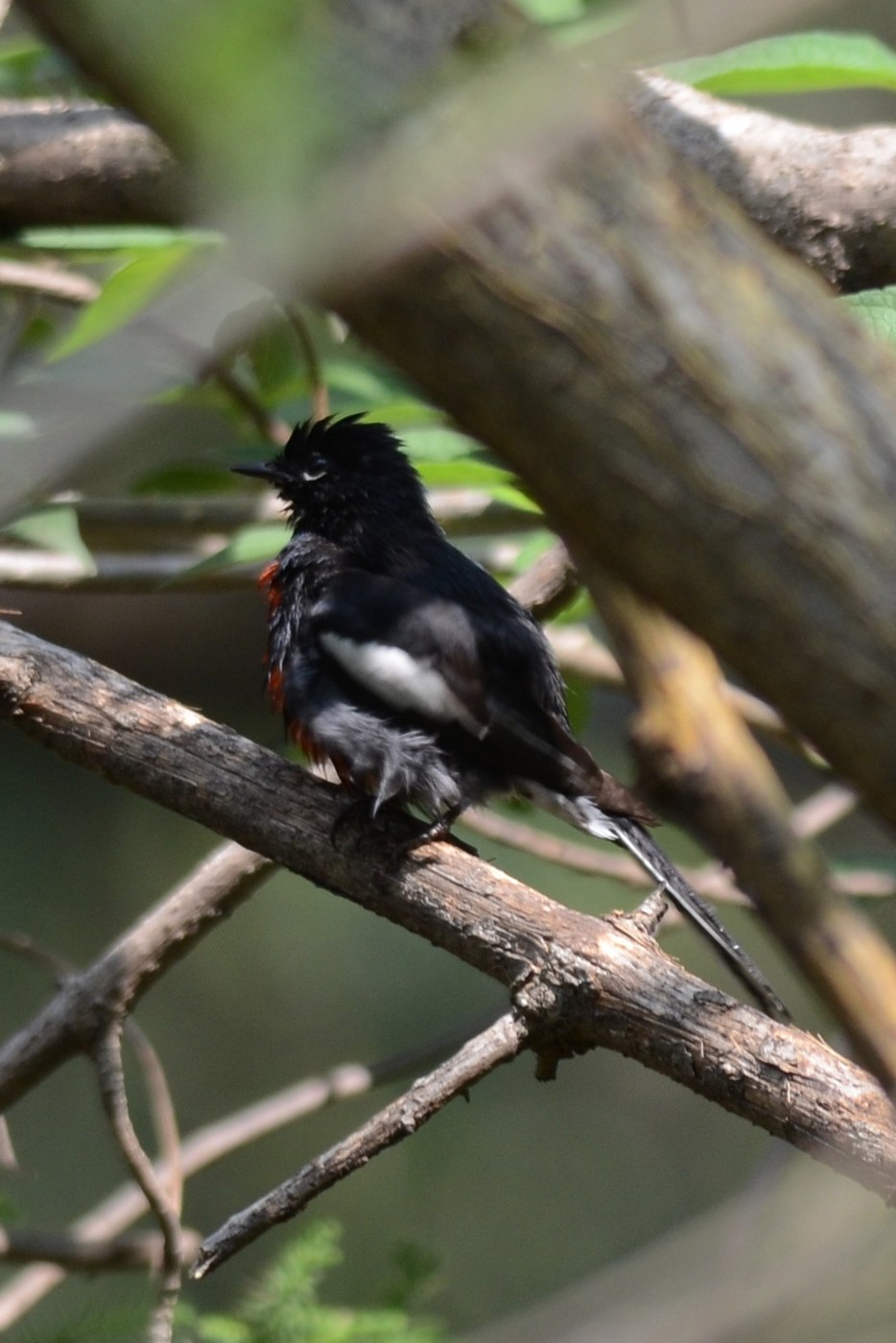
Painted Redstart
Myioborus pictus
A boldly patterned black warbler with a bright red breast patch and large white patches on the wings and outer tail, constantly fanning its tail while foraging.
- Feather type
- Small, glossy black contour feathers; bold white wing and tail patches
- Colours
- Glossy black, bright red breast patch, bold white wing patch and tail edges
- Bird size
- Sparrow-sized, ~13 cm
Found a feather like this?
Identify any feather from a photo, free.
Overview
Overview
The Painted Redstart is a striking, boldly patterned warbler of montane oak and pine-oak canyons in the southwestern United States and Mexico. Its combination of glossy black plumage, a bright red breast patch, and large white patches on the wings and tail make it one of the most easily identified warblers within its range, and its habit of constantly fanning and flashing its tail while foraging adds to its distinctive presence.
This species is often found foraging on tree trunks and branches in a manner recalling a small nuthatch or treecreeper, frequently flashing its white tail and wing patches, which is thought to help flush insects.
Identifying the Feather
Feather Identification
- Overall color: Body feathers are largely glossy black, including the head, back, and much of the wings and tail, providing strong contrast with the white and red markings.
- Breast patch: A bright red patch of feathers covers the center of the breast, sharply set off against the black surrounding plumage.
- Wing patch: A large white patch formed by white bases to the flight feathers is very conspicuous on the folded wing.
- Tail: Outer tail feathers show extensive white, especially visible when the tail is fanned, which this species does frequently while foraging.
- Underparts: Belly and undertail covert feathers are white, contrasting with the black breast sides and the central red patch.
- Size and shape: A fairly long tail relative to body size supports its frequent tail-fanning display, and feathers overall show a notably glossy sheen compared to duller-plumaged warblers.
Plumage & Molt
Plumage Details
Adults of both sexes are similarly patterned, with glossy black upperparts and breast sides, a bright red central breast patch, and bold white wing and tail patches; there is little sexual dimorphism in this species compared to many warblers. Immatures show a duller, sootier black and a reduced or paler, sometimes pinkish rather than red, breast patch, with the white wing and tail patches present but sometimes less extensive.
A complete molt occurs after breeding, and plumage remains fairly stable through the year given the largely resident or short-distance migratory nature of many populations, with young birds acquiring full adult coloration within their first year or so.
Habitat & Range
Habitat & Range
Painted Redstarts inhabit montane oak and pine-oak woodlands, particularly in shaded canyons with a mix of large trees, across the mountain ranges of the southwestern United States, including southeastern Arizona and southwestern New Mexico, extending south through the highlands of Mexico and into parts of Central America.
Many populations are resident or undertake only short elevational movements, though some northern populations may withdraw somewhat southward in winter. The species favors canyon woodlands with reliable water and mature trees for foraging and nesting.
Behavior & Field Notes
Behavior & Field Notes
This warbler forages actively on trunks, branches, and foliage, frequently fanning its tail and drooping its wings to flash the bold white patches, a behavior thought to startle and flush insects from cover, which are then caught by gleaning or short sallying flights.
The nest is typically built on the ground or in a sheltered niche such as a bank, root mass, or rock crevice within its canyon woodland habitat. The song is a clear, warbling series of notes, and the species is often quite vocal and conspicuous, in contrast to many of the skulking warblers described elsewhere. Its bold pattern and confiding, active foraging behavior make it a popular species among birders visiting southwestern canyon habitats.
Frequently asked questions
What is the most eye-catching feather feature of a Painted Redstart?
The combination of glossy black plumage with a bright red breast patch and bold white wing and tail patches, unlike any other warbler in its range.
Why does this species fan its tail so often?
Tail-fanning flashes the white outer tail feathers, which is thought to help flush hidden insects from foliage and bark crevices while foraging.
Do males and females look different?
They are quite similar in plumage, showing little of the sexual dimorphism seen in many other warbler species.
What type of forest does the Painted Redstart prefer?
Montane oak and pine-oak canyon woodlands, especially shaded canyons with mature trees and reliable water sources.
Painted Redstart guides
In-depth guides for identifying and understanding Painted Redstart.
Other feathers you may enjoy

Yellow-breasted Bunting
Contour and flight feathers, chestnut-and-yellow breeding pattern

Sedge Wren
Tiny streaked crown and back feathers

Yellow-winged Cacique
Glossy black body feathers, yellow wing patch, shaggy crest

Yellow Warbler
Small contour and flight feathers

Yellow-throated Warbler
Small contour and flight feathers

Yellow-throated Vireo
Bright yellow throat and spectacle feathers; olive-green back feathers; two white wing-bar feathers

Yellow-rumped Warbler
Small contour and flight feathers

Yellow-hooded Blackbird
Contrasting hood and body feathers

Yellow-headed Blackbird
Glossy black body plumage with a bright yellow head and breast

Yellow-eyed Junco
Contour and flight feathers

Yellow-fronted Canary
Small, smooth body plumage

Yellow-breasted Greenfinch
Compact, smooth body plumage