
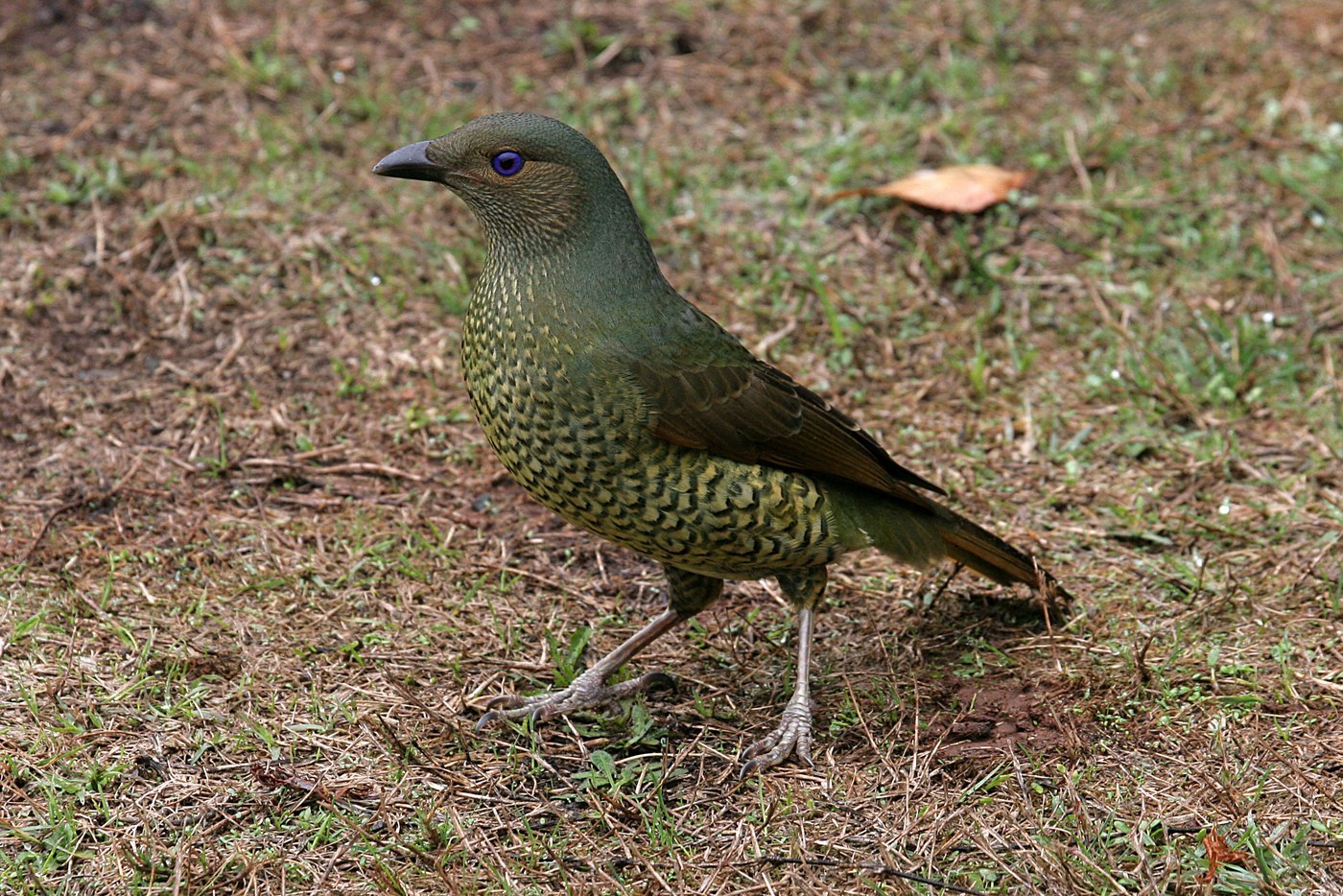
Satin Bowerbird
Ptilonorhynchus violaceus
The Satin Bowerbird is famous for the male's glossy blue-black plumage and violet eyes, and for its habit of building and decorating an elaborate bower with blue objects to attract mates.
- Feather type
- Dense, glossy contour feathers in males; looser scalloped feathers in females and immatures
- Colours
- Glossy blue-black in adult males; olive-green with dark scalloping in females
- Bird size
- Medium-large, ~30 cm
Found a feather like this?
Identify any feather from a photo, free.
Overview
Overview
The Satin Bowerbird is renowned for the male's remarkable courtship behaviour: constructing an avenue-shaped bower of sticks decorated with blue and other brightly coloured objects, used purely for display rather than nesting. It takes several years for males to acquire their glossy adult plumage.
- Family: Ptilonorhynchidae (bowerbirds)
- Distribution: eastern Australia, in two disjunct regions
- Notable trait: male's bower-building and object-collecting display behaviour
Identifying the Feather
Feather Identification
Adult males are glossy blue-black overall, the plumage showing an iridescent satin-like sheen in good light, with pale bluish-white eyes. Females and immature males (which can take several years to mature) are olive-green above with dark crescent-shaped scalloping on the underparts, quite different from the adult male's solid dark plumage.
- Overall pattern: solid glossy blue-black (adult male) versus scalloped olive-green (female/immature)
- Key mark: pale violet-blue eye in males
- Compare with: immature males can resemble females for several years before moulting into full glossy black adult plumage
Plumage & Molt
Plumage
Adult males show glossy blue-black plumage, reached only after several years of delayed plumage maturation, during which young males resemble females. Females are olive-green with dark scalloped underparts throughout their lives. This slow maturation is unusual and means many apparently 'female-plumaged' birds seen at bowers are actually young males.
Habitat & Range
Habitat & Range
Satin Bowerbirds inhabit rainforest, wet eucalypt forest, and adjacent cleared or garden habitat along parts of the eastern Australian coast and ranges, in two separated regional populations. They are largely sedentary, though some seasonal altitudinal movement occurs.
Behavior & Field Notes
Behavior & Field Notes
Males build a distinctive avenue-shaped bower of two parallel walls of sticks and decorate the display area with blue objects, using this structure solely to attract and court females rather than for nesting. Diet includes fruit, leaves, and insects. Calls include a mix of harsh chattering, whistles, and mimicry of other species. Nests are built by the female alone in tree foliage away from the bower.
- Diet: fruit, leaves, and insects
- Voice: harsh chattering, whistles, and mimicked sounds
- Field note: males famously favour blue objects to decorate their bowers, from feathers to man-made items
Frequently asked questions
Why do male Satin Bowerbirds collect blue objects?
They decorate their display bower with blue and other bright objects to attract females, a behaviour distinct from nest-building.
How can I tell an adult male from a female?
Adult males are solid glossy blue-black with pale eyes, while females are olive-green with dark scalloped underparts.
Do young males look like adult males?
No, immature males resemble females for several years before gradually moulting into full glossy black adult plumage.
Does the bower serve as a nest?
No, the bower is used purely for courtship display; the female builds a separate nest elsewhere to raise young.
Satin Bowerbird guides
In-depth guides for identifying and understanding Satin Bowerbird.
Other feathers you may enjoy

Yellow-breasted Bunting
Contour and flight feathers, chestnut-and-yellow breeding pattern

Sedge Wren
Tiny streaked crown and back feathers

Yellow-winged Cacique
Glossy black body feathers, yellow wing patch, shaggy crest

Yellow Warbler
Small contour and flight feathers

Yellow-throated Warbler
Small contour and flight feathers

Yellow-throated Vireo
Bright yellow throat and spectacle feathers; olive-green back feathers; two white wing-bar feathers

Yellow-rumped Warbler
Small contour and flight feathers

Yellow-hooded Blackbird
Contrasting hood and body feathers

Yellow-headed Blackbird
Glossy black body plumage with a bright yellow head and breast

Yellow-eyed Junco
Contour and flight feathers

Yellow-fronted Canary
Small, smooth body plumage

Yellow-breasted Greenfinch
Compact, smooth body plumage