
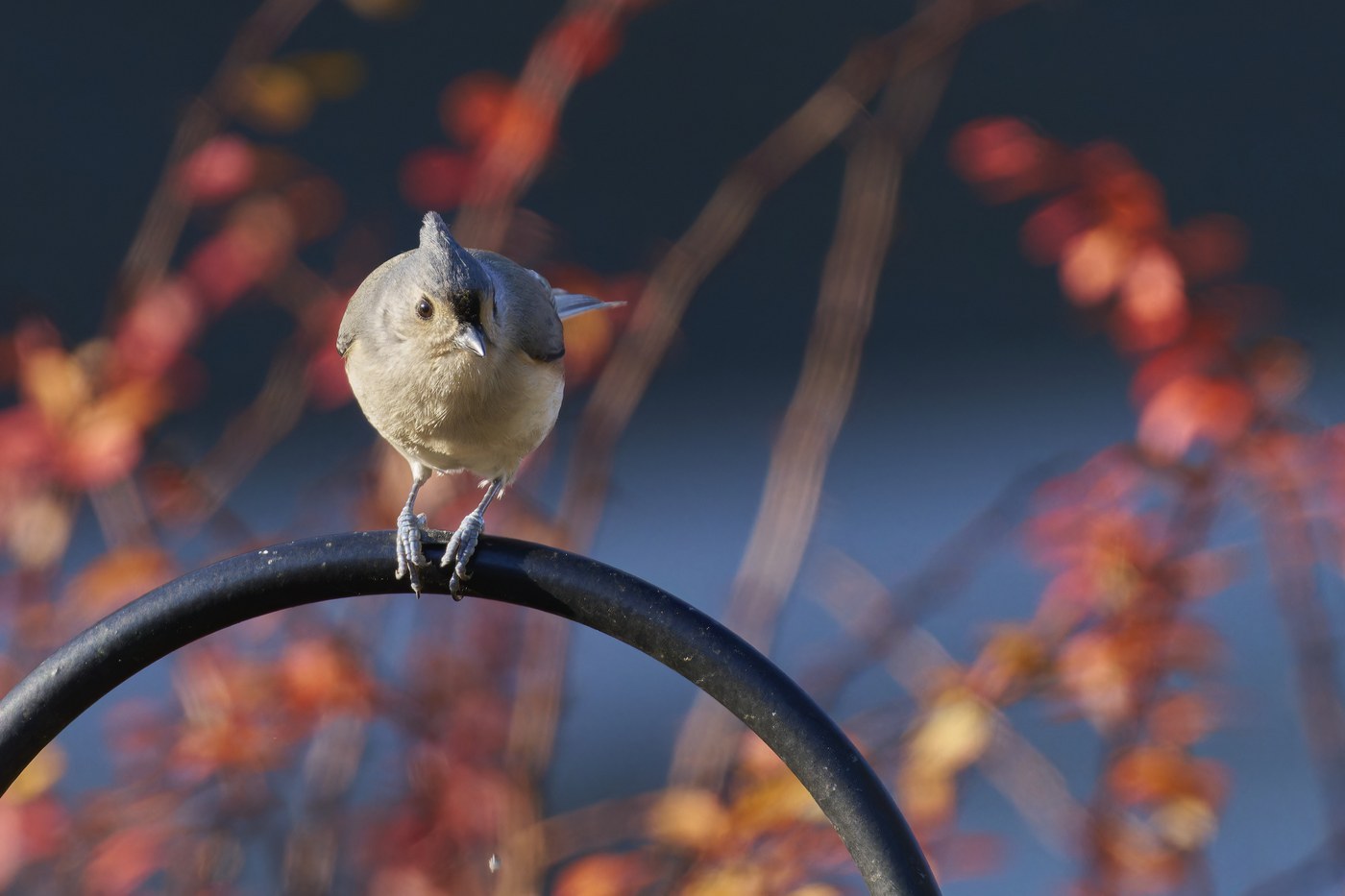
Tufted Titmouse
Baeolophus bicolor
The Tufted Titmouse is a common eastern woodland bird known for its jaunty gray crest feathers and soft, plain-gray body feathers washed with rust along the flanks.
- Feather type
- Distinctive pointed crest feathers; soft gray body feathers; rust-washed flank feathers
- Colours
- Uniform soft gray above, white below, with rusty-orange flanks and a black forehead patch
- Bird size
- Sparrow-to-robin sized, ~15-16 cm
Found a feather like this?
Identify any feather from a photo, free.
Overview
Overview
The Tufted Titmouse is a common eastern woodland and backyard bird best known for its jaunty gray crest. Its feathers are soft and mostly plain gray, but a rusty wash along the flanks and a small black patch above the bill give useful identification clues.
This species is closely related to chickadees but lacks their black cap, instead relying on its crest and overall soft gray tone to stand out among feeder birds.
Identifying the Feather
Recognizing the Feathers
- Crest feathers: long, pointed, soft gray, easily recognizable when found intact
- Back & wing feathers: plain soft gray, unbarred
- Flank feathers: washed with a distinctive peachy-rust color
- Forehead feathers: small black patch just above the bill base
The pointed crest feather is the most diagnostic find; combined with rusty flank feathers and plain gray back feathers (no black cap, no barring), it separates this species from chickadees and nuthatches.
Plumage & Molt
Plumage
Sexes look alike: soft gray above, whitish below, with rust-colored flanks and a small black patch on the forehead. Juveniles are similar but with a less defined forehead patch. One complete molt occurs in late summer.
Habitat & Range
Habitat & Range
Tufted Titmice are year-round residents of deciduous and mixed forests, parks, and suburban yards throughout the eastern United States, with a range that has expanded northward over recent decades. They do not migrate.
Behavior & Field Notes
Behavior & Field Notes
Titmice forage actively for insects, seeds and berries, often hanging from twig tips, and are frequent visitors to feeders for sunflower seeds, which they carry off to hammer open. They nest in tree cavities or nest boxes, often lining nests with fur plucked from live animals, and give a loud, whistled song. A gray, pointed crest feather with a rusty flank feather nearby is a good sign of this species.
Frequently asked questions
What is the most recognizable feather of a Tufted Titmouse?
Its pointed gray crest feather, unique in shape among common backyard birds.
Does the Tufted Titmouse have any barring on its feathers?
No, its feathers are plain, unbarred gray with rusty flanks.
How can I tell it from a chickadee feather?
Titmice lack a black cap; instead look for the crest shape and rusty-flank coloring.
Do juveniles look different from adults?
Only subtly - a less distinct black forehead patch.
Tufted Titmouse guides
In-depth guides for identifying and understanding Tufted Titmouse.
Other feathers you may enjoy

Yellow-breasted Bunting
Contour and flight feathers, chestnut-and-yellow breeding pattern

Sedge Wren
Tiny streaked crown and back feathers

Yellow-winged Cacique
Glossy black body feathers, yellow wing patch, shaggy crest

Yellow Warbler
Small contour and flight feathers

Yellow-throated Warbler
Small contour and flight feathers

Yellow-throated Vireo
Bright yellow throat and spectacle feathers; olive-green back feathers; two white wing-bar feathers

Yellow-rumped Warbler
Small contour and flight feathers

Yellow-hooded Blackbird
Contrasting hood and body feathers

Yellow-headed Blackbird
Glossy black body plumage with a bright yellow head and breast

Yellow-eyed Junco
Contour and flight feathers

Yellow-fronted Canary
Small, smooth body plumage

Yellow-breasted Greenfinch
Compact, smooth body plumage