
Eurasian Treecreeper
Certhia familiaris
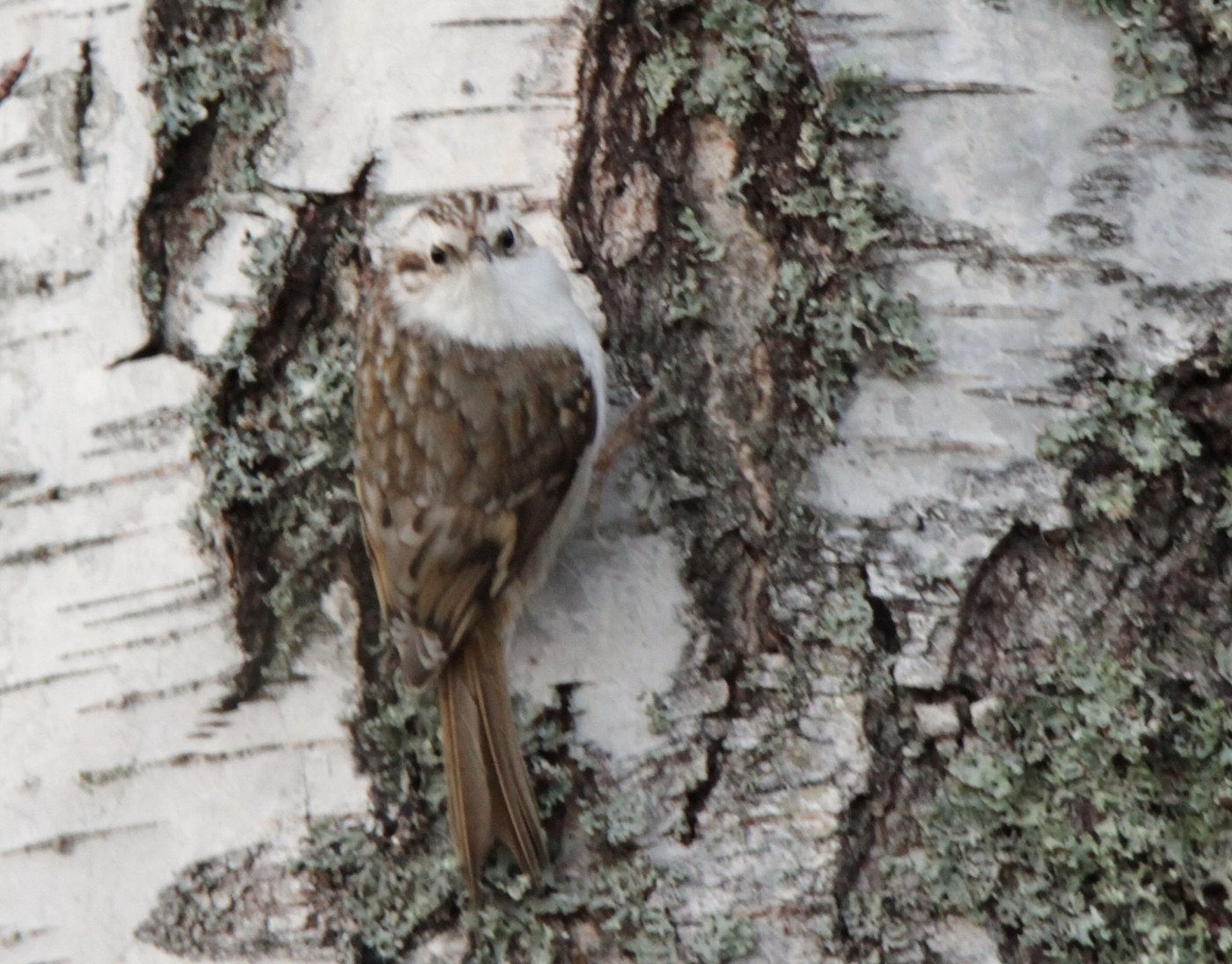
The Eurasian Treecreeper has cryptic, bark-patterned upperpart feathers that provide near-perfect camouflage against tree trunks, paired with stiff, pointed tail feathers that brace it as it spirals up trees.
- Feather type
- Stiff, pointed tail feathers used as a climbing prop; long curved bill; camouflaged contour feathers
- Colours
- Mottled brown-and-buff upperparts (bark-like), silky white underparts
- Bird size
- Small, ~12.5 cm
Found a feather like this?
Identify any feather from a photo, free.
Overview
The Eurasian Treecreeper is a small, inconspicuous woodland bird that forages by creeping up tree trunks in spiraling paths, using its stiff tail as a prop much like a woodpecker.
Its mottled brown-and-buff back provides camouflage so effective that the bird is often overlooked until it moves.
Feathers from this species are prized by finders mainly for the bark-like pattern of the upperparts contrasted with clean white underparts.
Identifying the Feather
Size & Shape
- Tail feathers are notably stiff and pointed at the tips, worn down from constant contact with bark as a climbing prop - a key diagnostic feature.
- Body feathers are small and softly textured; facial feathers are fine, framing a thin, downcurved bill.
Color & Pattern
- Upperpart feathers: mottled brown, buff, and blackish streaking that mimics bark texture, often with pale spotting.
- Rump feathers are warmer rufous-buff, a useful field mark.
- Underparts are silky white to buff-white, unmarked.
Similar Species
- The bark-mimicking mottled pattern combined with stiff, worn tail-feather tips separates this species from similarly sized woodland songbirds, which lack such camouflage patterning and tail stiffness.
Plumage & Molt
Overall Plumage
Cryptically mottled brown, buff, and blackish above resembling bark; clean whitish below; warm buff rump.
Sex & Age Differences
Sexes look alike. Juveniles are similar to adults but slightly softer and less crisply marked before their first molt.
Molt
One complete molt annually in late summer; tail feathers wear down through the year from constant bracing against bark and are renewed at molt.
Habitat & Range
Habitat
Woodland with mature trees and rough bark, including conifer plantations and old broadleaf woods, also parks with large trees.
Range
Widespread across Europe and temperate Asia.
Movements
Largely resident, with only local or altitudinal movements in winter in some populations.
Behavior & Field Notes
Behavior
Creeps up tree trunks in a spiral path from the base, then flies down to the base of the next tree to repeat, rarely descending headfirst.
Diet
Gleans insects, spiders, and their eggs from bark crevices using its slender, curved bill.
Nesting
Builds a nest in a niche behind loose bark or in a crevice, often shaped to fit the narrow space.
Voice
A very high, thin, drawn-out 'srree' call, easily missed.
Field Notes
Look for stiff, pointed tail-feather tips with worn edges - a hallmark of a bark-climbing lifestyle shared only with woodpeckers among common woodland birds.
Frequently asked questions
Why are Treecreeper tail feathers pointed and stiff?
They are used as a climbing prop against bark, similar to a woodpecker's tail, and wear to stiff points with use.
What pattern do Treecreeper back feathers show?
A mottled brown, buff, and blackish pattern that mimics bark texture for camouflage.
How can I distinguish a Treecreeper feather from a sparrow's?
The bark-like mottling and stiffened, worn tail-feather tips are unique to the Treecreeper among common small woodland birds.
Is this species migratory?
No, it is largely resident, with only minor local movements in winter.
Eurasian Treecreeper guides
In-depth guides for identifying and understanding Eurasian Treecreeper.
Other feathers you may enjoy

Yellow-breasted Bunting
Contour and flight feathers, chestnut-and-yellow breeding pattern

Sedge Wren
Tiny streaked crown and back feathers

Yellow-winged Cacique
Glossy black body feathers, yellow wing patch, shaggy crest

Yellow Warbler
Small contour and flight feathers

Yellow-throated Warbler
Small contour and flight feathers

Yellow-throated Vireo
Bright yellow throat and spectacle feathers; olive-green back feathers; two white wing-bar feathers

Yellow-rumped Warbler
Small contour and flight feathers

Yellow-hooded Blackbird
Contrasting hood and body feathers

Yellow-headed Blackbird
Glossy black body plumage with a bright yellow head and breast

Yellow-eyed Junco
Contour and flight feathers

Yellow-fronted Canary
Small, smooth body plumage

Yellow-breasted Greenfinch
Compact, smooth body plumage