
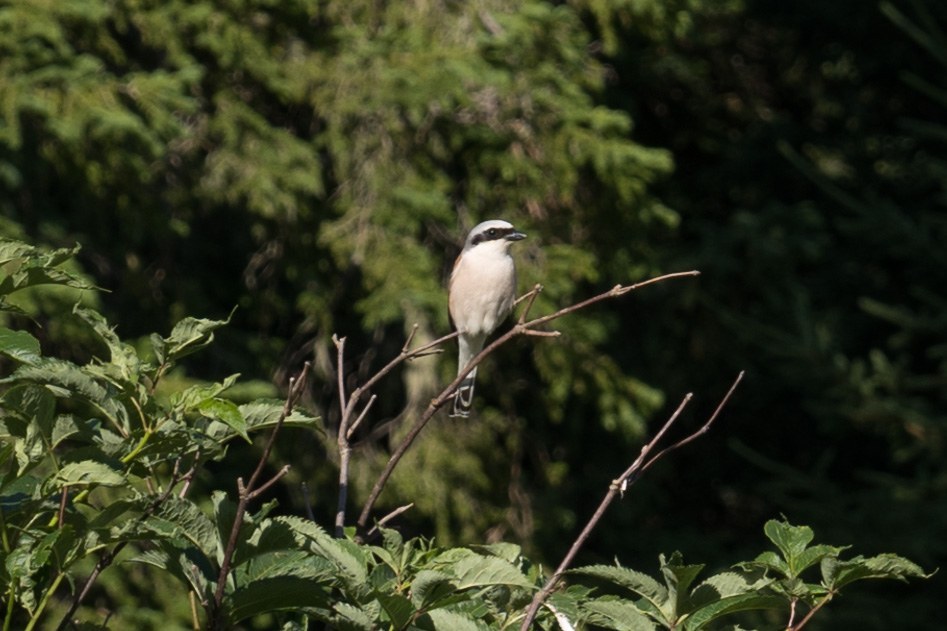
Red-backed Shrike
Lanius collurio
A small Eurasian shrike with strongly different male and female plumages, the male showing a gray head, chestnut back, and black bandit mask.
- Feather type
- Firm body feathers, hooked bill, stiff flight feathers
- Colours
- Male: gray head, chestnut back, black mask; female: brown with scaly barring
- Bird size
- Robin-sized, ~17 cm
Found a feather like this?
Identify any feather from a photo, free.
Overview
The Red-backed Shrike is a small, migratory predatory songbird that breeds across Europe and western Asia and winters in sub-Saharan Africa. It shows one of the more pronounced sexual plumage differences among shrikes, with males displaying a colorful gray, chestnut, and pink pattern while females are cryptically brown and scaly.
Identifying the Feather
Flight feathers: dark brown to blackish, lacking the bold white primary patch seen in larger shrikes. Tail feathers: dark with white edges, notched at the tip in some individuals. Body feathers: males show a blue-gray crown and nape, a rich chestnut back, a black mask through the eye, and pale pinkish underparts; females and juveniles are grayish-brown above with fine crescent-shaped barring on the underparts, giving a scaly appearance. This barred, scaly plumage in females and young birds distinguishes their feathers from the plainer females of other shrikes.
Plumage & Molt
Sexes differ markedly: males have a gray head, chestnut back, black mask, and pale pink-washed underparts, while females are duller brown above with buffy, crescent-barred underparts and a less distinct facial mask. Juveniles resemble females but with even heavier barring above and below. Molt occurs mostly on the African wintering grounds, and first-year males may show a mix of female-like and adult-like feathers before completing their transition.
Habitat & Range
Red-backed Shrikes breed in scrubby farmland, hedgerows, and open bushy habitat across much of Europe and western Asia, favoring areas with thorny shrubs used both for perching and for impaling prey. The species is a long-distance migrant, wintering in savanna and open woodland across sub-Saharan Africa.
Behavior & Field Notes
This shrike hunts large insects and occasionally small vertebrates from low perches, often caching prey on thorns. It builds a cup nest low in dense thorny shrubs. Calls are harsh and chattering, and the male's song combines scratchy notes with imitations of other bird species, delivered from an exposed perch during the breeding season.
Frequently asked questions
How different are male and female Red-backed Shrike feathers?
Very different: males show a gray head and chestnut back with pink-washed underparts, while females and juveniles are brown above with fine, crescent-shaped barring below.
Do Red-backed Shrikes have the white wing patch seen in larger shrikes?
No, they lack the bold white primary patch found in species like the Great Grey or Loggerhead Shrike; their flight feathers are dark brown to blackish.
What does the scaly pattern on female feathers indicate?
It is simply the natural cryptic plumage of females and juveniles, providing camouflage while incubating or perching low in vegetation.
Where does this species spend the winter?
Red-backed Shrikes are long-distance migrants that winter in savanna and open woodland habitats across sub-Saharan Africa.
Red-backed Shrike guides
In-depth guides for identifying and understanding Red-backed Shrike.
Other feathers you may enjoy

Yellow-breasted Bunting
Contour and flight feathers, chestnut-and-yellow breeding pattern

Sedge Wren
Tiny streaked crown and back feathers

Yellow-winged Cacique
Glossy black body feathers, yellow wing patch, shaggy crest

Yellow Warbler
Small contour and flight feathers

Yellow-throated Warbler
Small contour and flight feathers

Yellow-throated Vireo
Bright yellow throat and spectacle feathers; olive-green back feathers; two white wing-bar feathers

Yellow-rumped Warbler
Small contour and flight feathers

Yellow-hooded Blackbird
Contrasting hood and body feathers

Yellow-headed Blackbird
Glossy black body plumage with a bright yellow head and breast

Yellow-eyed Junco
Contour and flight feathers

Yellow-fronted Canary
Small, smooth body plumage

Yellow-breasted Greenfinch
Compact, smooth body plumage