
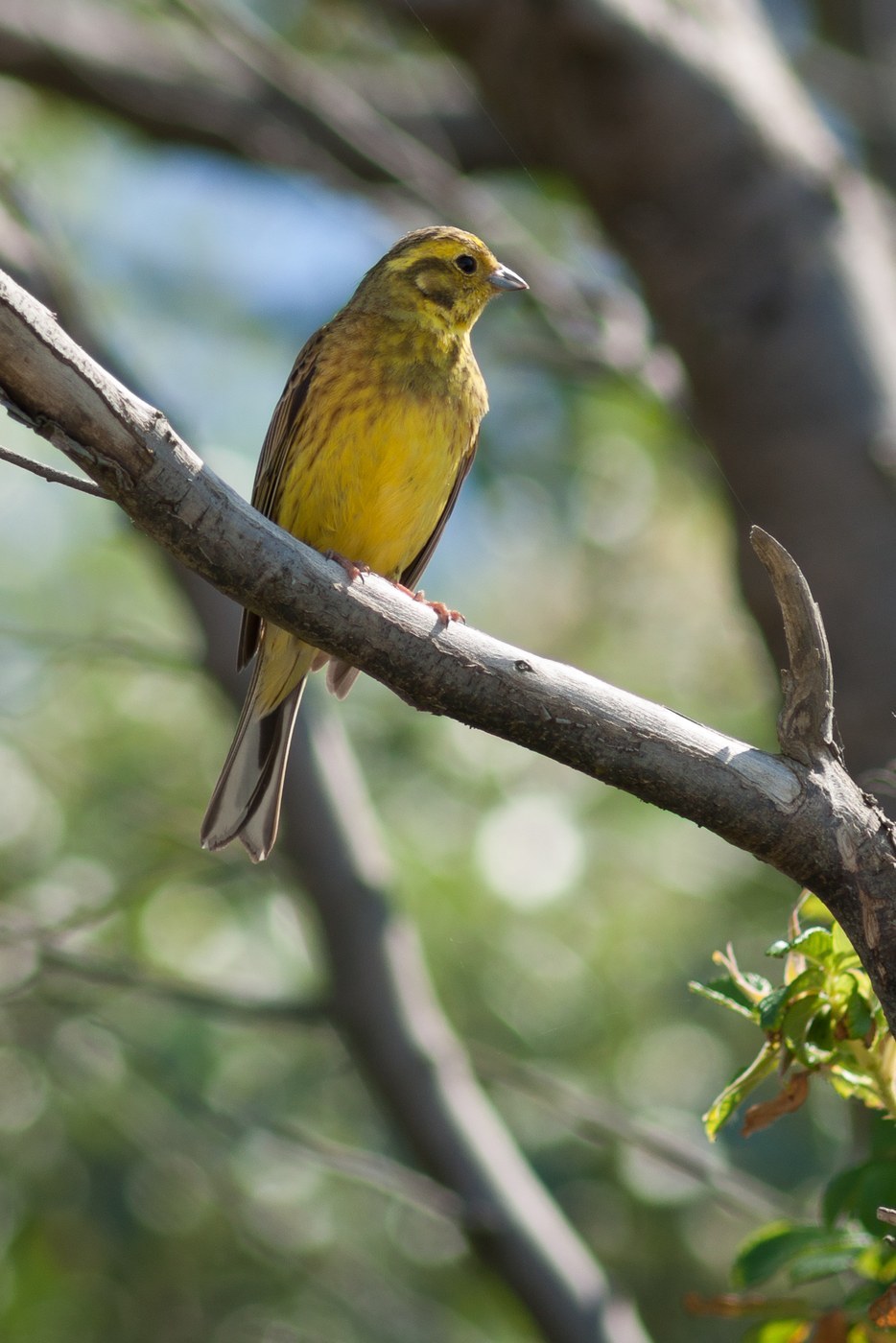
Yellowhammer
Emberiza citrinella
The Yellowhammer is a farmland bunting whose males show vivid yellow head and underpart feathers against a chestnut-streaked back, one of the most colorful seed-eating songbirds of open countryside.
- Feather type
- Streaked contour feathers; chestnut rump feathers; notched tail with white outer edges
- Colours
- Bright yellow head and underparts (male), chestnut-streaked brown back, chestnut rump
- Bird size
- Sparrow-sized to slightly larger, ~16-17 cm
Found a feather like this?
Identify any feather from a photo, free.
Overview
The Yellowhammer is a familiar bunting of hedgerows and farmland across Britain and much of Europe, well known for its bright yellow plumage in males and its distinctive song.
Feathers combine strong yellow tones on the head and underparts with warm chestnut-brown streaking on the back and a chestnut rump.
Because it favors open farmland with hedges, feathers are commonly found along field margins and hedge bases.
Identifying the Feather
Size & Shape
- Feathers are of typical bunting proportions: a fairly long, notched tail with white outer feather edges, and a stout seed-eating bill reflected in robust facial feathering.
Color & Pattern
- Head and underpart feathers in males: bright yellow, sometimes with fine dark streaking on the crown.
- Back feathers: chestnut-brown with dark streaking.
- Rump feathers: warm chestnut, unstreaked - a key identification feature.
- Outer tail feathers show white edges, flashing in flight.
- Females and juveniles are duller, with more streaking and less yellow.
Similar Species
- The combination of yellow head/underparts with a plain chestnut (not streaked) rump separates Yellowhammer from Reed Bunting and Corn Bunting, both of which lack extensive yellow and show different rump patterns.
Plumage & Molt
Overall Plumage
Bright yellow head and underparts in males, chestnut-streaked brown back, and a plain chestnut rump.
Sex & Age Differences
Males are much brighter yellow, especially in breeding plumage; females and juveniles are duller with heavier dark streaking on the head and breast and less yellow overall.
Molt
One complete molt after breeding in late summer; brighter male coloration is revealed by spring as pale feather tips wear away over winter rather than through a distinct extra molt.
Habitat & Range
Habitat
Farmland with hedgerows, scrub edges, field margins, and open countryside with scattered bushes.
Range
Widespread across Europe, introduced to New Zealand.
Movements
Mostly resident, with some local movement to stubble fields and farmyards in winter.
Behavior & Field Notes
Behavior
Forages on the ground and in low vegetation, often in small flocks outside the breeding season, especially around stubble fields in winter.
Diet
Feeds on seeds and grain for much of the year, taking small invertebrates during the breeding season.
Nesting
Builds a grass nest low in a hedge bank or dense scrub.
Voice
A distinctive song often rendered as 'a little bit of bread and no cheese,' ending in a long drawn note.
Field Notes
Feathers with bright yellow tones and a plain chestnut rump, found along hedgerows or field margins, are diagnostic of Yellowhammer.
Frequently asked questions
What is the key rump feature for identifying a Yellowhammer feather?
A plain, unstreaked chestnut rump, distinguishing it from Reed and Corn Bunting.
Do female Yellowhammers show as much yellow as males?
No, females are duller with more streaking on the head and breast and less overall yellow.
Where is a Yellowhammer feather most likely to be found?
Along farmland hedgerows, scrub, or field margins.
Is the Yellowhammer migratory?
No, it is mostly resident, though it may move locally to feed in winter.
Yellowhammer guides
In-depth guides for identifying and understanding Yellowhammer.
Other feathers you may enjoy

Yellow-breasted Bunting
Contour and flight feathers, chestnut-and-yellow breeding pattern

Sedge Wren
Tiny streaked crown and back feathers

Yellow-winged Cacique
Glossy black body feathers, yellow wing patch, shaggy crest

Yellow Warbler
Small contour and flight feathers

Yellow-throated Warbler
Small contour and flight feathers

Yellow-throated Vireo
Bright yellow throat and spectacle feathers; olive-green back feathers; two white wing-bar feathers

Yellow-rumped Warbler
Small contour and flight feathers

Yellow-hooded Blackbird
Contrasting hood and body feathers

Yellow-headed Blackbird
Glossy black body plumage with a bright yellow head and breast

Yellow-eyed Junco
Contour and flight feathers

Yellow-fronted Canary
Small, smooth body plumage

Yellow-breasted Greenfinch
Compact, smooth body plumage