

Emerald Dove
Chalcophaps indica
The Emerald Dove is a small forest dove instantly recognizable by the brilliant metallic-green sheen across its folded wings.
- Feather type
- Iridescent wing coverts over compact contour feathering
- Colours
- Metallic emerald-green wings, purplish-brown body, with white shoulder bars in males
- Bird size
- Small dove, ~23-27 cm
Found a feather like this?
Identify any feather from a photo, free.
Overview
The Emerald Dove is a compact, fast-flying forest dove found across a wide range from India through Southeast Asia to northern Australia. It is best known for the glossy emerald-green wing coverts that flash as it flies swiftly and directly through gaps in the canopy, contrasting with a warm purplish-brown body.
Identifying the Feather
The wing covert feathers show an unmistakable metallic emerald-green iridescence, brightest in good light and appearing darker in shade. Flight feathers are blackish and lack the green sheen. Males show two or three narrow white bars across the upper wing coverts near the shoulder, useful for separating them from females, which lack or show reduced white barring. Tail feathers are short and dark. Compared to other small doves, no other species combines this bright green wing color with a plain brown body.
Plumage & Molt
Males have a grey crown, pinkish-brown underparts, and bold white shoulder markings alongside the green wings. Females are duller overall with browner heads and reduced or absent white wing bars. Juveniles resemble females but show more scaling on the underparts. Molt is gradual and continuous without strong seasonal timing given the tropical range.
Habitat & Range
Inhabits lowland and hill forest, forest edge, mangroves, and dense scrub from India and Sri Lanka through Southeast Asia, the Philippines, Indonesia, and into northern and eastern Australia. Populations are largely resident, though some island and peripheral populations show local movements.
Behavior & Field Notes
Emerald Doves forage on the ground for fallen seeds and fruit within forest, typically alone or in pairs, and flush explosively with fast, low, whirring flight through the understorey. They build a flimsy twig platform nest low in a tree or shrub. The call is a soft, repeated low moaning coo. Their preference for dense cover and fast direct flight makes them easy to hear but hard to see well.
Frequently asked questions
Why is it called the Emerald Dove?
Its wing covert feathers show a brilliant metallic emerald-green sheen visible in good light.
How do you tell male and female Emerald Doves apart?
Males show bolder white shoulder bars and a bluish-grey crown, while females are duller with less white on the wing.
What kind of forest do Emerald Doves prefer?
Dense lowland and hill forest with thick understorey cover across South and Southeast Asia and northern Australia.
Are Emerald Doves easy to spot?
They are more often heard than seen, flushing fast and low through dense vegetation rather than perching in the open.
Emerald Dove guides
In-depth guides for identifying and understanding Emerald Dove.

Emerald Dove identified by the community
Real feathers identified with Feather Identifier.

Other feathers you may enjoy

Victoria Crowned Pigeon
Large lace-like fan crest plumes over dense body contour feathers

Plain Pigeon
Contour feathers, plain and uniformly toned, with a white wing patch

Zenaida Dove
Contour and flight feathers, faint iridescent sheen on neck

Pink Pigeon
Soft contour feathers with graduated tail

Nicobar Pigeon
Long, hackle-like elongated neck feathers with iridescent sheen
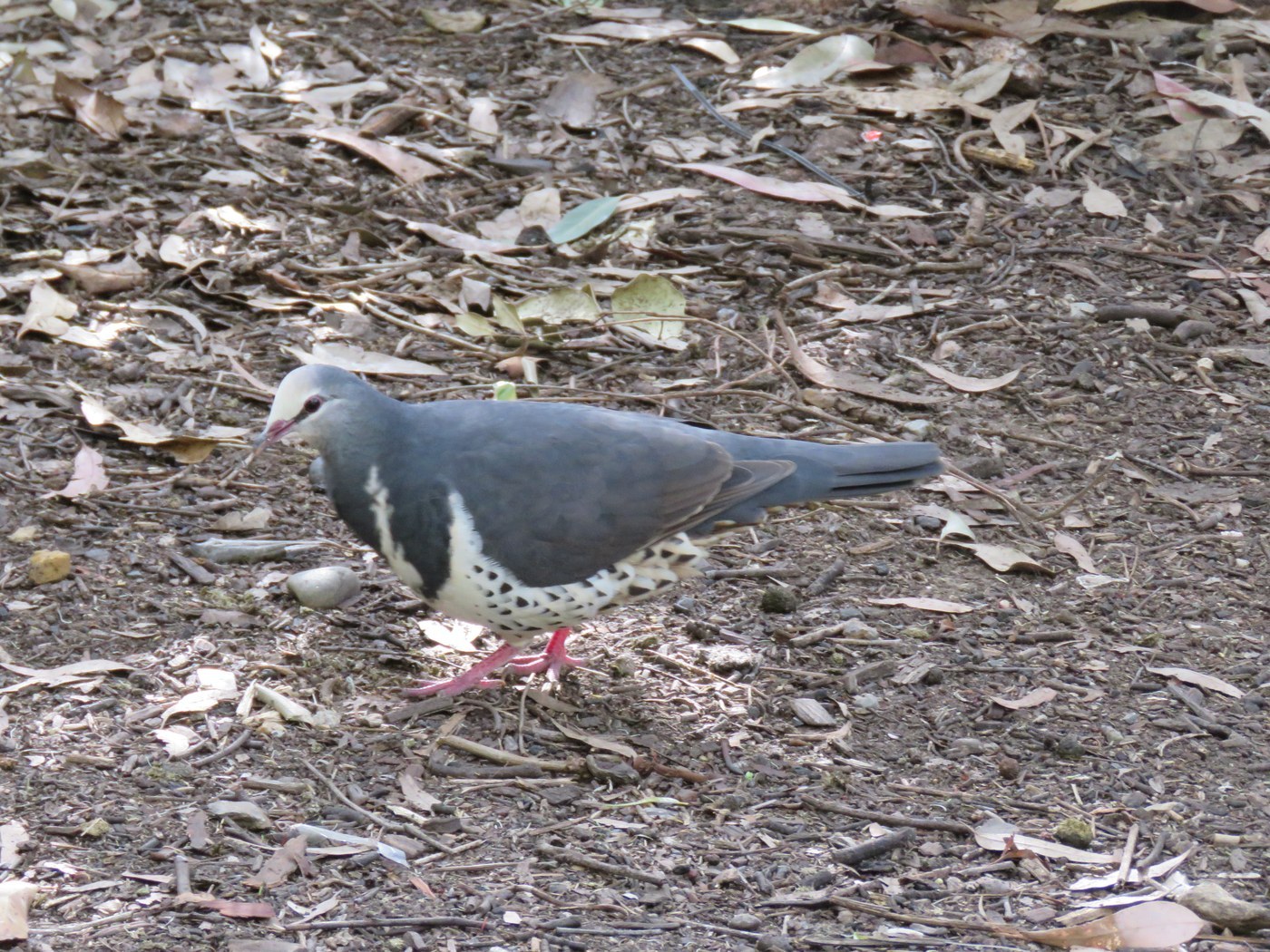
Wonga Pigeon
Dense, soft body contour feathers over a stocky frame

Squatter Pigeon
Dense, cryptic body contour feathers with a bold facial pattern

White-winged Dove
Broad, sturdy flight feathers with a bold white wing stripe

Western Crowned Pigeon
Rounded fan crest plumes over dense soft body feathers

Snow Pigeon
Dense insulating body contour feathers with a bold white rump and belly patch

Zebra Dove
Contour feathers with bold, extensive black-and-white barring

Scaly-naped Pigeon
Contour feathers with iridescent scaled nape pattern