
Tufted Duck
Aythya fuligula
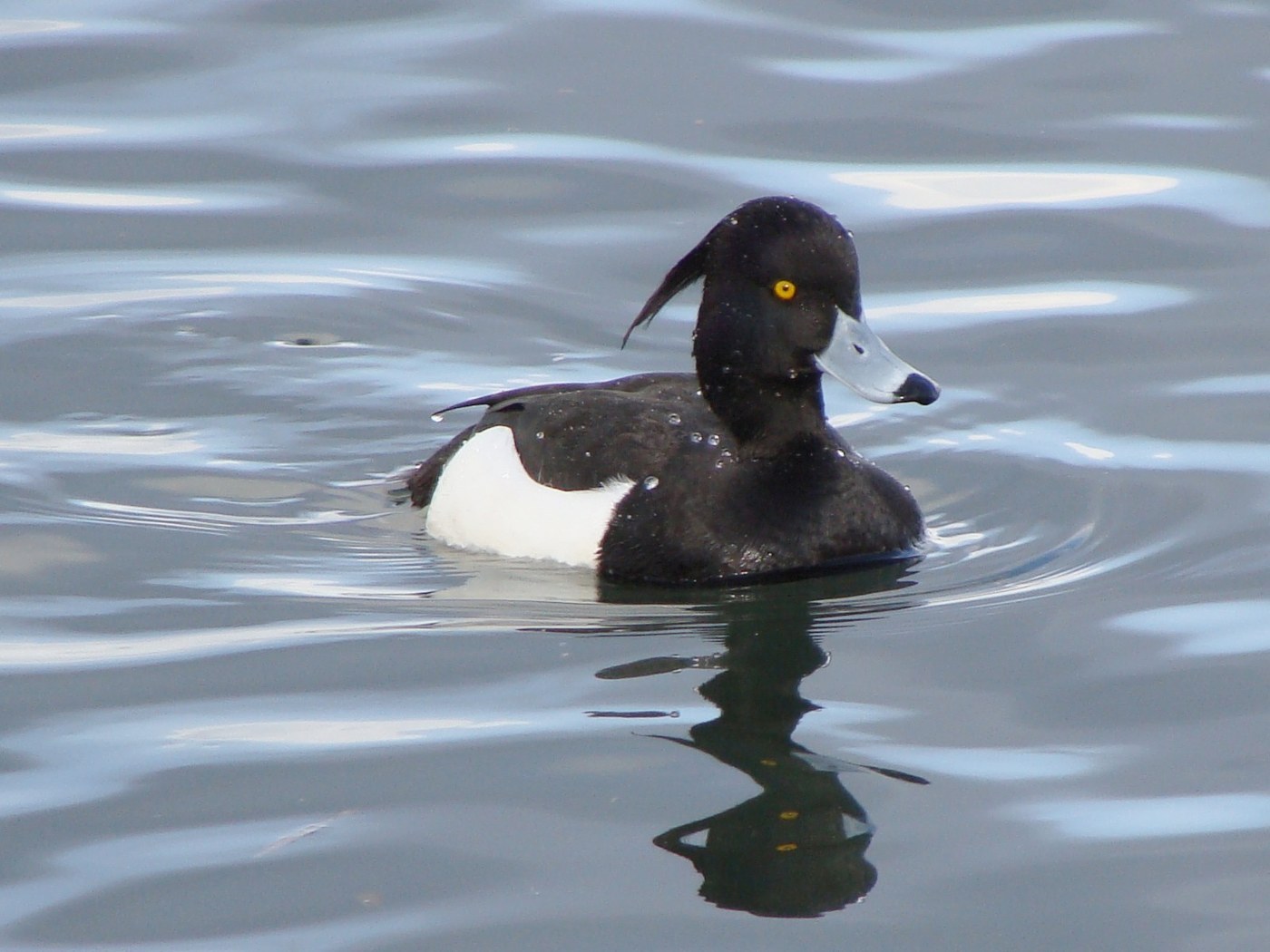
The Tufted Duck is a strikingly patterned Eurasian diving duck, easily recognized by the male's drooping head tuft and sharp contrast between black upperparts and white flanks.
- Feather type
- Diving-duck body feathers with an elongated crest
- Colours
- Glossy black head and back, bright white flanks, drooping black head tuft
- Bird size
- Slightly smaller than a Mallard, ~40-47 cm
Found a feather like this?
Identify any feather from a photo, free.
Overview
Overview
The Tufted Duck is a compact diving duck native to Europe and Asia, occurring as a scarce but regular visitor elsewhere, often turning up among flocks of scaup. Males are boldly two-toned, appearing black overall except for gleaming white flanks, with a long, thin crest of feathers drooping from the back of the head. Females are duller brown with a much shorter tuft and sometimes a small pale patch near the bill, leading to occasional confusion with female scaup.
Identifying the Feather
Feather Identification
- Head tuft: A slender, drooping crest of elongated feathers extends from the back of the crown in males, unlike any other similarly patterned diving duck - the single most reliable feather-based field mark.
- Body contrast: Male body feathering is sharply bicolored - glossy black head, breast, back, and rear against bright white flanks, with almost no vermiculation visible at a distance (unlike scaup, whose backs look pale gray).
- Wing stripe: A broad white speculum crosses the secondaries and is visible in flight, similar to other Aythya ducks.
- Female crest: Females show a much shorter, less obvious tuft than males, along with dark brown body feathering; the amount of white near the bill base is variable and smaller than in scaup.
- Eye color: Bright golden-yellow eyes stand out against the dark head feathering.
Plumage & Molt
Plumage Notes
Breeding males are glossy black on the head, neck, breast, and back with a thin backward-drooping crest, contrasting with pure white flanks. Females are chocolate brown with a shorter crest and variably sized pale area at the base of the bill. Eclipse males resemble females but retain some black back feathering and a hint of the crest. The species undergoes a complete post-breeding molt with a flightless period, typical of diving ducks. Juveniles resemble females, with young males gradually developing the black-and-white pattern and longer crest through their first year.
Habitat & Range
Habitat & Range
Tufted Ducks breed across temperate and northern Eurasia on freshwater lakes, ponds, and slow rivers, wintering further south on lakes, reservoirs, and sheltered coastal waters within their native range. The species is a rare but regular vagrant to North America, typically detected among wintering rafts of scaup on large lakes or coastal bays. Where it occurs outside its normal range, it is generally a solitary or small-group visitor rather than part of an established population.
Behavior & Field Notes
Behavior & Field Notes
Tufted Ducks are active divers, foraging on aquatic invertebrates and plant matter from the bottoms of lakes and slow-moving waters. They readily associate with scaup and other diving ducks, which makes careful feather and plumage comparison useful when one turns up far from its normal range. Courtship involves head movements and soft calls, and nests are built on the ground near water, well concealed in vegetation. Flight is fast and direct, and the species is generally quiet outside of the breeding season.
Frequently asked questions
What is the easiest feather-based way to identify a Tufted Duck?
The long, drooping crest of feathers at the back of the male's head is unique among similar black-and-white diving ducks and is the clearest identification feature.
How does a Tufted Duck differ from a Scaup in plumage?
Tufted Ducks show a solidly black back rather than the pale, finely vermiculated gray back typical of scaup, along with the distinctive head crest.
Do female Tufted Ducks have a crest?
Yes, but it is much shorter and less noticeable than the male's long, drooping tuft.
Is the Tufted Duck native to North America?
No, it is native to Eurasia and appears in North America only as an uncommon vagrant, usually among flocks of scaup.
Tufted Duck guides
In-depth guides for identifying and understanding Tufted Duck.
Other feathers you may enjoy

Mallard
Wing (speculum), body, and tail feathers

Spectacled Eider
Large sea-duck body feathers with distinctive eye-ring patches

Canada Goose
Body and flight feathers
Mute Swan
Body (contour) and flight feathers

Wood Duck
Iridescent crest feathers; ornate scapular and flank feathers; white teardrop facial feathers (female)
Whooper Swan
Contour and flight feathers

White-winged Scoter
Large sea-duck body feathers with a white wing patch

Ruddy Duck
Stiff tail feathers and compact body plumage

Ross's Goose
Contour and flight feathers

White-cheeked Pintail
Contour and elongated tail feathers

Torrent Duck
Dense, sleek contour feathers; stiff, pointed tail feathers used for bracing against rocks

Tundra Swan
Contour and flight feathers