
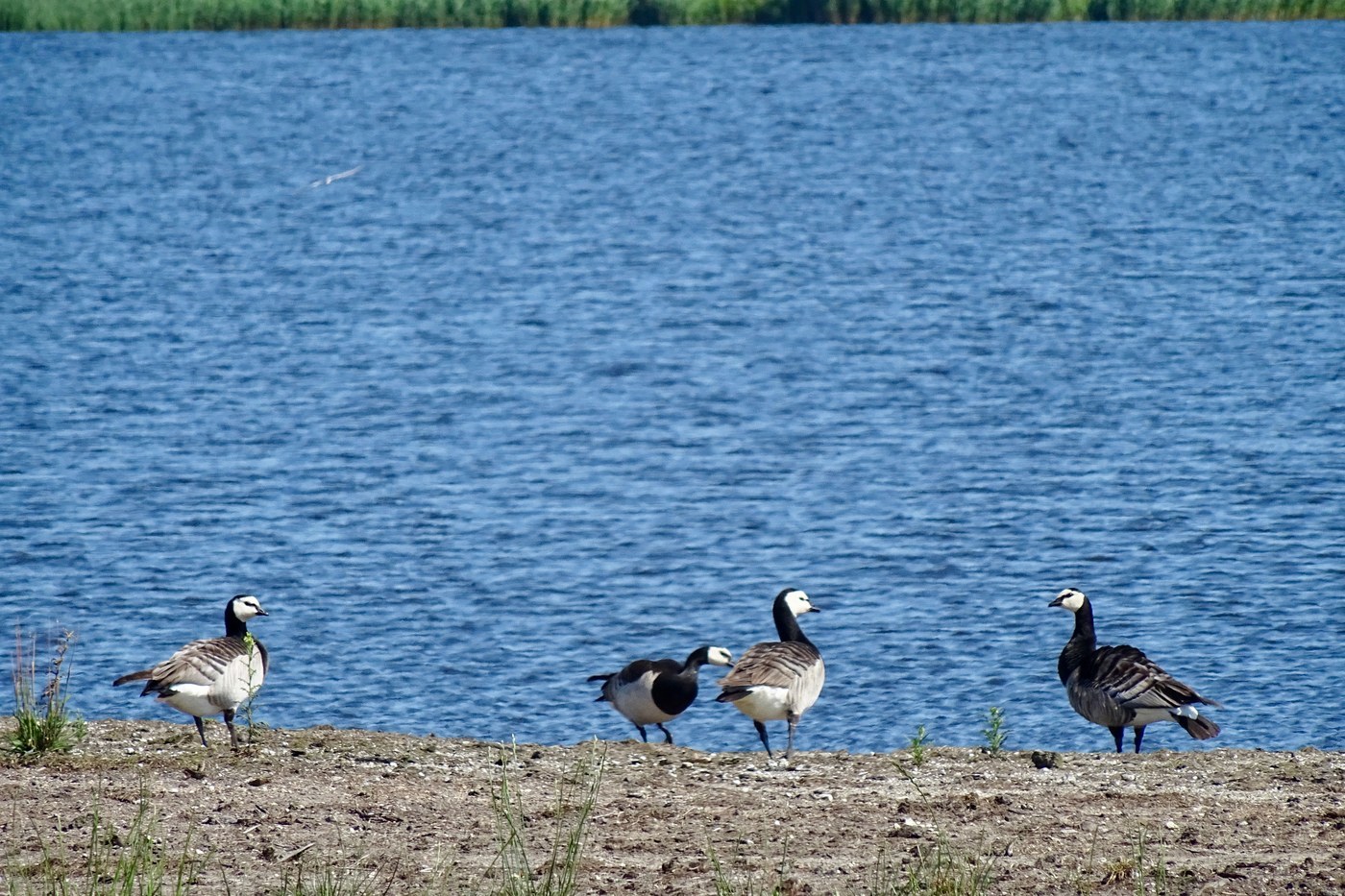
Barnacle Goose
Branta leucopsis
A small, sharply patterned goose with a bold black-and-white face and finely barred silver-gray flanks, breeding on Arctic cliffs and wintering on coastal grassland.
- Feather type
- Contour and flight feathers
- Colours
- Black, white, and silvery-gray bars
- Bird size
- Small goose, ~63 cm
Found a feather like this?
Identify any feather from a photo, free.
Overview
The Barnacle Goose is a compact, contrastingly plumaged goose of the North Atlantic, named for an old folk belief that it hatched from goose barnacles rather than an egg. It breeds on steep Arctic cliffs and coastal tundra in Greenland, Svalbard, and Novaya Zemlya, and winters in dense flocks on coastal grassland and saltmarsh in northwest Europe. Its bold black, white, and gray pattern makes it one of the more instantly recognizable geese at any distance.
Identifying the Feather
Feathers from the head, neck, and breast are solid black, sharply set off from the creamy-white face. Flank and back feathers are pale silvery-gray with fine, even black barring near the tip, giving a soft scalloped or lace-like texture rather than the coarse scaling seen in gray geese. Primaries and secondaries are blackish-brown with little pattern. Compare with the Brant, which is uniformly darker with only a small white neck patch and lacks the barnacle's extensive white face and barred flanks; and with Canada Goose, whose flank feathers are plain brown without barring.
Plumage & Molt
Sexes look alike year-round, with males averaging only slightly larger. Juveniles are duller, with less crisply defined barring on the flanks and a grayer wash to the face. Adults undergo a complete molt on the Arctic breeding grounds in midsummer, becoming flightless for several weeks while flightless goslings are still growing their own feathers.
Habitat & Range
Breeds on narrow cliff ledges and rocky Arctic coastlines, nesting well above ground to avoid mammalian predators. Winters almost entirely on low-lying coastal grassland, saltmarsh, and estuaries in the British Isles, the Netherlands, and neighboring areas, with a growing number of feral and reintroduced populations breeding at lower latitudes in Europe.
Behavior & Field Notes
An almost entirely herbivorous grazer, feeding on short grasses, sedges, and saltmarsh vegetation in tightly packed flocks. Nests are placed on cliff ledges, and famously, downy goslings must jump from considerable heights within a day or two of hatching to reach feeding grounds below, since neither parent can carry them down. Highly gregarious and vocal, with a rapid, barking chatter given almost constantly in flight and while feeding.
Frequently asked questions
Why is it called the Barnacle Goose?
Medieval Europeans, who never saw the species nest, believed it developed from goose barnacles found on driftwood, since its Arctic breeding grounds were unknown at the time.
How can I tell a Barnacle Goose feather from a Canada Goose feather?
Barnacle Goose flank feathers show fine silvery-gray and black barring, while Canada Goose flank feathers are plain brown without barring.
Do Barnacle Geese fly in family groups?
Yes, families typically stay together through migration and into the winter, with young birds recognizable by slightly duller, less contrasting plumage.
Where do Barnacle Geese nest?
They nest on steep cliff ledges and rocky Arctic coastal slopes, a strategy that keeps eggs and small goslings safer from ground predators like Arctic foxes.
Barnacle Goose guides
In-depth guides for identifying and understanding Barnacle Goose.
Other feathers you may enjoy

Mallard
Wing (speculum), body, and tail feathers

Spectacled Eider
Large sea-duck body feathers with distinctive eye-ring patches

Canada Goose
Body and flight feathers
Mute Swan
Body (contour) and flight feathers

Wood Duck
Iridescent crest feathers; ornate scapular and flank feathers; white teardrop facial feathers (female)
Whooper Swan
Contour and flight feathers

White-winged Scoter
Large sea-duck body feathers with a white wing patch

Ruddy Duck
Stiff tail feathers and compact body plumage

Ross's Goose
Contour and flight feathers

White-cheeked Pintail
Contour and elongated tail feathers

Torrent Duck
Dense, sleek contour feathers; stiff, pointed tail feathers used for bracing against rocks

Tundra Swan
Contour and flight feathers