
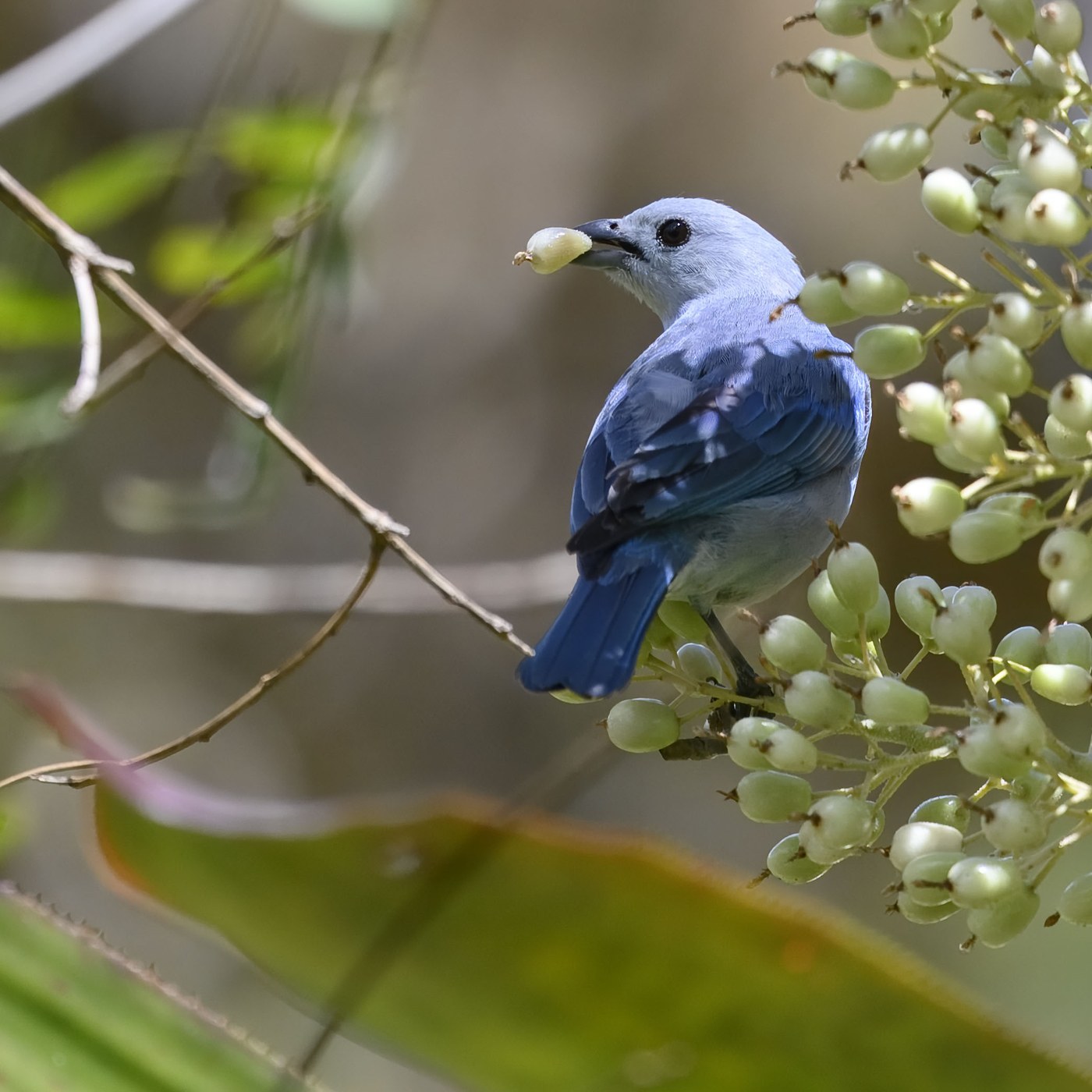
Blue-gray Tanager
Thraupis episcopus
One of the most familiar tanagers of Central and South America, the Blue-gray Tanager shows an overall soft blue-gray body accented by a brighter blue shoulder patch.
- Feather type
- Soft, evenly colored contour feathers with a brighter blue shoulder patch
- Colours
- Pale blue-gray overall with a brighter blue wing shoulder patch
- Bird size
- ~16-18 cm
Found a feather like this?
Identify any feather from a photo, free.
Overview
The Blue-gray Tanager is a common and widespread songbird found in gardens, forest edge, and open woodland from Mexico through much of South America, often considered one of the most familiar tanagers due to its tolerance of human-altered landscapes including parks and gardens. Both sexes show a similar overall pale blue-gray plumage, subtly enhanced by a brighter blue patch on the wing shoulder (lesser coverts) that provides a useful accent against the more muted body color.
Identifying the Feather
Body feathers show a soft, pale blue-gray tone covering the head, back, and underparts, with the wing and tail feathers slightly darker blue-gray. A distinctly brighter, more saturated blue patch is present on the lesser wing coverts (shoulder), standing out against the more muted body tone and useful for separating this species from similar-looking tanagers. The bill is short and conical, typical of the tanager family. Sexes are alike in plumage, unlike many tanagers, so the blue-gray pattern with the brighter shoulder patch applies to both males and females.
Plumage & Molt
Adult plumage is consistent year-round with no marked seasonal change, and sexes are essentially identical, which is unusual among the more sexually dimorphic tanagers. Immatures show a somewhat duller, less contrasted version of the adult pattern before completing molt into full adult coloration.
Habitat & Range
Blue-gray Tanagers are found in a wide range of open and semi-open habitats including forest edge, second growth, gardens, parks, and agricultural land from Mexico through Central America and into much of South America. The species is a year-round resident throughout its extensive range and shows notable adaptability to human-modified landscapes.
Behavior & Field Notes
This species forages for fruit and insects in the canopy, edge habitat, and even garden plantings, often in pairs or small groups. The voice includes a range of thin, squeaky calls and simple warbled songs. Nests are cup-shaped, placed in trees, shrubs, or even on structures near human habitation given the species' tolerance for developed areas. Blue-gray Tanagers are frequently seen in urban parks and gardens throughout their range, making them one of the more commonly observed tanagers by casual birdwatchers.
Frequently asked questions
What is the most useful identification feature of the Blue-gray Tanager?
Its overall pale blue-gray body plumage combined with a brighter blue patch on the wing shoulder.
Do male and female Blue-gray Tanagers look different?
No, unlike many tanagers, males and females share essentially the same blue-gray plumage.
Where is the Blue-gray Tanager commonly seen?
It is common in gardens, parks, forest edge, and open woodland from Mexico through much of South America.
Is the Blue-gray Tanager migratory?
No, it is a year-round resident throughout its range and adapts well to human-modified habitats.
Blue-gray Tanager guides
In-depth guides for identifying and understanding Blue-gray Tanager.
Other feathers you may enjoy

Yellow-breasted Bunting
Contour and flight feathers, chestnut-and-yellow breeding pattern

Sedge Wren
Tiny streaked crown and back feathers

Yellow-winged Cacique
Glossy black body feathers, yellow wing patch, shaggy crest

Yellow Warbler
Small contour and flight feathers

Yellow-throated Warbler
Small contour and flight feathers

Yellow-throated Vireo
Bright yellow throat and spectacle feathers; olive-green back feathers; two white wing-bar feathers

Yellow-rumped Warbler
Small contour and flight feathers

Yellow-hooded Blackbird
Contrasting hood and body feathers

Yellow-headed Blackbird
Glossy black body plumage with a bright yellow head and breast

Yellow-eyed Junco
Contour and flight feathers

Yellow-fronted Canary
Small, smooth body plumage

Yellow-breasted Greenfinch
Compact, smooth body plumage