
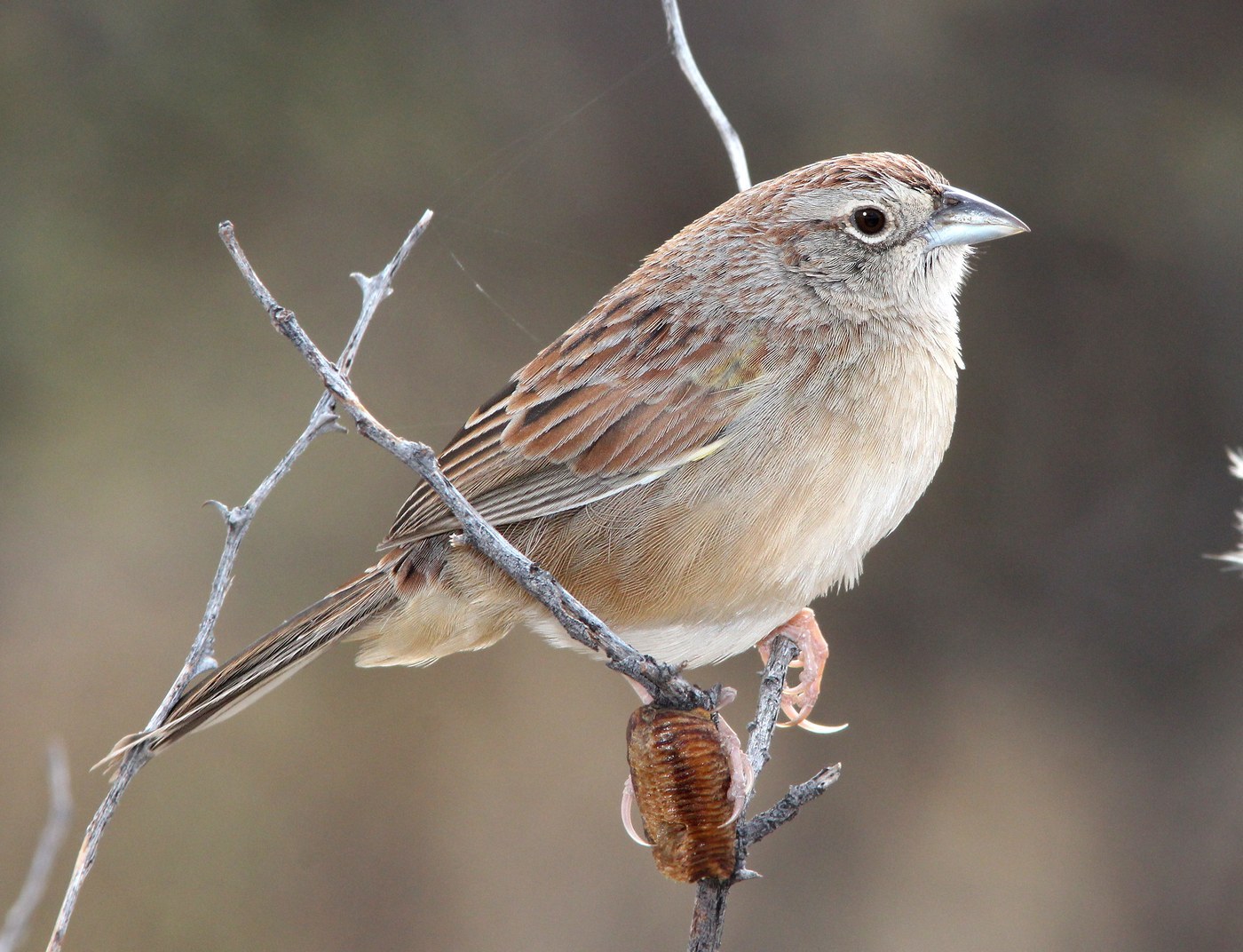
Botteri's Sparrow
Peucaea botterii
Botteri's Sparrow is a plain, grassland-loving sparrow of the Southwest, known for its dry, accelerating trill delivered from grass stems.
- Feather type
- Contour feathers, long rounded tail feathers
- Colours
- Grayish-brown with fine dark streaking, plain below
- Bird size
- Sparrow-sized, ~15 cm
Found a feather like this?
Identify any feather from a photo, free.
Overview
Overview
Botteri's Sparrow is a nondescript, large-billed grassland sparrow found in patches of tall grass in the arid Southwest and coastal Texas. Its feathers are subtly patterned rather than boldly marked, an adaptation for blending into dry grass.
- Family: New World sparrows (Passerellidae)
- Genus: Peucaea, shared with Bachman's and Cassin's sparrows
- Best distinguished from close relatives by voice and habitat rather than plumage alone
Identifying the Feather
Feather Identification
Botteri's Sparrow feathers are grayish-brown overall with fine, somewhat blurry dark streaking on the back and crown, and plain grayish-buff underparts.
- Shape: Rounded contour feathers; long, rounded tail feathers without white edging
- Size: Small sparrow-sized feathers, similar in scale to other Peucaea sparrows
- Color pattern: Muted grayish-brown to sandy tones with narrow blackish streaks on the back; lacks strong rufous tones seen in Bachman's Sparrow
- Shaft: Pale and inconspicuous
- Vs. similar species: Compared to Cassin's Sparrow, Botteri's feathers are plainer and lack the peppered edging on the tail; compared to Bachman's Sparrow, tones are grayer and less rufous
Plumage & Molt
Plumage Details
Adults are plain grayish-brown above with fine streaking, and pale buffy-gray, essentially unmarked below.
- Sexes: Sexes look alike
- Juveniles: Show a lightly streaked breast that is lost with the first prebasic molt
- Seasonal changes: Little seasonal color change; feathers wear to a slightly grayer tone by late summer
- Molt: Complete molt occurs after breeding, typically in late summer
Habitat & Range
Habitat & Range
Botteri's Sparrow occupies tall native grasslands, often with scattered shrubs, in arid and semi-arid parts of its range.
- Range: Southeastern Arizona, southern Texas, and south into Mexico
- Habitat: Sacaton grassland, coastal prairie, and desert grassland with tall grass cover
- Migratory status: Short-distance migrant in the US portion of its range, generally present only during the breeding season and withdrawing toward Mexico in winter
Behavior & Field Notes
Behavior & Field Notes
Botteri's Sparrow forages on the ground within dense grass, feeding on seeds and insects, and is best detected by its distinctive song.
- Diet: Grass and forb seeds along with insects taken from the ground and low vegetation
- Nesting: Builds a grass-cup nest low in dense grass clumps, well concealed from above
- Voice: A dry introductory chip followed by an accelerating trill, often compared to a bouncing ping-pong ball
- Field notes: Males sing from the top of a grass stem or low shrub, especially in early morning and after summer rains
Frequently asked questions
What does Botteri's Sparrow's song sound like?
It begins with a few dry chips and accelerates into a rapid trill, a sound often likened to a dropped ping-pong ball bouncing to a stop.
Where would you find Botteri's Sparrow?
Look in tall, dense native grasslands of southeastern Arizona and southern Texas, especially sacaton grass flats and coastal prairie.
How do Botteri's Sparrow feathers differ from Cassin's Sparrow?
Botteri's feathers are plainer overall, lacking the scaled, peppered tail edging that gives Cassin's Sparrow a more patterned look.
Is Botteri's Sparrow present year-round in the US?
No, US populations are largely present for the breeding season and withdraw south toward Mexico in winter.
Botteri's Sparrow guides
In-depth guides for identifying and understanding Botteri's Sparrow.
Other feathers you may enjoy

Yellow-breasted Bunting
Contour and flight feathers, chestnut-and-yellow breeding pattern

Sedge Wren
Tiny streaked crown and back feathers

Yellow-winged Cacique
Glossy black body feathers, yellow wing patch, shaggy crest

Yellow Warbler
Small contour and flight feathers

Yellow-throated Warbler
Small contour and flight feathers

Yellow-throated Vireo
Bright yellow throat and spectacle feathers; olive-green back feathers; two white wing-bar feathers

Yellow-rumped Warbler
Small contour and flight feathers

Yellow-hooded Blackbird
Contrasting hood and body feathers

Yellow-headed Blackbird
Glossy black body plumage with a bright yellow head and breast

Yellow-eyed Junco
Contour and flight feathers

Yellow-fronted Canary
Small, smooth body plumage

Yellow-breasted Greenfinch
Compact, smooth body plumage