
Brambling
Fringilla montifringilla
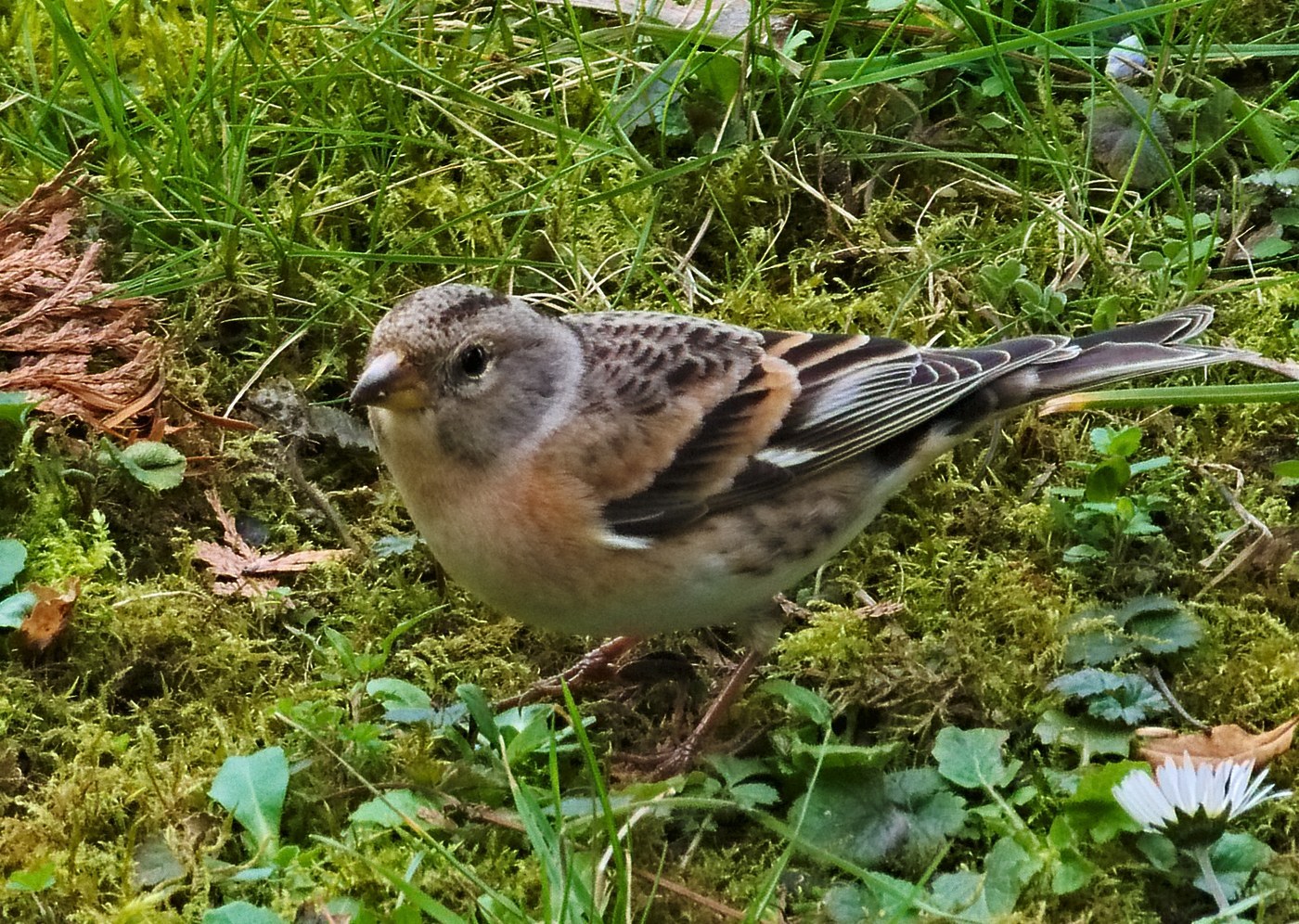
A northern finch closely related to the Chaffinch, showing warm orange breast and shoulder feathers, a mottled black-and-orange back, and a bold white rump patch that flashes distinctively in flight.
- Feather type
- Sturdy finch contour feathers; flight feathers with a bold white rump patch
- Colours
- Orange breast and shoulders, mottled black-and-orange back, white rump, white belly
- Bird size
- Small, ~14-16 cm
Found a feather like this?
Identify any feather from a photo, free.
Overview
The Brambling is a northern Eurasian finch that breeds in birch and conifer forests of the far north and migrates south in winter, sometimes forming enormous flocks in beech woodland where fallen seed is abundant. It is closely related to the Common Chaffinch but shows a distinctly different color palette.
Its bold white rump, visible in flight, is one of its most useful field marks and is reflected in a distinctive white patch among its otherwise orange-and-black feathers.
Breeding males develop a glossy black head, a plumage feature entirely absent outside the breeding season, making seasonal timing important when assessing Brambling feathers.
Identifying the Feather
Identifying Brambling feathers
- Breast and shoulder feathers: Warm orange, brightest on the breast and shoulder patches, a color tone distinct from the pinkish-brown of Chaffinch.
- Back feathers: Mottled black and orange, giving a scaled appearance in non-breeding plumage; breeding males show a more solidly glossy black back and head.
- Rump feathers: Bold white, contrasting sharply with the dark tail — one of the most diagnostic Brambling features, visible as a flash in flight.
- Belly feathers: White, unmarked.
- Compared to similar species: The white rump patch and orange (rather than pinkish) breast tone separate Brambling feathers from the very similar Common Chaffinch, which lacks a white rump and shows pinkish-brown rather than orange underparts.
Plumage & Molt
Plumage overview
Non-breeding adults and females show a mottled black-and-orange back, orange breast and shoulders, a white belly, and a bold white rump. Breeding males develop a glossy, solid black head and back through feather wear (the pale tips of winter feathers abrade away to reveal black beneath) rather than a full molt, along with a deeper orange breast.
A complete molt occurs after breeding in late summer, producing the mottled non-breeding appearance, which then wears into the striking glossy black-headed breeding male plumage by spring without a further molt.
Habitat & Range
Habitat and range
Bramblings breed across the birch and conifer forest belt of northern Scandinavia, Russia, and Siberia. In winter, they migrate south into central and southern Europe and parts of Asia, often forming huge flocks in beech woodland where fallen mast (beech seed) is abundant, with flock size varying dramatically year to year based on seed crops.
Its breeding range is entirely within the far northern boreal zone, making it a winter visitor rather than a breeder across most of temperate Europe.
Behavior & Field Notes
Behavior and field notes
Bramblings forage on the ground in flocks, often alongside Chaffinches, for seeds, particularly beech mast in winter, and insects during the breeding season. Winter flocks can be enormous, sometimes numbering in the millions in years of exceptional beech seed abundance.
Its call is a nasal, buzzy "tswayk," distinct from the more melodic Chaffinch calls. Nests are built in birch or conifer trees within its northern breeding range. A useful field note: an orange-and-black mottled feather with a clean white rump patch found in winter woodland, especially beech woodland, is a strong candidate for Brambling rather than Chaffinch.
Frequently asked questions
What is the best way to distinguish a Brambling feather from a Chaffinch feather?
Look for a bold white rump patch and orange (rather than pinkish-brown) breast tones, both of which are diagnostic for Brambling.
Why do breeding male Bramblings have a glossy black head?
This develops through feather wear over winter and spring, as pale feather tips abrade away to reveal the black base color beneath, rather than through a new molt.
Where would I find a Brambling feather in winter?
In beech woodland or farmland across central and southern Europe, where large winter flocks gather to feed on fallen beech seed.
Does the Brambling breed across most of Europe?
No, it breeds only in the far northern birch and conifer forest belt, appearing across the rest of Europe mainly as a winter visitor.
Brambling guides
In-depth guides for identifying and understanding Brambling.
Other feathers you may enjoy

Yellow-breasted Bunting
Contour and flight feathers, chestnut-and-yellow breeding pattern

Sedge Wren
Tiny streaked crown and back feathers

Yellow-winged Cacique
Glossy black body feathers, yellow wing patch, shaggy crest

Yellow Warbler
Small contour and flight feathers

Yellow-throated Warbler
Small contour and flight feathers

Yellow-throated Vireo
Bright yellow throat and spectacle feathers; olive-green back feathers; two white wing-bar feathers

Yellow-rumped Warbler
Small contour and flight feathers

Yellow-hooded Blackbird
Contrasting hood and body feathers

Yellow-headed Blackbird
Glossy black body plumage with a bright yellow head and breast

Yellow-eyed Junco
Contour and flight feathers

Yellow-fronted Canary
Small, smooth body plumage

Yellow-breasted Greenfinch
Compact, smooth body plumage