

Brush Bronzewing
Phaps elegans
A ground-loving Australian pigeon named for the shimmering bronze, green, and purple spots that gleam across its folded wings.
- Feather type
- Contour feathers with iridescent wing spots
- Colours
- Grey-brown, chestnut, iridescent green-bronze-purple
- Bird size
- Pigeon-sized, ~30 cm
Found a feather like this?
Identify any feather from a photo, free.
Overview
The Brush Bronzewing is a stocky, terrestrial pigeon of southern and coastal Australia, favoring dense heathland, coastal scrub, and forest edges. It walks with a quick, low-slung gait and bursts into flight with a sharp whirr of wings when flushed. Like other bronzewings, it is named for the row of glittering, jewel-toned spots on its wing coverts, which flash color only when the light catches them at the right angle.
Identifying the Feather
Look for a broad, rounded wing with a line of dark, glossy spots along the covert feathers-each spot rimmed in iridescent green, purple, or coppery bronze depending on the angle of light. Body feathers are soft grey-brown with a warm, buffy wash on the underparts. Males show a rich chestnut patch across the forehead and crown, while females have a duller, more uniform grey-brown head. The tail is short and rounded, lacking bold white tips seen in some related doves. Compare with the Common Bronzewing, which is larger and shows a more extensive rufous wash and a paler face; the Brush Bronzewing is smaller and darker overall with a more contrasting bronze wing-spot pattern.
Plumage & Molt
Adults are grey-brown above with a subtle vinous tint to the breast and a pale grey-white belly. The bronze-green wing spotting is present in both sexes but often looks brighter and more extensive in males. Juveniles are duller, with less defined spotting and a scalloped look to the covert edges until their first full molt. Seasonal plumage change is minimal; feather wear through the year can dull the iridescence, which is restored after the annual post-breeding molt.
Habitat & Range
Found across coastal and near-coastal districts of southern Australia, including Western Australia, South Australia, Victoria, and Tasmania, in heath, mallee, and dense coastal scrub. It is largely sedentary, though some local movement occurs in response to food availability and fire history in its shrubby habitat.
Behavior & Field Notes
A shy, ground-dwelling pigeon, it forages quietly on bare or leaf-littered ground beneath dense cover, feeding on seeds and small plant matter. Its call is a soft, resonant, repeated hooting note, often given from a low perch. Nests are flimsy stick platforms placed low in shrubs. When disturbed it prefers to run or freeze rather than flush, exploding into flight only at close range.
Frequently asked questions
What makes a Brush Bronzewing feather recognizable?
Wing covert feathers showing dark spots edged in iridescent green, purple, or bronze are the clearest sign, paired with soft grey-brown body plumage.
Do males and females look different?
Males show a chestnut forehead patch and often brighter wing spotting, while females are duller and more uniformly grey-brown.
Where would you find this species?
In coastal heath and dense scrub across southern Australia, usually low to the ground under cover.
How does it differ from the Common Bronzewing?
It is smaller and darker with a more contrasting bronze wing pattern, while the Common Bronzewing is larger with a paler, more rufous-washed face.
Brush Bronzewing guides
In-depth guides for identifying and understanding Brush Bronzewing.

Other feathers you may enjoy

Victoria Crowned Pigeon
Large lace-like fan crest plumes over dense body contour feathers

Plain Pigeon
Contour feathers, plain and uniformly toned, with a white wing patch

Zenaida Dove
Contour and flight feathers, faint iridescent sheen on neck

Pink Pigeon
Soft contour feathers with graduated tail

Nicobar Pigeon
Long, hackle-like elongated neck feathers with iridescent sheen
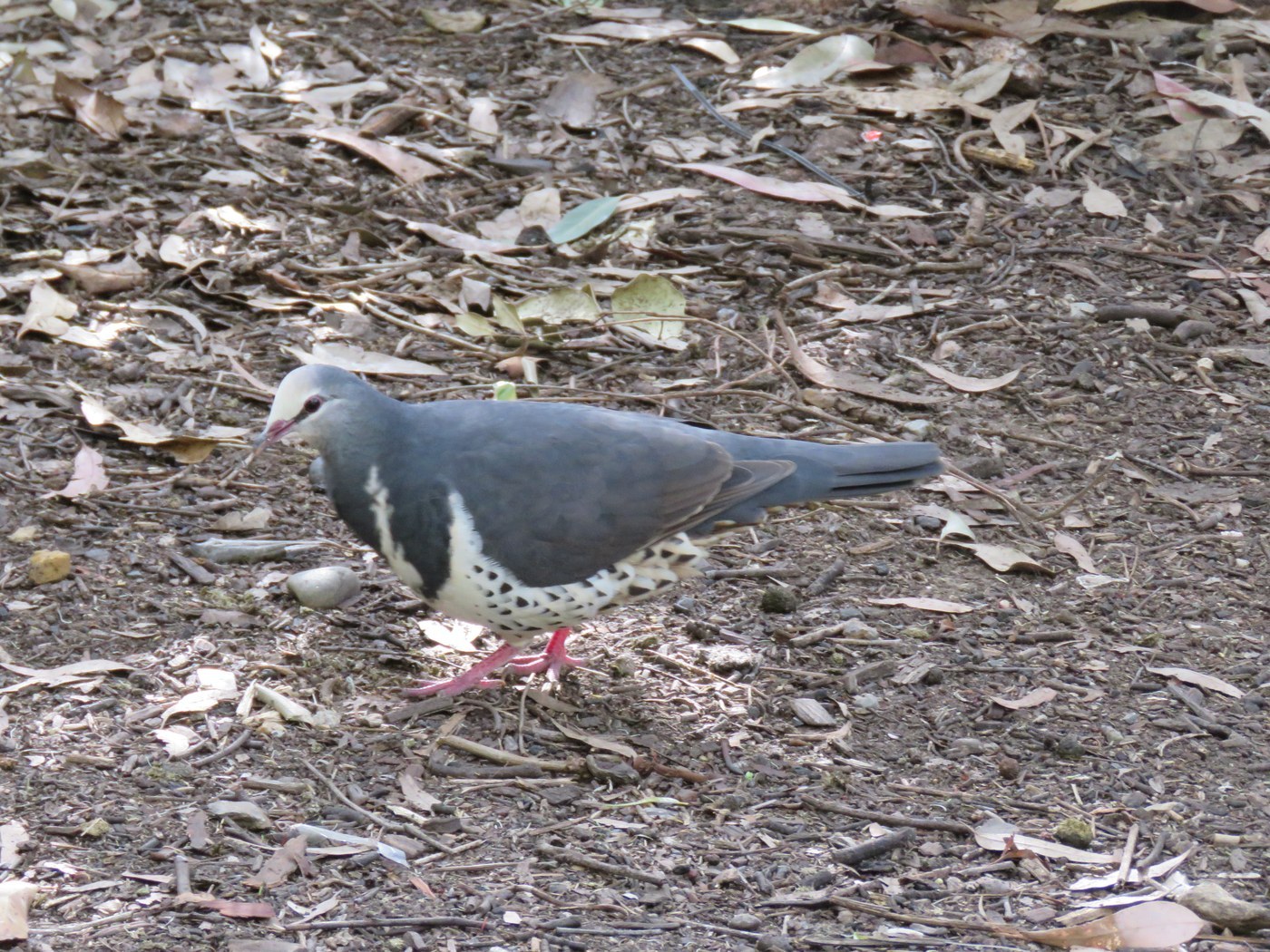
Wonga Pigeon
Dense, soft body contour feathers over a stocky frame

Squatter Pigeon
Dense, cryptic body contour feathers with a bold facial pattern

White-winged Dove
Broad, sturdy flight feathers with a bold white wing stripe

Western Crowned Pigeon
Rounded fan crest plumes over dense soft body feathers

Snow Pigeon
Dense insulating body contour feathers with a bold white rump and belly patch

Zebra Dove
Contour feathers with bold, extensive black-and-white barring

Scaly-naped Pigeon
Contour feathers with iridescent scaled nape pattern