
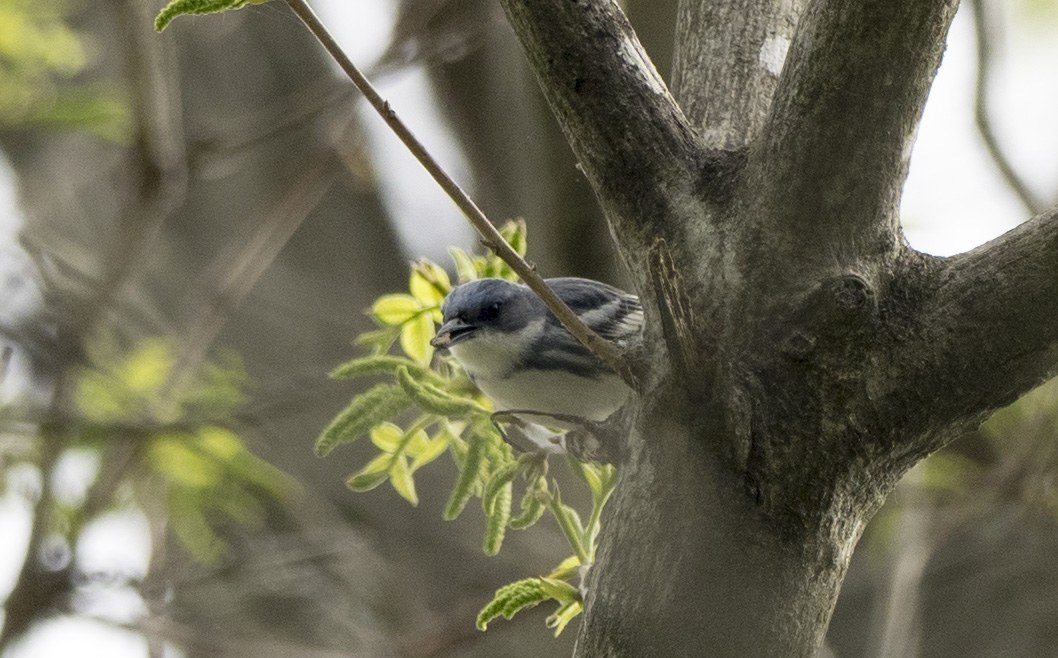
Cerulean Warbler
Setophaga cerulea
One of the smallest wood-warblers, with sky-blue upperparts in the male, breeding high in mature deciduous forest canopy of eastern North America.
- Feather type
- Small contour and flight feathers
- Colours
- Sky-blue upperparts with dark streaking, white underparts, and a blue breast band in males
- Bird size
- Small, ~11-12 cm
Found a feather like this?
Identify any feather from a photo, free.
Overview
The Cerulean Warbler is a tiny, sky-blue wood-warbler that breeds in the canopy of mature deciduous forest across the eastern United States, with a range centered on the Appalachian and Ohio and Mississippi valley regions. It winters in foothill forest of the Andes in South America. Its bright blue upperparts and habit of foraging very high in tall trees make it a challenging species to observe well.
Identifying the Feather
Breeding male upperpart feathers are a bright sky-blue with fine dark streaking on the back, while underparts are white with a narrow blue breast band across the upper chest and dark streaking along the flanks. Females lack the blue tones, showing instead pale blue-green upperparts and pale yellowish underparts without the breast band. Wings show two white wingbars in both sexes. The combination of blue upperparts, white underparts, and a narrow breast band in males is distinctive among small warblers.
Plumage & Molt
Breeding males show the brightest cerulean-blue upperparts and a clean white breast crossed by a blue band. Females are considerably duller, with a pale blue-green or grayish back and yellowish wash below, lacking the breast band. A single complete molt occurs after breeding, and plumage remains fairly similar between breeding and nonbreeding seasons compared to some other warblers.
Habitat & Range
Cerulean Warblers breed in mature deciduous forest with a tall, closed canopy, particularly in the Appalachian region and the Ohio and Mississippi river valleys of the eastern United States. They winter in foothill forest along the eastern slope of the Andes in South America. Populations have shown notable declines linked to habitat fragmentation on both breeding and wintering grounds.
Behavior & Field Notes
This species forages high in the forest canopy for insects, rarely descending to lower levels, which makes it one of the more difficult warblers to observe closely. The male's song is a buzzy, ascending series of notes. Nests are built high on horizontal branches, often well out from the trunk. It is a long-distance nocturnal migrant between eastern North American breeding grounds and Andean wintering areas.
Frequently asked questions
How do I identify a Cerulean Warbler feather?
Male feathers show a distinctive sky-blue color on the upperparts with fine streaking, paired with a narrow blue band across an otherwise white breast.
Where does the Cerulean Warbler winter?
It winters in foothill forest along the eastern slope of the Andes in South America.
Why is this species hard to observe?
It forages very high in the forest canopy and rarely comes down to lower levels, making close views difficult.
How do females differ from males?
Females lack the blue tones of males, showing pale blue-green upperparts and yellowish underparts without a breast band.
Cerulean Warbler guides
In-depth guides for identifying and understanding Cerulean Warbler.
Other feathers you may enjoy

Yellow-breasted Bunting
Contour and flight feathers, chestnut-and-yellow breeding pattern

Sedge Wren
Tiny streaked crown and back feathers

Yellow-winged Cacique
Glossy black body feathers, yellow wing patch, shaggy crest

Yellow Warbler
Small contour and flight feathers

Yellow-throated Warbler
Small contour and flight feathers

Yellow-throated Vireo
Bright yellow throat and spectacle feathers; olive-green back feathers; two white wing-bar feathers

Yellow-rumped Warbler
Small contour and flight feathers

Yellow-hooded Blackbird
Contrasting hood and body feathers

Yellow-headed Blackbird
Glossy black body plumage with a bright yellow head and breast

Yellow-eyed Junco
Contour and flight feathers

Yellow-fronted Canary
Small, smooth body plumage

Yellow-breasted Greenfinch
Compact, smooth body plumage