
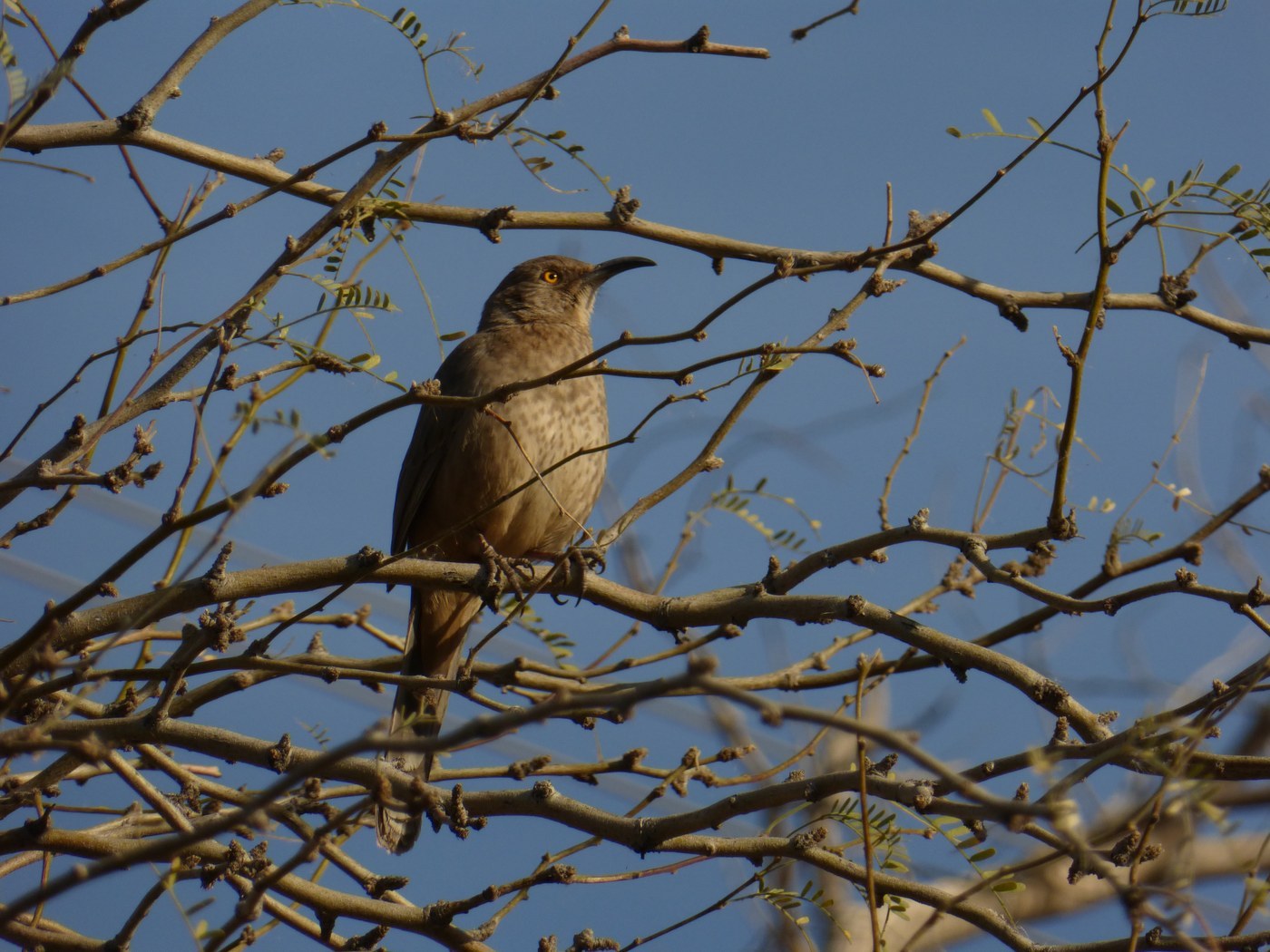
Curve-billed Thrasher
Toxostoma curvirostre
A grayish-brown desert songbird with a long, strongly down-curved bill, well adapted to foraging among cactus and thorny scrub of the American Southwest.
- Feather type
- Long tail and flight feathers typical of thrashers; sturdy body feathers
- Colours
- Grayish-brown overall with faint breast spotting
- Bird size
- Robin-sized to slightly larger, ~28 cm
Found a feather like this?
Identify any feather from a photo, free.
Overview
The Curve-billed Thrasher is a common desert songbird found across the southwestern United States and much of Mexico, recognized by its long, distinctly down-curved bill used for probing soil and leaf litter. It is a familiar resident of desert scrub, especially areas with abundant cholla and other cacti used for nesting.
Identifying the Feather
Flight feathers: grayish-brown, fairly broad and rounded at the tips, adapted for short bursts of flight rather than long-distance travel. Tail feathers: long and graduated, grayish-brown, sometimes with faint pale tips on the outer feathers. Body feathers: grayish-brown overall with faint, diffuse spotting on the breast that is less distinct than in some other thrashers. The orange-yellow eye is a useful accompanying field mark. Compared to the California Thrasher, Curve-billed Thrasher feathers are paler grayish-brown rather than dark chocolate brown, and the bill curvature is less extreme.
Plumage & Molt
Sexes look alike. Adults are grayish-brown above and below, with faint, blurry spotting on the breast, pale wing bars formed by whitish tips on the greater coverts, and an orange to yellow eye. Juveniles show duller plumage with less distinct spotting and a darker eye that lightens with age. There is no strong seasonal plumage variation.
Habitat & Range
Curve-billed Thrashers inhabit desert scrub, thorn scrub, and cactus-rich habitats across the southwestern United States and much of Mexico, often found in areas with cholla cactus used for nesting and cover. The species is generally non-migratory, remaining resident year-round within its range.
Behavior & Field Notes
This thrasher forages mainly on the ground, using its curved bill to flip aside soil, leaf litter, and debris in search of insects and other invertebrates, and also takes plant material seasonally. It builds a bulky twig nest, often within the protective spines of cholla or other cacti. Its calls include a sharp, whistled 'whit-wheet' contact call, and its song is a long series of varied, often repeated musical phrases.
Frequently asked questions
What feather feature helps confirm a Curve-billed Thrasher identification?
The combination of grayish-brown body feathers with faint, blurry breast spotting and pale wing bars, along with the species' characteristic strongly curved bill, helps confirm identification.
How does this species' plumage differ from the California Thrasher?
Curve-billed Thrasher feathers are paler grayish-brown rather than the dark chocolate brown of the California Thrasher, and the bill curve is somewhat less pronounced.
Do juvenile feathers look different from adult feathers?
Juveniles show duller, less distinctly spotted plumage and a darker eye color that brightens to orange-yellow as the bird matures.
Where would feathers of this species most likely be found?
In desert scrub and cactus-dominated habitat across the southwestern United States and much of Mexico, often near cholla cactus used for nesting and shelter.
Curve-billed Thrasher guides
In-depth guides for identifying and understanding Curve-billed Thrasher.
Other feathers you may enjoy

Yellow-breasted Bunting
Contour and flight feathers, chestnut-and-yellow breeding pattern

Sedge Wren
Tiny streaked crown and back feathers

Yellow-winged Cacique
Glossy black body feathers, yellow wing patch, shaggy crest

Yellow Warbler
Small contour and flight feathers

Yellow-throated Warbler
Small contour and flight feathers

Yellow-throated Vireo
Bright yellow throat and spectacle feathers; olive-green back feathers; two white wing-bar feathers

Yellow-rumped Warbler
Small contour and flight feathers

Yellow-hooded Blackbird
Contrasting hood and body feathers

Yellow-headed Blackbird
Glossy black body plumage with a bright yellow head and breast

Yellow-eyed Junco
Contour and flight feathers

Yellow-fronted Canary
Small, smooth body plumage

Yellow-breasted Greenfinch
Compact, smooth body plumage