
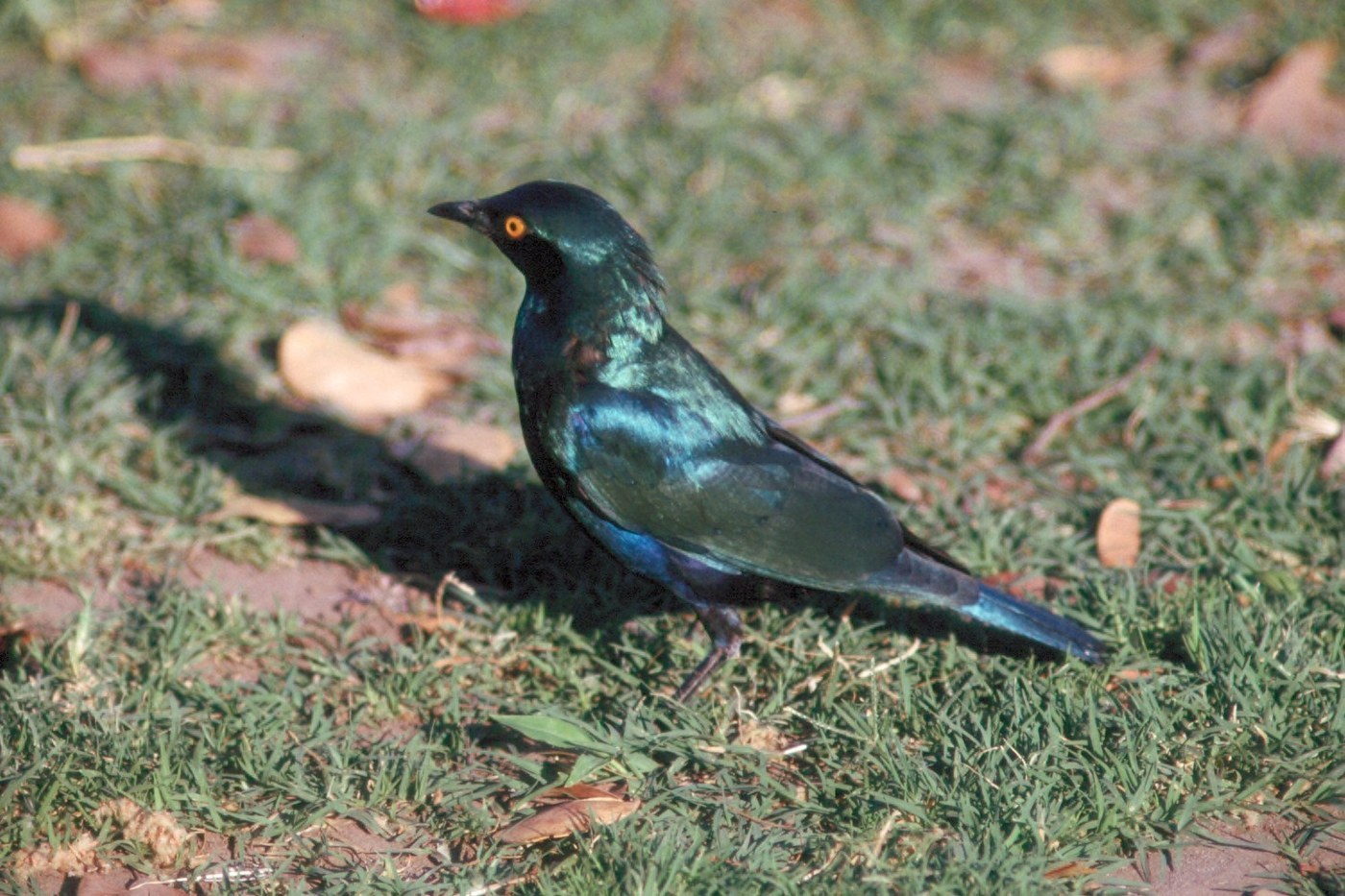
Greater Blue-eared Starling
Lamprotornis chalybaeus
A dazzling African starling with metallic blue-green plumage, a darker blue ear patch, and violet-tinged flanks that shimmer in sunlight.
- Feather type
- Highly iridescent, glossy contour feathers
- Colours
- Metallic blue-green with darker blue ear patch and violet flanks
- Bird size
- Robin-sized, ~22 cm
Found a feather like this?
Identify any feather from a photo, free.
Overview
Overview
The Greater Blue-eared Starling is a strikingly iridescent songbird found across savanna and open woodland habitats of sub-Saharan Africa. Its plumage shifts between shades of metallic blue, green, and violet depending on the angle of light, with a distinctively darker blue patch around the ear region giving the species its name.
Often seen in small flocks foraging on the ground or in trees, this species is one of many glossy starlings in the region and shows the characteristic sheen typical of the group.
Identifying the Feather
Feather Identification
- Body feathers: metallic blue-green, with an iridescent sheen that shifts color depending on lighting angle
- Ear feathers: darker blue-violet patch around the ear coverts, a key distinguishing feature within the genus
- Flank feathers: violet-tinged, adding further color contrast against the greener back and wings
- Eye: bright orange-yellow iris, a useful non-feather field mark alongside the plumage
- Distinguishing this species from similar glossy starlings relies on the darker ear patch and the specific combination of blue-green body with violet flanks, since several related species share a generally similar iridescent look
Plumage & Molt
Plumage Notes
Adults of both sexes show similar iridescent blue-green plumage with darker ear patches, with little visible sexual dimorphism. Juveniles are duller and less iridescent, with more matte, sooty plumage that brightens with maturity.
Molt occurs annually, with the iridescent structural coloration dependent on feather microstructure that is renewed with each new feather generation.
Habitat & Range
Habitat & Range
Greater Blue-eared Starlings are found across savanna, open woodland, and scrub habitats of sub-Saharan Africa. They are adaptable to a range of open and semi-open habitats, including areas near human settlement.
The species is largely resident, though local movements can occur in response to food availability.
Behavior & Field Notes
Behavior & Field Notes
Greater Blue-eared Starlings feed on insects and fruit, foraging both on the ground and in trees, often in small flocks. They are social birds, frequently seen interacting in noisy groups.
Nests are built in tree cavities or old woodpecker holes, lined with grass and feathers. Their calls include a variety of harsh chattering and whistling notes typical of glossy starlings.
Frequently asked questions
Why do Greater Blue-eared Starling feathers appear to change color?
The iridescent sheen results from the microscopic structure of the feathers, which reflects light differently depending on the viewing angle, producing shifting blue, green, and violet tones.
How can I tell this starling apart from other glossy starlings?
Look for the darker blue-violet ear patch combined with violet-tinged flanks, which help distinguish it from closely related glossy starling species.
Do juvenile Greater Blue-eared Starlings look iridescent like adults?
No, juveniles are duller and more matte in appearance, gaining the full iridescent sheen as they mature.
Where do Greater Blue-eared Starlings nest?
They typically nest in tree cavities or old woodpecker holes, lined with grass and feathers.
Greater Blue-eared Starling guides
In-depth guides for identifying and understanding Greater Blue-eared Starling.

Other feathers you may enjoy

Yellow-breasted Bunting
Contour and flight feathers, chestnut-and-yellow breeding pattern

Sedge Wren
Tiny streaked crown and back feathers

Yellow-winged Cacique
Glossy black body feathers, yellow wing patch, shaggy crest

Yellow Warbler
Small contour and flight feathers

Yellow-throated Warbler
Small contour and flight feathers

Yellow-throated Vireo
Bright yellow throat and spectacle feathers; olive-green back feathers; two white wing-bar feathers

Yellow-rumped Warbler
Small contour and flight feathers

Yellow-hooded Blackbird
Contrasting hood and body feathers

Yellow-headed Blackbird
Glossy black body plumage with a bright yellow head and breast

Yellow-eyed Junco
Contour and flight feathers

Yellow-fronted Canary
Small, smooth body plumage

Yellow-breasted Greenfinch
Compact, smooth body plumage