

Jambu Fruit Dove
Ptilinopus jambu
A small Southeast Asian fruit dove with a face flushed rosy-crimson, set against green upperparts, clean white underparts, and a chestnut patch beneath the tail.
- Feather type
- Soft contour feathers with distinct facial patch
- Colours
- Green upperparts, crimson-pink face, white underparts, chestnut vent
- Bird size
- Small-medium dove, ~24-27 cm
Found a feather like this?
Identify any feather from a photo, free.
Overview
The Jambu Fruit Dove is a small, quiet fruit dove of Southeast Asian lowland rainforest, named for its resemblance in coloring to the jambu, a pink-blushed tropical fruit. Its combination of a rosy face and clean white body sets it apart from the more uniformly green fruit doves sharing its range.
Identifying the Feather
The face and forecrown are washed rosy-pink to crimson in males, a color that fades toward the throat into white underparts, with a neat chestnut patch on the vent and undertail. The upperparts, including the back and wings, are a rich green. Females show a much duller, more olive-green face lacking the strong pink wash of males, though they retain the white underparts and chestnut vent patch. Compare with the Beautiful Fruit Dove, which has a purple crown rather than a pink face, helping separate the two where ranges overlap.
Plumage & Molt
Marked sexual dimorphism is present: males show a bright rosy-crimson face while females are duller and greener-faced, though both sexes share white underparts and a chestnut vent patch. Juveniles resemble females, with young males gaining the pink facial wash gradually through successive molts. No strong seasonal plumage variation occurs in this tropical resident.
Habitat & Range
Found across the Malay Peninsula, Sumatra, Borneo, and Java, in lowland and hill rainforest. It is a forest-canopy resident, moving locally in response to fruiting patterns rather than undertaking long migrations.
Behavior & Field Notes
Feeds on small fruits gathered in the canopy, often in pairs or small groups moving between fruiting trees. Its call is a soft, low cooing note. Nests are simple twig platforms built in tree branches. Its rosy-faced males are a distinctive sight in the canopy, though the species can be inconspicuous when perched motionless among foliage.
Frequently asked questions
What gives the Jambu Fruit Dove its name?
Its pink-blushed face recalls the coloring of the jambu fruit, a pink tropical fruit found in the same region.
How do males and females differ?
Males show a bright rosy-crimson face, while females have a duller, more olive-green face; both share white underparts and a chestnut vent patch.
Where does it live?
In lowland and hill rainforest across the Malay Peninsula, Sumatra, Borneo, and Java.
How is it told apart from the Beautiful Fruit Dove?
The Beautiful Fruit Dove has a purple crown, while the Jambu Fruit Dove shows a pink to crimson face instead.
Jambu Fruit Dove guides
In-depth guides for identifying and understanding Jambu Fruit Dove.

Other feathers you may enjoy

Victoria Crowned Pigeon
Large lace-like fan crest plumes over dense body contour feathers

Plain Pigeon
Contour feathers, plain and uniformly toned, with a white wing patch

Zenaida Dove
Contour and flight feathers, faint iridescent sheen on neck

Pink Pigeon
Soft contour feathers with graduated tail

Nicobar Pigeon
Long, hackle-like elongated neck feathers with iridescent sheen
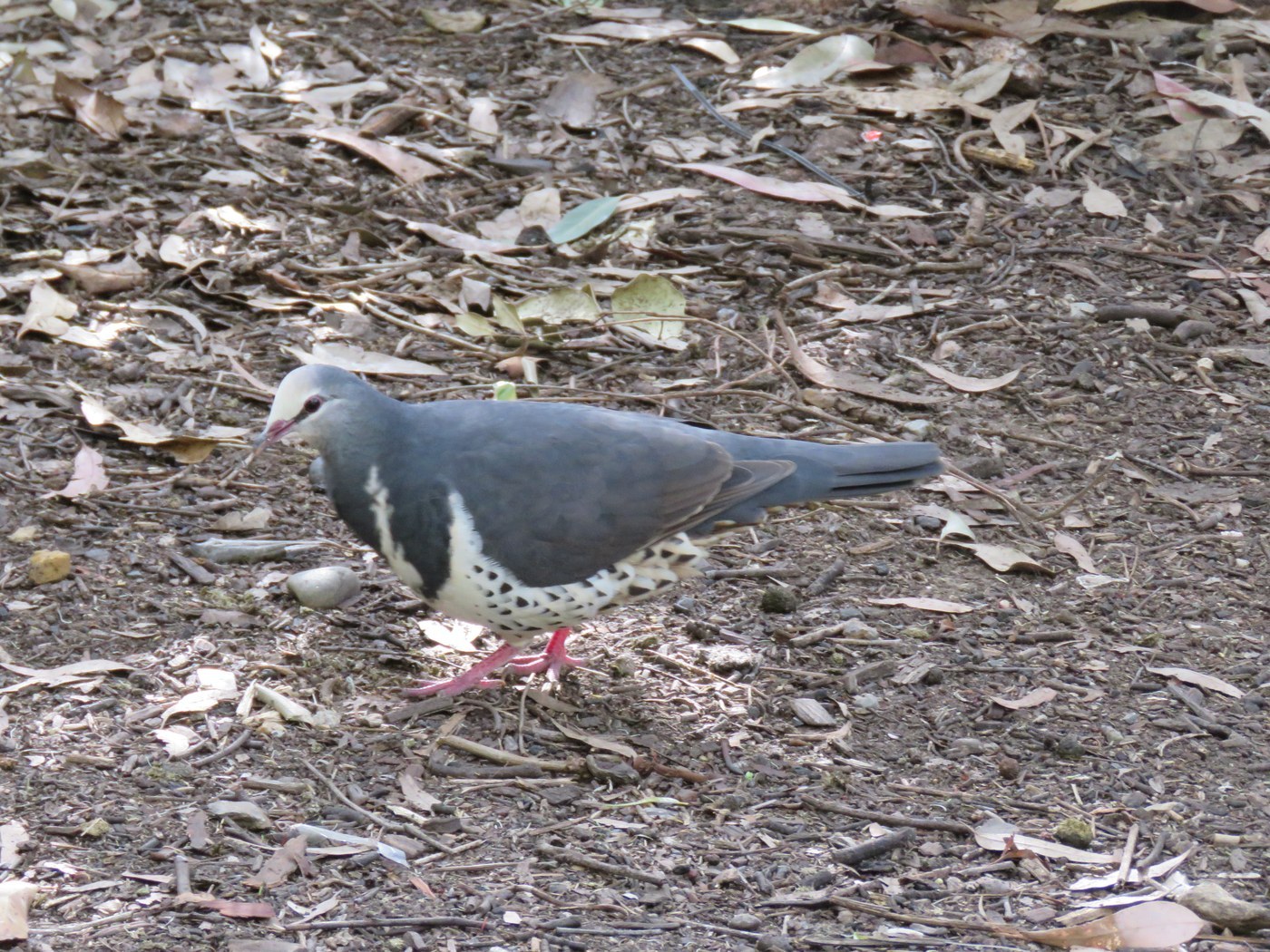
Wonga Pigeon
Dense, soft body contour feathers over a stocky frame

Squatter Pigeon
Dense, cryptic body contour feathers with a bold facial pattern

White-winged Dove
Broad, sturdy flight feathers with a bold white wing stripe

Western Crowned Pigeon
Rounded fan crest plumes over dense soft body feathers

Snow Pigeon
Dense insulating body contour feathers with a bold white rump and belly patch

Zebra Dove
Contour feathers with bold, extensive black-and-white barring

Scaly-naped Pigeon
Contour feathers with iridescent scaled nape pattern