

Key West Quail-Dove
Geotrygon chrysia
A richly iridescent Caribbean forest-floor dove with a bold white facial stripe, occasionally straying to the Florida Keys, for which it is named.
- Feather type
- Contour feathers with strong iridescence and a bold white facial stripe
- Colours
- Iridescent bronze-green upperparts, rufous underparts, and a bold white stripe below the eye
- Bird size
- Small, plump dove, ~28-30 cm
Found a feather like this?
Identify any feather from a photo, free.
Overview
The Key West Quail-Dove is native to the Bahamas and the Greater Antilles, inhabiting dry forest and woodland floor, with rare vagrant records in the Florida Keys that give the species its common name. It shows striking iridescent bronze-green upperparts, a rich rufous or cinnamon wash on the underparts, and a bold white stripe below the eye that stands out clearly against the darker face.
Identifying the Feather
- Upperpart feathers: strongly iridescent bronze-green to purplish, catching the light distinctly compared to duller quail-doves
- Facial stripe feathers: bold, clean white stripe below the eye, more prominent than in the Ruddy Quail-Dove
- Underpart feathers: warm rufous to cinnamon, providing contrast with the iridescent back
- Tail feathers: short and rounded, typical of ground-dwelling quail-doves
- Compare with the Ruddy Quail-Dove, which shows a less bold, more buffy facial stripe and less pronounced iridescence on the upperparts
Plumage & Molt
Sexes are broadly similar, though females may show marginally less vivid iridescence than males. Juveniles are duller overall with reduced iridescence and a less distinct facial stripe, developing full adult coloring after their first molt. Adults molt completely once per year.
Habitat & Range
This species is resident in the Bahamas and Greater Antilles, favoring dry forest floor and woodland understory. It is a rare vagrant to the Florida Keys and southern Florida, where individual birds are occasionally recorded well outside the normal range.
Behavior & Field Notes
Key West Quail-Doves forage on the forest floor for seeds and small fruit, walking quietly through leaf litter. Their voice is a low, soft cooing. Nests are simple platforms of twigs placed low in vegetation. Like other quail-doves, this species is often secretive and more readily detected by call than by direct observation.
Frequently asked questions
What feather feature best identifies the Key West Quail-Dove?
The bold, clean white facial stripe combined with strongly iridescent bronze-green upperparts is the clearest identification combination.
Why is it named after the Florida Keys if it is a Caribbean species?
It is a rare vagrant to the Florida Keys, where occasional individuals are recorded outside its core range in the Bahamas and Greater Antilles.
How does it differ from the Ruddy Quail-Dove?
It shows a bolder white facial stripe and more pronounced upperpart iridescence than the buffier-faced, less iridescent Ruddy Quail-Dove.
Do juvenile feathers show the same iridescence as adults?
No, juveniles show reduced iridescence and a less distinct facial stripe until they molt into adult plumage.
Key West Quail-Dove guides
In-depth guides for identifying and understanding Key West Quail-Dove.

Other feathers you may enjoy

Victoria Crowned Pigeon
Large lace-like fan crest plumes over dense body contour feathers

Plain Pigeon
Contour feathers, plain and uniformly toned, with a white wing patch

Zenaida Dove
Contour and flight feathers, faint iridescent sheen on neck

Pink Pigeon
Soft contour feathers with graduated tail

Nicobar Pigeon
Long, hackle-like elongated neck feathers with iridescent sheen
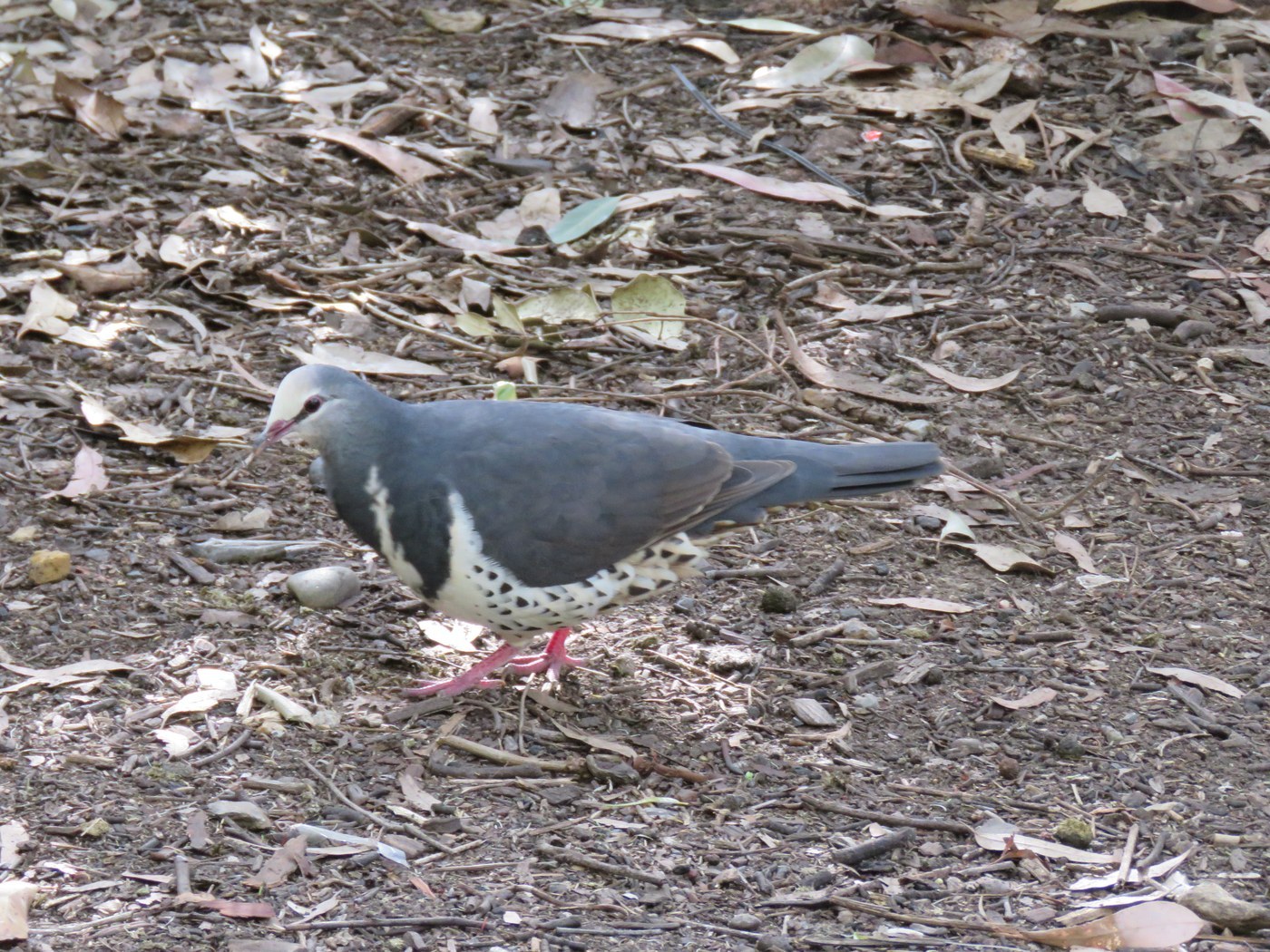
Wonga Pigeon
Dense, soft body contour feathers over a stocky frame

Squatter Pigeon
Dense, cryptic body contour feathers with a bold facial pattern

White-winged Dove
Broad, sturdy flight feathers with a bold white wing stripe

Western Crowned Pigeon
Rounded fan crest plumes over dense soft body feathers

Snow Pigeon
Dense insulating body contour feathers with a bold white rump and belly patch

Zebra Dove
Contour feathers with bold, extensive black-and-white barring

Scaly-naped Pigeon
Contour feathers with iridescent scaled nape pattern