
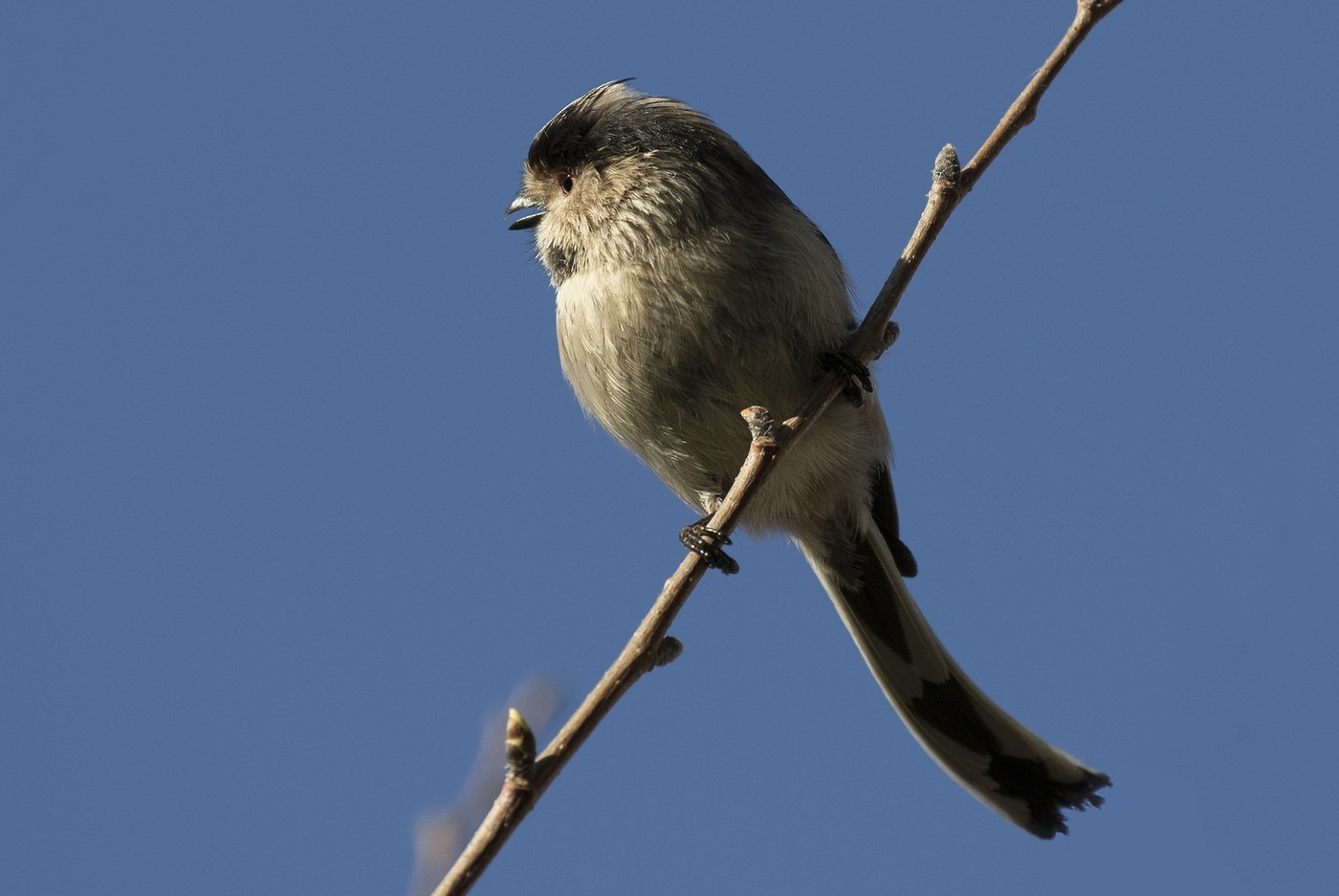
Long-tailed Tit
Aegithalos caudatus
A tiny, round-bodied tit with an extraordinarily long tail exceeding its body length, patterned in black, white, and soft dusky pink, among the most distinctive silhouettes in European woodland.
- Feather type
- Very long, graduated tail feathers relative to a tiny round body; soft fluffy contour feathers
- Colours
- Black, white, and dusky pink patterning with a black eyebrow stripe over a white head
- Bird size
- Very small body, ~13-15 cm total length including a long tail (tail exceeds body length)
Found a feather like this?
Identify any feather from a photo, free.
Overview
The Long-tailed Tit is instantly recognizable by its improbably long tail attached to a tiny, round, fluffy body, giving it a distinctive lollipop-like silhouette. It travels in tight, constantly moving flocks that flit through hedgerows and woodland edge.
Its soft pinkish and black-and-white plumage, combined with the exceptionally long tail, make its feathers among the more unmistakable of small European songbirds when the tail feathers are present.
Flocks build elaborate, dome-shaped nests covered in lichen and lined with feathers, sometimes using hundreds of feathers per nest, so loose feathers can occasionally be found near active nest sites.
Identifying the Feather
Identifying Long-tailed Tit feathers
- Tail feathers: Extremely long and graduated relative to the tiny body, black with white outer edges — proportionally the longest tail feathers of any common small European songbird.
- Head feathers: White with a bold black eyebrow stripe running back from above the eye (in the widespread European subspecies).
- Body feathers: Soft, fluffy, showing black scapulars and back contrasting with dusky pink flanks and underparts, a delicate blush tone unusual among small songbirds.
- Wing feathers: Black with white edging, forming a subtly patterned closed wing.
- Compared to similar species: No other common European songbird combines a tail feather this long relative to body size with a soft pink flank wash, making Long-tailed Tit feathers relatively easy to identify once the tail feather is seen.
Plumage & Molt
Plumage overview
Adults show a white head with a black eyebrow stripe, black back and wings edged white, a very long black-and-white tail, and soft dusky pink flanks and underparts. Sexes look alike.
Juveniles have darker, more solid black-and-white heads without the adult's clean white crown, along with duskier overall tones, before molting to adult-like plumage in their first autumn.
Habitat & Range
Habitat and range
Long-tailed Tits are widespread across Europe and temperate Asia, inhabiting woodland edge, hedgerows, scrub, and parks with dense shrubby cover. They are largely resident, moving in tight family flocks that maintain a home range through the non-breeding season.
They favor habitats with dense thorny or twiggy shrubs, which provide cover for their elaborate nests and protection from predators.
Behavior & Field Notes
Behavior and field notes
Long-tailed Tits move in cohesive flocks of family members and associates, constantly calling to maintain contact as they forage together through hedgerows and shrub layers for small insects and spiders. Flock members often roost huddled together in a line for warmth on cold nights.
Their call is a distinctive, high-pitched trilling "si-si-si" combined with a lower "tupp" note. Nests are elaborate, dome-shaped structures woven from moss, lichen, spider silk, and lined with an extraordinary number of feathers for insulation — sometimes over a thousand. A useful field note: loose feathers found near a mossy, lichen-covered dome-shaped nest in a dense shrub may be either the birds' own molted feathers or feathers collected for nest lining.
Frequently asked questions
What makes a Long-tailed Tit feather easy to recognize?
The tail feathers are exceptionally long relative to the bird's tiny body, and the soft dusky pink flank feathers are rarely matched by other small European songbirds.
Why might I find many feathers near a Long-tailed Tit nest?
This species lines its dome-shaped nest with an extraordinary number of feathers collected from various birds, sometimes over a thousand per nest.
Do juvenile Long-tailed Tits have the same white head as adults?
No, juveniles show darker, more solid black-and-white head patterning before molting into the cleaner white-headed adult plumage.
Where are Long-tailed Tits typically found?
In woodland edge, hedgerows, and scrub with dense shrubby cover across Europe and temperate Asia.
Long-tailed Tit guides
In-depth guides for identifying and understanding Long-tailed Tit.
Other feathers you may enjoy

Yellow-breasted Bunting
Contour and flight feathers, chestnut-and-yellow breeding pattern

Sedge Wren
Tiny streaked crown and back feathers

Yellow-winged Cacique
Glossy black body feathers, yellow wing patch, shaggy crest

Yellow Warbler
Small contour and flight feathers

Yellow-throated Warbler
Small contour and flight feathers

Yellow-throated Vireo
Bright yellow throat and spectacle feathers; olive-green back feathers; two white wing-bar feathers

Yellow-rumped Warbler
Small contour and flight feathers

Yellow-hooded Blackbird
Contrasting hood and body feathers

Yellow-headed Blackbird
Glossy black body plumage with a bright yellow head and breast

Yellow-eyed Junco
Contour and flight feathers

Yellow-fronted Canary
Small, smooth body plumage

Yellow-breasted Greenfinch
Compact, smooth body plumage