
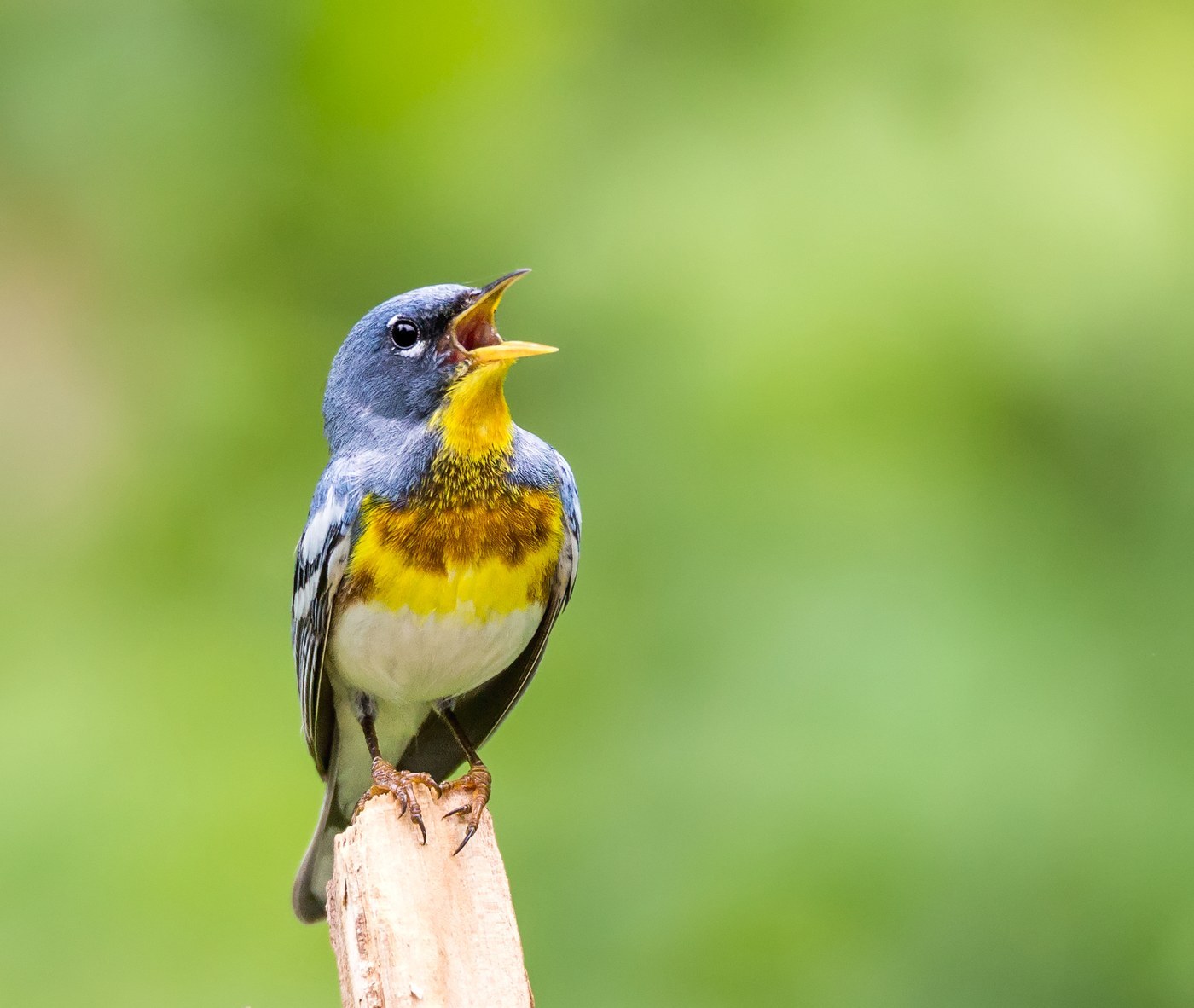
Northern Parula
Setophaga americana
One of the smallest and most compact wood-warblers, blue-gray above with a yellow throat and a distinctive olive-green back patch, tied to hanging moss or lichen for nesting.
- Feather type
- Small contour and flight feathers
- Colours
- Blue-gray upperparts with a yellow-green back patch, yellow throat and breast with a dark breast band in males
- Bird size
- Small, ~11 cm, one of the smallest warblers
Found a feather like this?
Identify any feather from a photo, free.
Overview
The Northern Parula is a tiny, compact wood-warbler found in forests across the eastern United States and southeastern Canada, closely associated with hanging epiphytic growths such as Spanish moss in the South or old-man's-beard lichen in the North, which it uses for nest building. It winters mainly in Mexico, Central America, and the Caribbean. Its small size and distinctive blue-gray, yellow, and greenish coloring make it one of the more readily identified small warblers.
Identifying the Feather
Upperpart feathers are blue-gray, broken by a distinctive yellow-green patch on the upper back. The throat and breast are bright yellow, and breeding males show a dark breast band formed by a blend of chestnut and blackish feathers crossing the upper chest. Two bold white wingbars cross the wing. The combination of a small compact body, blue-gray upperparts with a contrasting green back patch, and a broken white eye-ring is distinctive among small warblers.
Plumage & Molt
Breeding males show the boldest breast band and cleanest blue-gray tones; females and immatures show a paler, less defined breast band or lack it altogether, with slightly duller overall coloring. A single complete molt occurs after the breeding season.
Habitat & Range
Northern Parulas breed in a variety of forest types across the eastern United States and southeastern Canada, generally where hanging moss or lichen is available for nest construction, including bottomland and riparian forest in the South and mixed or coniferous forest in the North. They winter in forest and forest-edge habitats of Mexico, Central America, and the Caribbean.
Behavior & Field Notes
This species forages actively for insects in the outer foliage of trees, often at varying heights. The male's song is a distinctive buzzy trill that rises and then drops abruptly at the end. Nests are built inside hanging clumps of Spanish moss or similar epiphytic growth, giving the nest natural concealment. It is a fairly common migrant across much of eastern North America.
Frequently asked questions
How do I identify a Northern Parula feather?
Look for blue-gray upperpart feathers with a contrasting yellow-green patch on the back, along with bright yellow throat feathers and, in breeding males, a dark breast band.
Why is this species tied to hanging moss?
It typically builds its nest inside clumps of Spanish moss or similar hanging lichen, using the material for natural concealment and structure.
How big is the Northern Parula compared to other warblers?
It is one of the smallest and most compact of the North American wood-warblers.
Where does the Northern Parula winter?
It winters in forest and forest-edge habitats of Mexico, Central America, and the Caribbean.
Northern Parula guides
In-depth guides for identifying and understanding Northern Parula.
Other feathers you may enjoy

Yellow-breasted Bunting
Contour and flight feathers, chestnut-and-yellow breeding pattern

Sedge Wren
Tiny streaked crown and back feathers

Yellow-winged Cacique
Glossy black body feathers, yellow wing patch, shaggy crest

Yellow Warbler
Small contour and flight feathers

Yellow-throated Warbler
Small contour and flight feathers

Yellow-throated Vireo
Bright yellow throat and spectacle feathers; olive-green back feathers; two white wing-bar feathers

Yellow-rumped Warbler
Small contour and flight feathers

Yellow-hooded Blackbird
Contrasting hood and body feathers

Yellow-headed Blackbird
Glossy black body plumage with a bright yellow head and breast

Yellow-eyed Junco
Contour and flight feathers

Yellow-fronted Canary
Small, smooth body plumage

Yellow-breasted Greenfinch
Compact, smooth body plumage