
Paradise Shelduck
Tadorna variegata
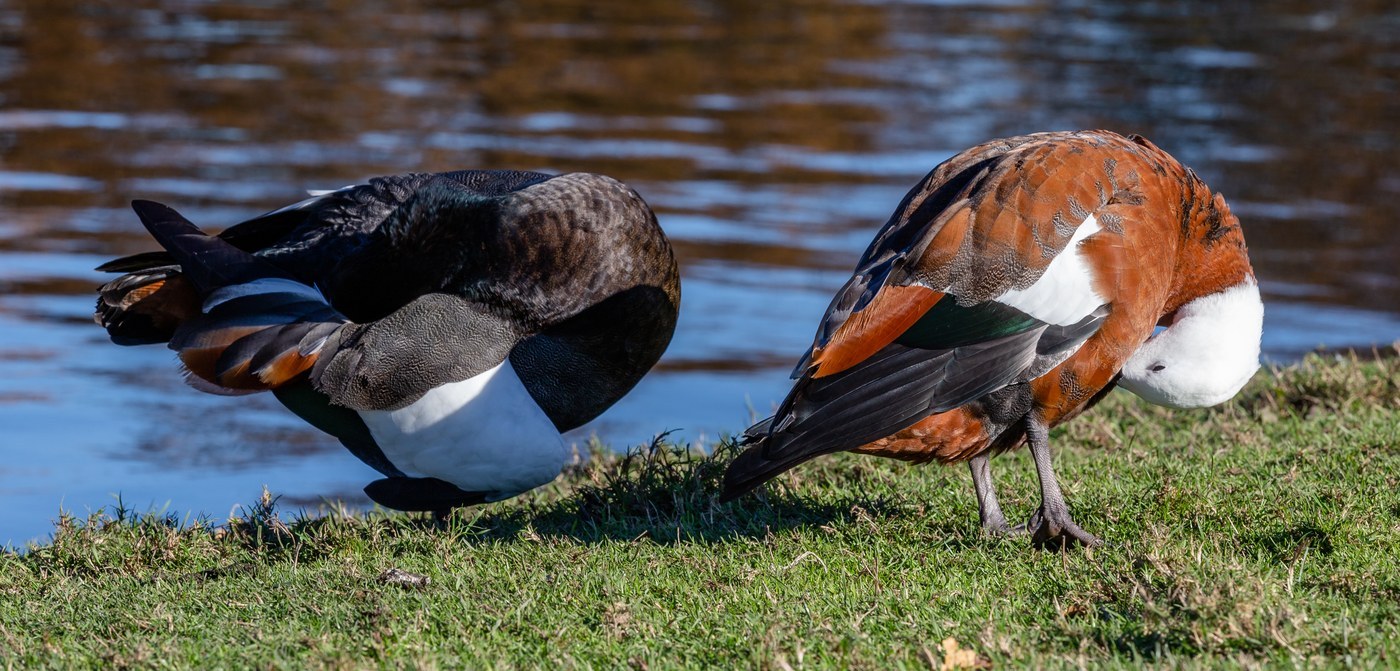
A large New Zealand duck with striking sex-based color difference, males dark and glossy while females show a bright white head and chestnut body.
- Feather type
- Glossy contour feathers with strong sexual dimorphism
- Colours
- Female: white head, chestnut body; Male: dark grey-black overall
- Bird size
- Large duck, ~63-71 cm
Found a feather like this?
Identify any feather from a photo, free.
Overview
Overview
The Paradise Shelduck is a large, boldly patterned waterfowl endemic to New Zealand, known locally as putangitangi. It is unusual among ducks for its dramatic plumage difference between sexes, making males and females easy to tell apart at a glance even from a distance.
Pairs mate for life and are commonly seen grazing on pasture near rivers, lakes, and estuaries throughout both main islands of New Zealand.
Identifying the Feather
Feather Identification
- Female head/neck feathers: pure white, sharply contrasting with the rest of the body
- Female body feathers: rich chestnut-orange with fine vermiculated barring visible up close
- Male body feathers: blackish with a subtle green-blue sheen on the head and dark grey barring on the back
- Flight feathers: dark, glossy, with white wing patches visible in both sexes during flight
- Shaft: sturdy, typical of a large dabbling-type duck
- Sex is the primary identification cue; unlike many ducks, males lack bright color and females are the more vividly plumaged sex
Plumage & Molt
Plumage Notes
Adult females have a striking white head contrasting with chestnut body plumage, while males are almost entirely blackish-grey with a faint green sheen on the head. Juveniles resemble adult males initially, with females developing the white head as they mature.
Adults undergo an eclipse-like flightless molt period after breeding, during which they gather in flocks on open water or pasture while replacing flight feathers.
Habitat & Range
Habitat & Range
Paradise Shelducks are widespread across New Zealand, occupying pastureland, riverbeds, lake margins, and estuaries. They have adapted well to farmland, often seen grazing in open fields near water.
The species is largely resident, though some flocking and local movement occurs outside the breeding season, particularly during the molt period.
Behavior & Field Notes
Behavior & Field Notes
Pairs are territorial and mate for life, defending grazing and nesting areas with loud, distinctive calls, the female's cry higher-pitched than the male's. They feed on grasses, seeds, and invertebrates in pasture and shallow water.
Nests are built in tree hollows, dense vegetation, or other sheltered sites near water, lined with down. Their calls carry over long distances and are a familiar sound of New Zealand farmland.
Frequently asked questions
Why do male and female Paradise Shelducks look so different?
This species shows strong sexual dimorphism, with females displaying a bright white head and chestnut body while males remain dark grey-black overall.
How can feathers reveal the sex of a Paradise Shelduck?
Feathers from the head and body will be either pure white and chestnut (female) or dark grey-black (male), making sex identification straightforward.
Are Paradise Shelducks native to New Zealand?
Yes, they are endemic to New Zealand and are commonly found on farmland, rivers, and lakes throughout the country.
Do Paradise Shelducks migrate?
They are largely resident, though flocks may move locally, especially during the post-breeding molt period.
Paradise Shelduck guides
In-depth guides for identifying and understanding Paradise Shelduck.
Other feathers you may enjoy

Mallard
Wing (speculum), body, and tail feathers

Spectacled Eider
Large sea-duck body feathers with distinctive eye-ring patches

Canada Goose
Body and flight feathers
Mute Swan
Body (contour) and flight feathers

Wood Duck
Iridescent crest feathers; ornate scapular and flank feathers; white teardrop facial feathers (female)
Whooper Swan
Contour and flight feathers

White-winged Scoter
Large sea-duck body feathers with a white wing patch

Ruddy Duck
Stiff tail feathers and compact body plumage

Ross's Goose
Contour and flight feathers

White-cheeked Pintail
Contour and elongated tail feathers

Torrent Duck
Dense, sleek contour feathers; stiff, pointed tail feathers used for bracing against rocks

Tundra Swan
Contour and flight feathers