

Peaceful Dove
Geopelia placida
A small, gentle Australian dove with fine dark barring across the neck and breast and a soft, pale blue ring around the eye.
- Feather type
- Contour feathers with fine dark barring on the neck and breast
- Colours
- Soft gray-brown body with fine black barring on the neck and upper breast, and a pale blue eye-ring
- Bird size
- Small dove, ~20-23 cm
Found a feather like this?
Identify any feather from a photo, free.
Overview
The Peaceful Dove is a small, common dove found across much of Australia and New Guinea, typically inhabiting open woodland, grassland, and scrub near water. It has a soft gray-brown body overall, with the neck and upper breast marked by fine, narrow black barring that gives a delicately scaled appearance. A pale blue ring of bare skin surrounds the eye, offering an additional identification clue.
Identifying the Feather
- Neck and breast feathers: fine, narrow black bars on a pale gray-brown background, creating a delicate scalloped or barred pattern
- Back and wing covert feathers: plainer grayish-brown, without the fine barring seen on the neck and breast
- Tail feathers: dark with white outer tips, visible when the tail is fanned
- Eye-ring: pale blue bare skin, useful as a supporting field mark
- Compare with the Zebra Dove, which shows more extensive, heavier barring that extends further down onto the flanks and lower breast
Plumage & Molt
Sexes look alike. Juveniles show duller, less distinct barring and browner overall tones, developing the crisper adult pattern after their first molt. Adults undergo one complete molt annually and may breed multiple times in a season when conditions allow.
Habitat & Range
Peaceful Doves are widespread across Australia, excluding the driest desert interior, and also occur in New Guinea and nearby islands. They favor open woodland, grassland, scrub, and areas near water, and are generally resident, though local movements can occur with changing conditions.
Behavior & Field Notes
This dove forages on the ground for small seeds, often in pairs or small groups, and is a familiar visitor to parks, gardens, and rural properties. Its call is a soft, repetitive cooing, often described as gentle and unhurried, fitting its common name. Nests are small, flimsy stick platforms built low in trees or shrubs.
Frequently asked questions
What feather pattern distinguishes the Peaceful Dove?
Fine, narrow black barring across the neck and upper breast, set against a soft gray-brown background, is the key identifying feature.
How does the barring compare to the Zebra Dove?
The Peaceful Dove's barring is finer and more restricted to the neck and breast, while the Zebra Dove shows heavier, more extensive barring reaching further down the body.
Is the eye-ring color useful for identification?
Yes, the pale blue eye-ring is a helpful supporting feature, particularly when barring details are hard to see at a distance.
How do juvenile feathers differ from adult feathers?
Juveniles show duller, less distinct barring and an overall browner tone until they complete their first molt.
Peaceful Dove guides
In-depth guides for identifying and understanding Peaceful Dove.

Other feathers you may enjoy

Victoria Crowned Pigeon
Large lace-like fan crest plumes over dense body contour feathers

Plain Pigeon
Contour feathers, plain and uniformly toned, with a white wing patch

Zenaida Dove
Contour and flight feathers, faint iridescent sheen on neck

Pink Pigeon
Soft contour feathers with graduated tail

Nicobar Pigeon
Long, hackle-like elongated neck feathers with iridescent sheen
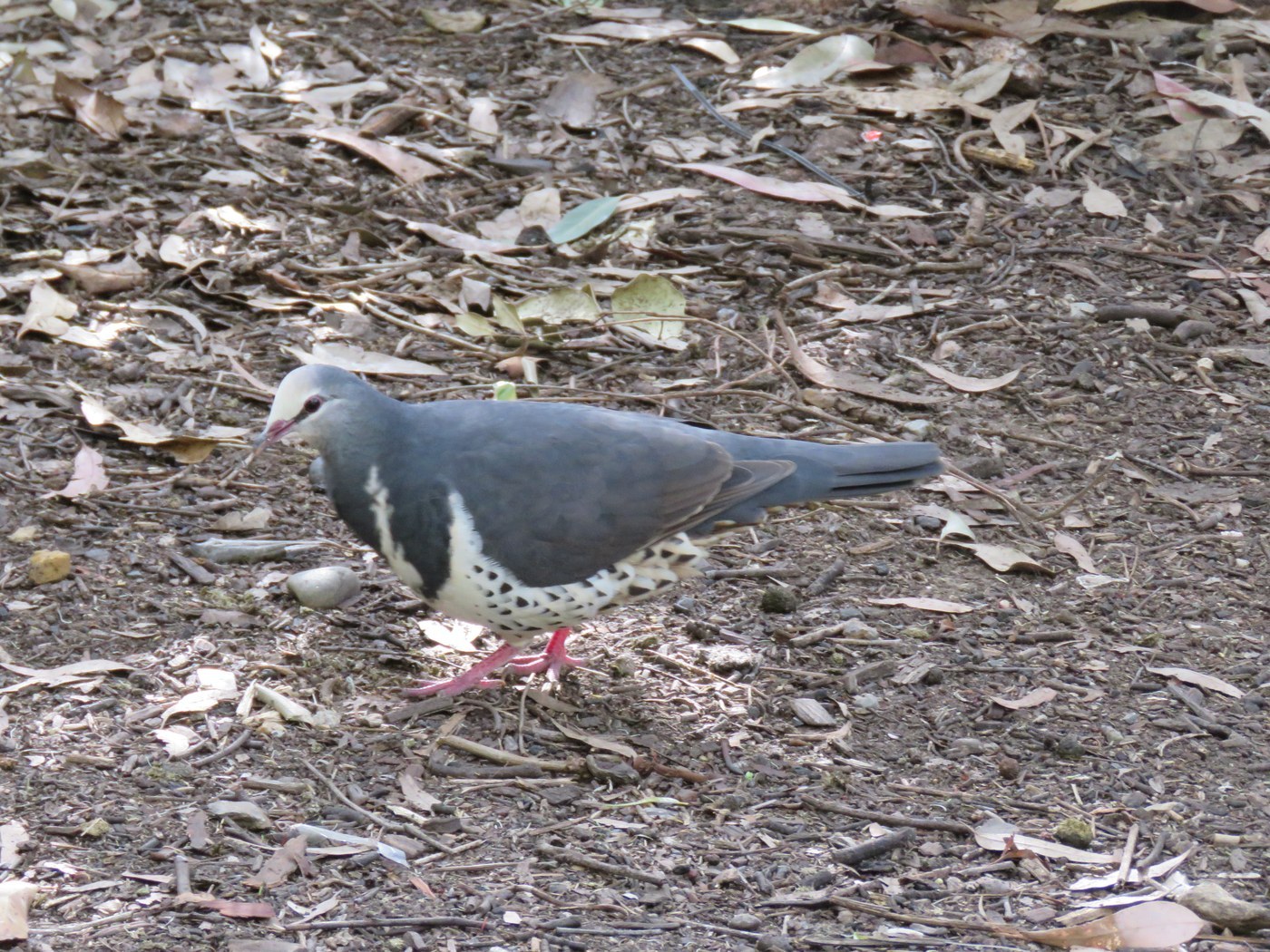
Wonga Pigeon
Dense, soft body contour feathers over a stocky frame

Squatter Pigeon
Dense, cryptic body contour feathers with a bold facial pattern

White-winged Dove
Broad, sturdy flight feathers with a bold white wing stripe

Western Crowned Pigeon
Rounded fan crest plumes over dense soft body feathers

Snow Pigeon
Dense insulating body contour feathers with a bold white rump and belly patch

Zebra Dove
Contour feathers with bold, extensive black-and-white barring

Scaly-naped Pigeon
Contour feathers with iridescent scaled nape pattern