
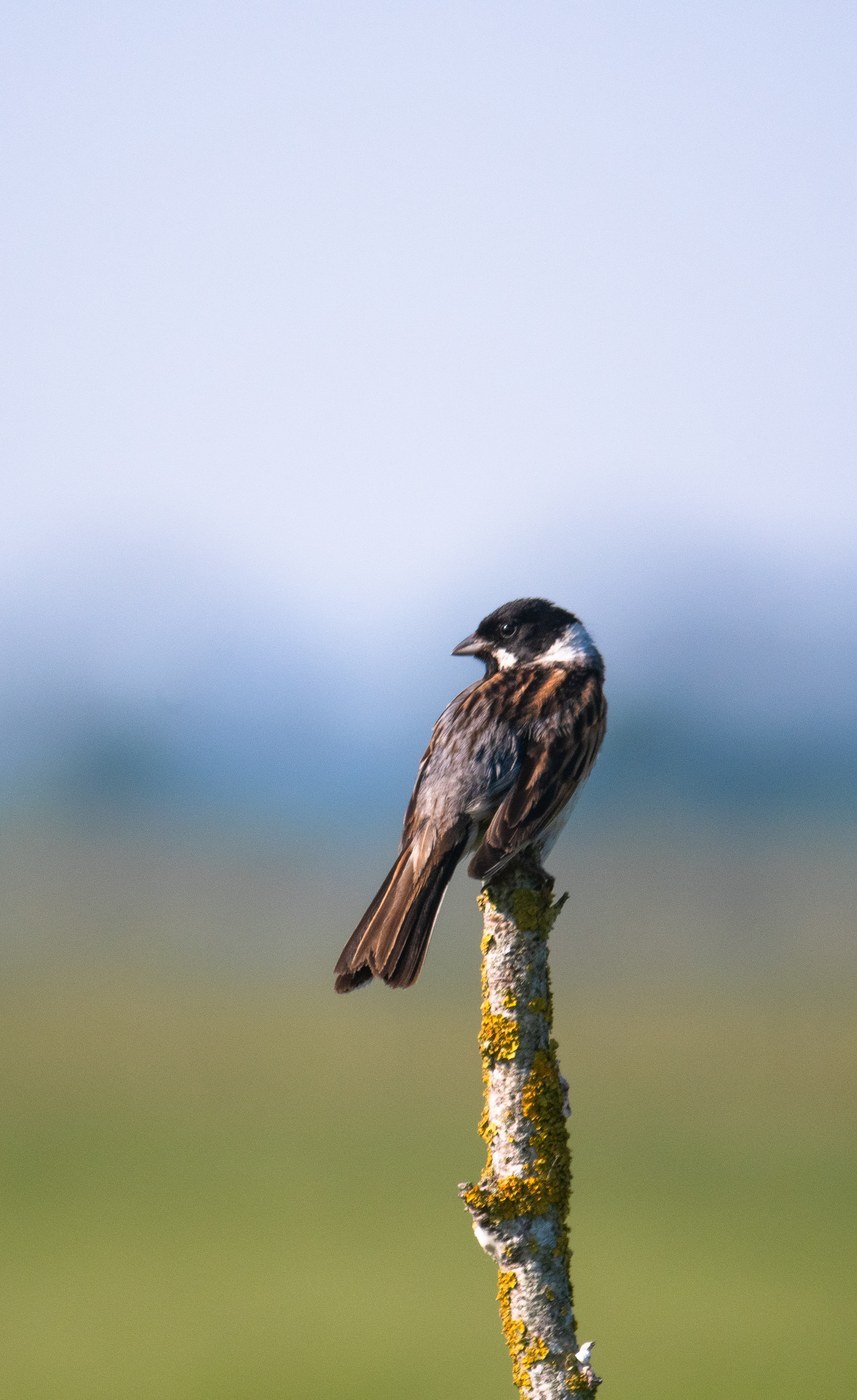
Reed Bunting
Emberiza schoeniclus
The Reed Bunting is a wetland-associated songbird whose breeding males show a striking black head and white collar against streaked brown upperparts, while females and winter birds are more subtly patterned brown.
- Feather type
- Streaked contour feathers; notched tail with white outer edges
- Colours
- Black head and bib with white collar (breeding male); streaked brown back; brown-buff female/winter plumage
- Bird size
- Sparrow-sized, ~15-16 cm
Found a feather like this?
Identify any feather from a photo, free.
Overview
The Reed Bunting is closely tied to wetland habitats, especially reedbeds and damp scrub, though it increasingly uses drier farmland outside the breeding season.
Breeding male feathers show a bold black head and throat set off by a white submoustachial stripe and collar, quite different from the streaky brown females.
Feathers are often found around reedbed margins and wet ditches where the species nests low in dense vegetation.
Identifying the Feather
Size & Shape
- Feathers show typical bunting proportions: a fairly long, notched tail with white outer edges and a stout, seed-cracking bill reflected in the facial feathering.
Color & Pattern
- Breeding male head/throat feathers: solid black, bordered by a white moustachial stripe and half-collar.
- Back feathers: streaked chestnut-brown and black in both sexes.
- Females and non-breeding males show a streaked brown head with a pale eyebrow and dark moustachial stripe instead of solid black.
- Underparts are whitish, lightly streaked on the flanks.
Similar Species
- Breeding male's solid black head separates it from Yellowhammer and Corn Bunting; female Reed Bunting is best told from female Yellowhammer by the more contrasting head stripes and lack of yellow tones.
Plumage & Molt
Overall Plumage
Streaked chestnut-brown and black back in both sexes; breeding males add a black head, throat, and white collar; females and winter males are streaked brown-buff on the head.
Sex & Age Differences
Breeding males are boldly patterned with a black head; females and non-breeding males are duller and streakier. Juveniles resemble females.
Molt
A complete molt after breeding in late summer; males acquire the black head through feather wear over winter rather than a full extra molt, as pale feather tips abrade to reveal black beneath.
Habitat & Range
Habitat
Reedbeds, marshes, wet ditches, and damp scrub; increasingly uses drier farmland and hedgerows outside the breeding season.
Range
Widespread across Europe and temperate Asia.
Movements
Partially migratory; northern populations move south or to milder lowland and coastal areas in winter.
Behavior & Field Notes
Behavior
Forages low in reeds and waterside vegetation, often perching prominently on reed stems to sing.
Diet
Feeds on seeds for much of the year, switching to insects during the breeding season.
Nesting
Builds a grass nest low in dense reed or scrub vegetation, often close to the ground or water.
Voice
A simple, repetitive song of a few short notes given from an exposed reed-top perch.
Field Notes
Feathers with a bold black head pattern found near reedbeds strongly suggest a breeding male Reed Bunting; streakier brown feathers in the same habitat likely belong to a female or winter bird.
Frequently asked questions
How do I recognize a breeding male Reed Bunting feather?
By the solid black head and throat bordered by a white moustachial stripe and collar.
Do female Reed Buntings show the black head?
No, females have a streaked brown head with a pale eyebrow and dark moustachial stripe instead.
Where would I find Reed Bunting feathers?
Around reedbeds, marshes, and wet ditches, though also in drier farmland in winter.
How does the male acquire his black head each spring?
Through wear of pale feather tips over winter rather than a full additional molt, revealing the black feather bases beneath.
Reed Bunting guides
In-depth guides for identifying and understanding Reed Bunting.
Other feathers you may enjoy

Yellow-breasted Bunting
Contour and flight feathers, chestnut-and-yellow breeding pattern

Sedge Wren
Tiny streaked crown and back feathers

Yellow-winged Cacique
Glossy black body feathers, yellow wing patch, shaggy crest

Yellow Warbler
Small contour and flight feathers

Yellow-throated Warbler
Small contour and flight feathers

Yellow-throated Vireo
Bright yellow throat and spectacle feathers; olive-green back feathers; two white wing-bar feathers

Yellow-rumped Warbler
Small contour and flight feathers

Yellow-hooded Blackbird
Contrasting hood and body feathers

Yellow-headed Blackbird
Glossy black body plumage with a bright yellow head and breast

Yellow-eyed Junco
Contour and flight feathers

Yellow-fronted Canary
Small, smooth body plumage

Yellow-breasted Greenfinch
Compact, smooth body plumage