
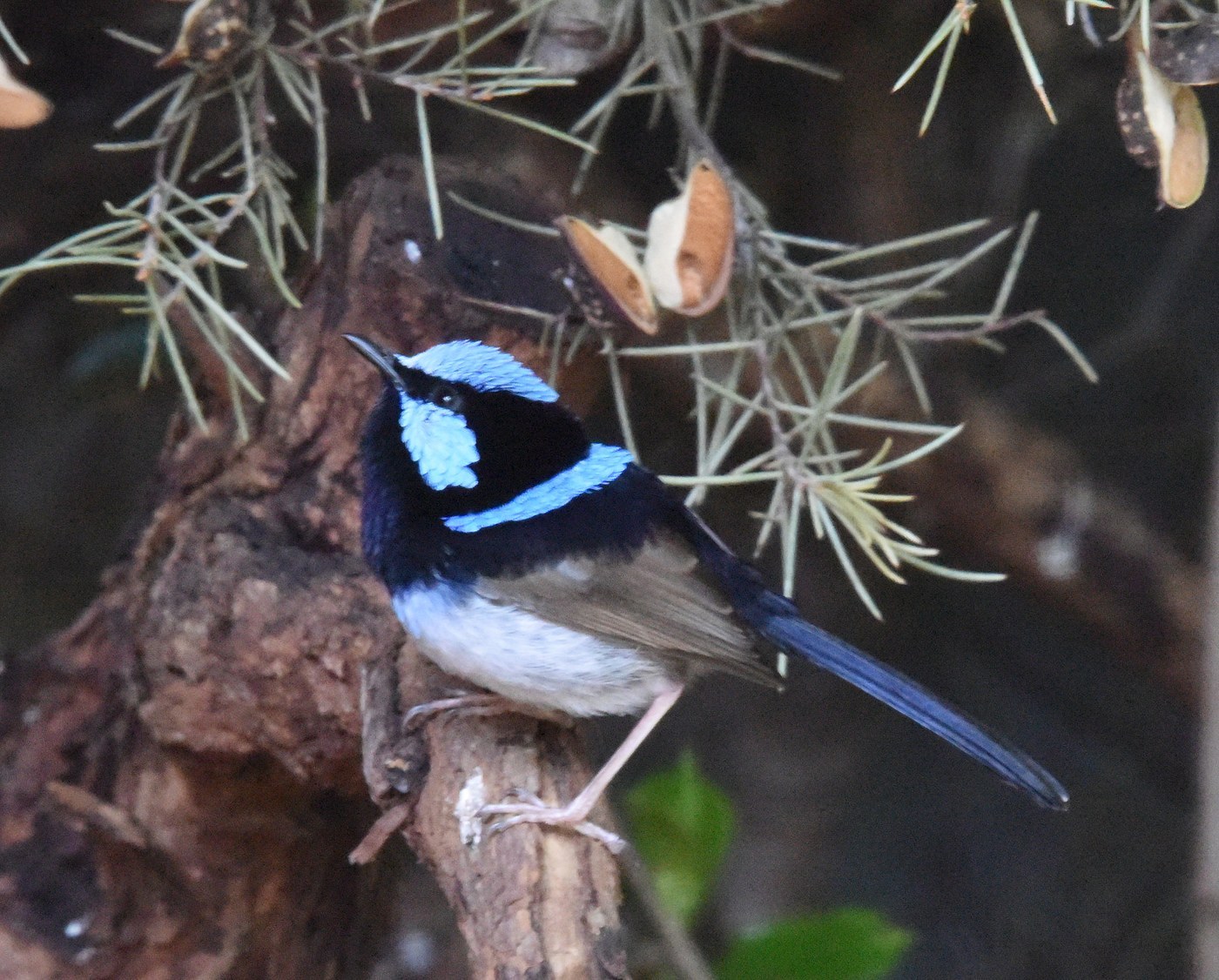
Superb Fairywren
Malurus cyaneus
The Superb Fairywren is a tiny Australian songbird whose breeding males show brilliant iridescent blue plumage, while females and non-breeding males are plain brown with a distinctive cocked tail.
- Feather type
- Soft, fine contour feathers with a long, often cocked tail
- Colours
- Brilliant iridescent blue and black in breeding males; soft brown in females
- Bird size
- Tiny, ~14 cm
Found a feather like this?
Identify any feather from a photo, free.
Overview
Overview
The Superb Fairywren is one of Australia's most recognisable small birds, living in cooperative family groups that defend a shared territory year-round. Breeding males display a vivid blue-and-black plumage that is unmistakable, while for much of the year most group members wear a much plainer brown coat.
- Family: Maluridae (Australasian wrens)
- Distribution: southeastern Australia, including Tasmania
- Social structure: cooperative breeder, living in small family groups
Identifying the Feather
Feather Identification
Breeding male feathers show a brilliant, iridescent cobalt-blue crown, ear coverts, and mantle, contrasting with a black mask, throat, and back band; the tail is longer blue-grey with a cocked carriage typical of fairywrens. Females and non-breeding males (in 'eclipse' brown plumage) are soft warm brown above and paler below, with a blue-grey tail retained even out of breeding dress.
- Overall shape: tiny body, long thin cocked tail
- Key mark: retained blue-grey tail even on otherwise brown birds
- Compare with: Splendid Fairywren (breeding male entirely blue with no black-and-blue mantle contrast; ranges barely overlap)
Plumage & Molt
Plumage
Adult males moult into brilliant blue-and-black breeding plumage and moult out to a duller brown 'eclipse' plumage resembling females for part of the year. Females are brown year-round with a rufous eye-ring lores area and a blue-grey tail. Juveniles resemble females. This seasonal male plumage change is one of the most striking in Australian songbirds.
Habitat & Range
Habitat & Range
Superb Fairywrens live in grassy woodland, heath, scrub, and well-vegetated gardens across southeastern Australia and Tasmania. Family groups are sedentary, holding a territory throughout the year with the aid of non-breeding helpers.
Behavior & Field Notes
Behavior & Field Notes
These wrens forage low to the ground and in dense cover for insects, hopping with the tail frequently cocked and flicked. Groups consist of a dominant breeding pair plus helper birds, often male offspring from previous broods, that assist in raising young. Calls include a reeling, insect-like trill and sharp alarm notes. Nests are small domed structures built low in dense vegetation.
- Diet: mainly small insects and other invertebrates
- Voice: a fast, reeling trill and thin contact calls
- Field note: family groups often forage together, with a single blue male among several brown birds
Frequently asked questions
Why do I mostly see brown fairywrens instead of blue ones?
Most fairywrens in a group are females, juveniles, or males in non-breeding 'eclipse' plumage, which is brown; only breeding males show the vivid blue.
How can I tell a brown Superb Fairywren from a female?
Both look similar, but eclipse males and females can be told apart mainly by close examination of eye-ring and lores colour, which is difficult in the field.
Do Superb Fairywrens migrate?
No, they are sedentary and hold the same territory year-round as a family group.
What does the tail look like?
It is long, thin, and blue-grey, usually held cocked upward, present on both blue males and brown birds alike.
Superb Fairywren guides
In-depth guides for identifying and understanding Superb Fairywren.

Other feathers you may enjoy

Yellow-breasted Bunting
Contour and flight feathers, chestnut-and-yellow breeding pattern

Sedge Wren
Tiny streaked crown and back feathers

Yellow-winged Cacique
Glossy black body feathers, yellow wing patch, shaggy crest

Yellow Warbler
Small contour and flight feathers

Yellow-throated Warbler
Small contour and flight feathers

Yellow-throated Vireo
Bright yellow throat and spectacle feathers; olive-green back feathers; two white wing-bar feathers

Yellow-rumped Warbler
Small contour and flight feathers

Yellow-hooded Blackbird
Contrasting hood and body feathers

Yellow-headed Blackbird
Glossy black body plumage with a bright yellow head and breast

Yellow-eyed Junco
Contour and flight feathers

Yellow-fronted Canary
Small, smooth body plumage

Yellow-breasted Greenfinch
Compact, smooth body plumage