
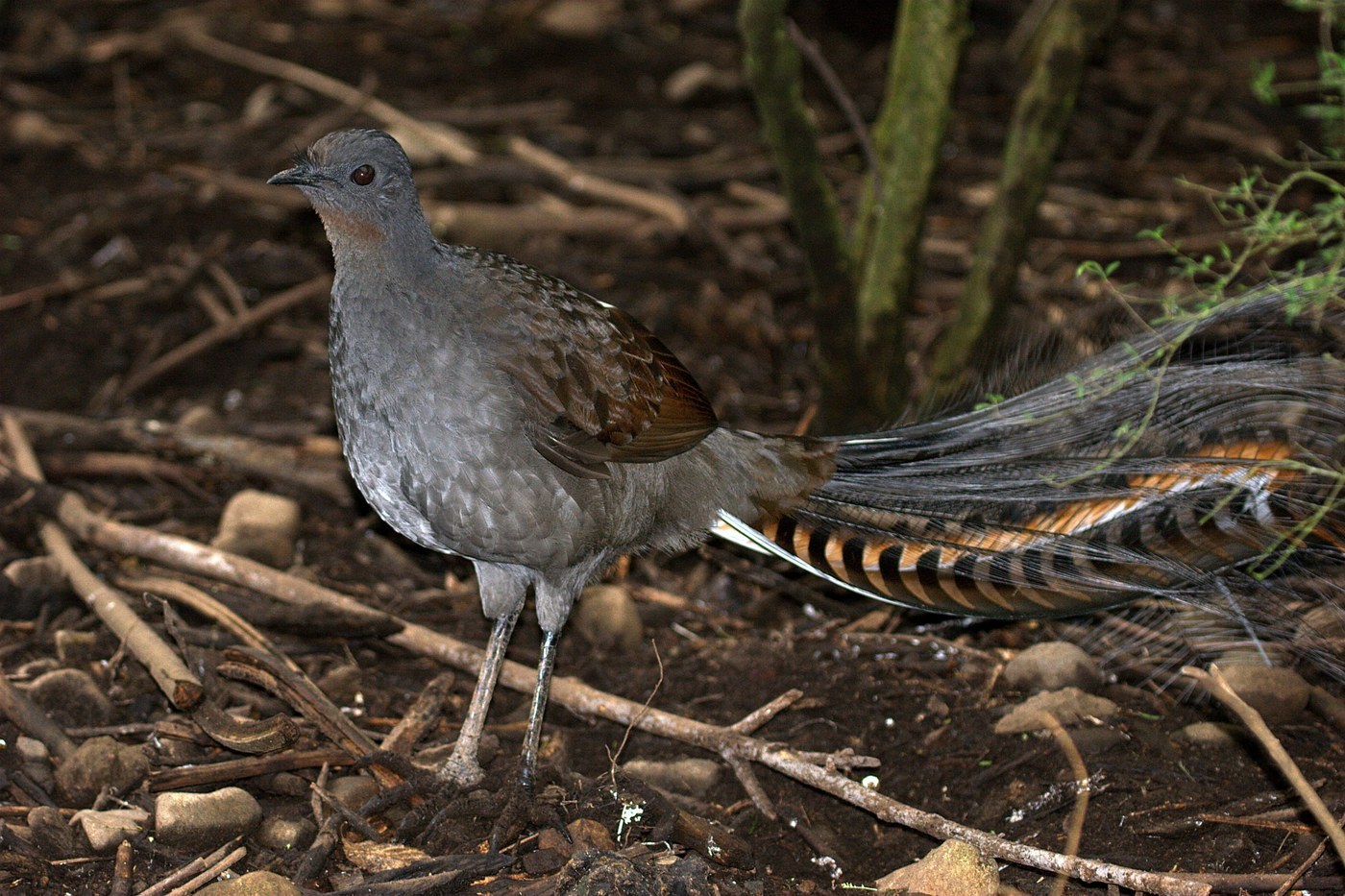
Superb Lyrebird
Menura novaehollandiae
One of the largest songbirds, the male Superb Lyrebird carries an extraordinary lyre-shaped tail with lace-like filamentous feathers, displayed during elaborate courtship performances.
- Feather type
- Elaborate, elongated ornamental tail feathers in males; soft brownish body contour feathers
- Colours
- Brown-gray body, silvery-white and lace-patterned outer tail feathers in males
- Bird size
- Large songbird, ~80-100 cm including male's elaborate tail
Found a feather like this?
Identify any feather from a photo, free.
Overview
The Superb Lyrebird is a large, ground-dwelling Australian songbird famous both for the male's ornate tail and for its remarkable ability to mimic other birds and environmental sounds. Despite the spectacular tail, the bird's body plumage is fairly plain brown, and it spends most of its time walking and foraging on the forest floor rather than in flight.
Identifying the Feather
The male's tail consists of two broad, curved outer feathers with silvery undersides shaped somewhat like a lyre, along with a set of narrow, lace-patterned filamentous feathers and two central plain feathers, a combination unmatched by any other bird. Individual lace feathers show fine, evenly spaced barbs that create a translucent, net-like appearance rather than a solid vane. Body contour feathers are soft, loose-textured, and brownish-gray, with little iridescence, providing camouflage against leaf litter. Females and young males lack the ornamental tail feathers entirely, showing only plain, moderately long brown tail feathers, so any lyre-shaped or lace-patterned feather found on the ground can be confidently attributed to an adult male of this species.
Plumage & Molt
Adult males grow the full ornamental tail only after several years of maturation, with tail feathers replaced annually through molt outside the breeding display season. Females and juveniles retain plain brown tails throughout their lives, showing no lyrate feather development. Overall body plumage color and pattern differ little between the sexes aside from the tail.
Habitat & Range
Superb Lyrebirds inhabit wet eucalypt forest, temperate rainforest, and dense gullies in southeastern Australia, favoring areas with thick leaf litter and understory cover. The species is non-migratory and largely sedentary, with pairs and territories maintained within forest habitat year-round.
Behavior & Field Notes
This species forages on the forest floor, scratching through leaf litter and soil for invertebrates using its strong feet and bill. Males perform elaborate courtship displays on constructed earth mounds, raising and shivering the tail over the body while producing an extended, highly varied song that incorporates mimicry of other bird species and, occasionally, other sounds. Nests are large, domed structures built low in vegetation or on ledges. Its complex vocal repertoire and secretive ground-dwelling habits make it a distinctive presence in its forest range.
Frequently asked questions
What makes a Superb Lyrebird tail feather so distinctive?
The lace-like filamentous feathers and broad, curved lyre-shaped outer feathers found only on adult males are unlike any other bird's plumage.
Do female Superb Lyrebirds have the ornamental tail?
No, females and young males have plain brown tails and never develop the lyre-shaped or lace feathers.
How does the male use his tail?
He raises and shivers it over his body during courtship displays performed on constructed earth mounds.
Is the Superb Lyrebird a strong flier?
No, it is largely ground-dwelling and spends most of its time walking and foraging on the forest floor.
Superb Lyrebird guides
In-depth guides for identifying and understanding Superb Lyrebird.
Other feathers you may enjoy

Yellow-breasted Bunting
Contour and flight feathers, chestnut-and-yellow breeding pattern

Sedge Wren
Tiny streaked crown and back feathers

Yellow-winged Cacique
Glossy black body feathers, yellow wing patch, shaggy crest

Yellow Warbler
Small contour and flight feathers

Yellow-throated Warbler
Small contour and flight feathers

Yellow-throated Vireo
Bright yellow throat and spectacle feathers; olive-green back feathers; two white wing-bar feathers

Yellow-rumped Warbler
Small contour and flight feathers

Yellow-hooded Blackbird
Contrasting hood and body feathers

Yellow-headed Blackbird
Glossy black body plumage with a bright yellow head and breast

Yellow-eyed Junco
Contour and flight feathers

Yellow-fronted Canary
Small, smooth body plumage

Yellow-breasted Greenfinch
Compact, smooth body plumage